Tucker Carlson says he has become the target of a potential federal investigation after communicating with people in Iran, claiming the CIA is preparing a criminal referral against him. The conservative commentator says the matter could involve accusations under the Foreign Agents Registration Act, a law designed to identify people acting on behalf of foreign governments.
Carlson made the explosive claim in a video posted online, saying he learned that intelligence officials were reviewing his private communications and considering sending a referral to the Department of Justice. He denied any wrongdoing and argued that speaking with foreign sources is part of his work as a journalist and political commentator.
The allegation immediately created a new debate in Washington and beyond: where is the line between legitimate journalism, foreign influence, and national security concerns?
Tucker Carlson Says His Iran Conversations Put Him Under Scrutiny
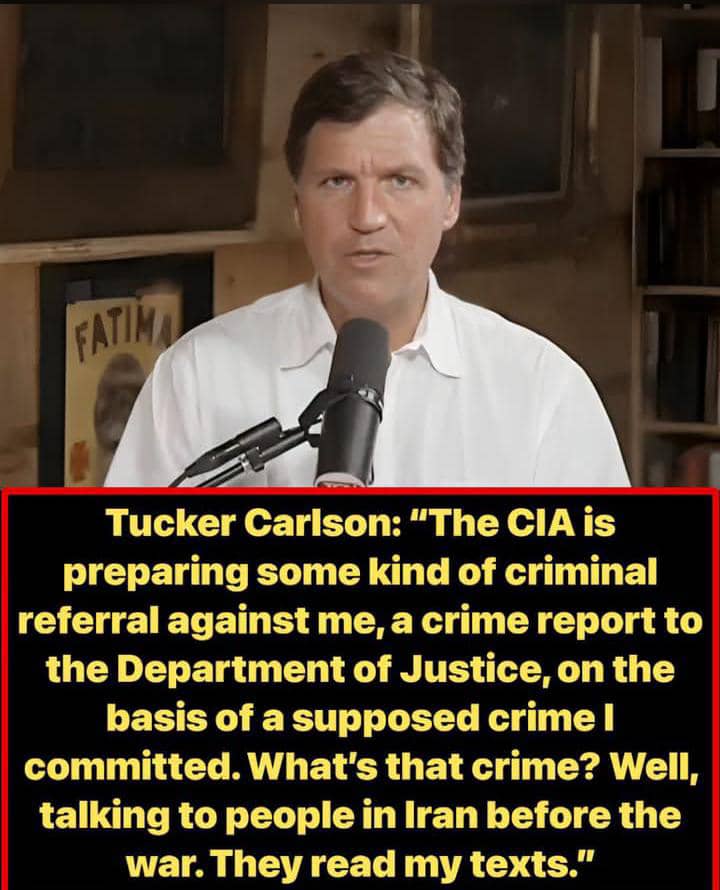
In his video statement, Carlson said he was informed that the CIA was preparing “some kind of criminal referral” against him. He questioned why his conversations with Iranian contacts would be considered a crime.
“So the other day I found out that the CIA is preparing some kind of criminal referral against me,” Carlson said. “What’s that crime? Well, talking to people in Iran before the war. They read my texts.”
Carlson suggested that officials were looking into whether his communications could fall under the Foreign Agents Registration Act, commonly known as FARA. The law requires certain individuals who work on behalf of foreign governments or political entities to disclose that relationship to the Justice Department.
Carlson pushed back strongly against the idea that his conversations represented foreign influence. He said he was not working for Iran and rejected the suggestion that private discussions with foreign individuals automatically meant someone was acting as a foreign agent.
“I’m not an agent of a foreign power,” Carlson said, adding that his loyalty was to the United States.
The former Fox News host also argued that journalists and commentators routinely communicate with people around the world to gather information, understand events, and conduct interviews.
The Foreign Agent Question Behind the Controversy
At the center of the dispute is FARA, a decades-old law that has gained increased attention in recent years. The law was originally passed in 1938 and requires certain people representing foreign interests to register with the Justice Department.
However, simply speaking with foreign citizens, officials, or sources does not automatically mean someone has violated FARA. The law generally focuses on individuals acting under the direction or control of foreign governments or political organizations.
Carlson’s comments did not include evidence that the CIA or Justice Department had officially filed charges against him. Neither agency has publicly confirmed that a criminal referral exists.
The controversy has also emerged during a period of intense political disagreement over U.S. policy toward Iran. Carlson has been one of the most vocal conservative critics of military intervention and has questioned American foreign policy decisions involving the Middle East.
His critics argue that conversations with foreign officials require careful scrutiny, especially when national security issues are involved. Supporters argue that restricting communication between journalists and foreign sources could create a dangerous precedent.
The dispute has quickly expanded beyond Carlson himself and into a broader argument about government power, surveillance, and press freedom.
A Bigger Debate Over Journalism, Government Power, and Free Speech

Carlson’s accusations have renewed discussions about how intelligence agencies interact with American citizens, especially public figures who regularly discuss international affairs.
The question at the heart of the debate is whether contacting foreign individuals is an ordinary part of media work or whether certain communications cross into activities that require legal oversight.
Carlson has maintained that his conversations were connected to his work as a commentator. He said he speaks with people across the world to understand conflicts and political developments, not to represent foreign interests.
The situation has also drawn attention because Carlson has previously conducted high-profile interviews with foreign leaders and figures, making his approach to international communication a regular part of his public profile.
For now, there is no public confirmation that charges have been filed against Carlson or that prosecutors have formally decided to pursue a case. The claims remain Carlson’s allegations about what intelligence officials are considering.
Still, the controversy highlights a growing tension in American politics: how should the government respond when influential voices communicate with foreign actors during periods of conflict?
As the debate continues, the focus will likely remain on one major question: where should the government draw the line between protecting national security and protecting the freedom to ask questions, gather information, and speak with people around the world?