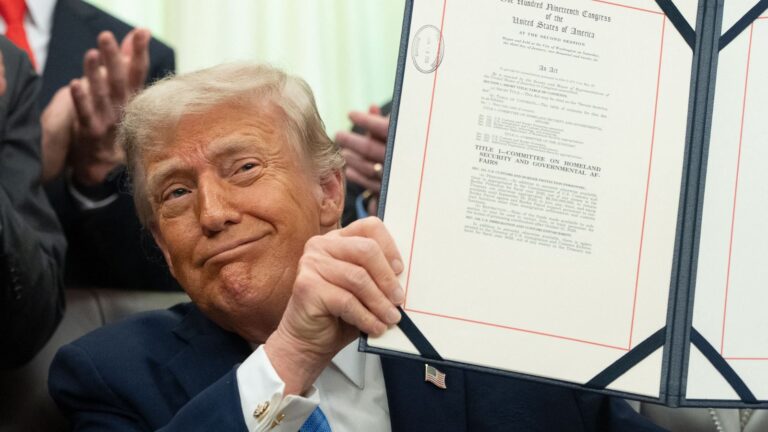
The Strait of Hormuz has long been one of the world’s most important shipping routes, serving as a narrow gateway between the Persian Gulf and the broader global energy market. Now, the strategic waterway has become the center of a new geopolitical dispute after President Donald Trump announced a plan requiring commercial cargo operators to pay for U.S. protection services in the region.
The proposal would transform America’s traditional role as a security provider into something closer to a paid maritime protection system. Trump said the United States would take on the role of “guardian” of the Strait of Hormuz and seek reimbursement from vessels traveling through the area.
The announcement comes after escalating military tensions involving Iran, the United States, and Israel turned the once-busy shipping corridor into a heavily contested zone. The situation has raised questions about the future of global trade, energy prices, and maritime security, as well as whether military protection of international waterways can become a revenue-generating operation.
The Strait of Hormuz is responsible for transporting a significant portion of the world’s oil supply, making stability in the region critical for economies around the globe. Any disruption can quickly affect fuel prices, shipping costs, and inflation.
Why The Strait Of Hormuz Matters To The Global Economy
The Strait of Hormuz is one of the world’s most valuable maritime chokepoints. Located between Iran and Oman, the narrow passage connects major oil-producing nations in the Persian Gulf with international shipping routes.
Millions of barrels of crude oil pass through the strait every day, supplying markets across Asia, Europe, and other regions. Because of its importance, control over the waterway has always carried enormous strategic value.
For decades, the United States Navy has maintained a strong presence in the region to protect commercial shipping and discourage attacks against international vessels. American military forces have historically viewed freedom of navigation as a core principle of global trade.
However, recent tensions have challenged that long-standing approach.
According to reports, Iran attempted to restrict movement through the waterway during the conflict by requiring ships to obtain approval before crossing certain areas. Tehran argued that it had the authority to control access near its coastline, while Washington rejected those claims and maintained that the strait should remain open to international shipping.
The result was a dangerous environment in which commercial vessels faced heightened security risks, prompting shipping companies and insurers to reconsider whether crossing the waterway was worth the potential danger.
Trump’s Proposed 20% Cargo Charge Changes the Security Equation.
Trump’s announcement introduced a new element into the ongoing dispute: a financial cost for maritime protection.
The president said commercial cargo moving through the Strait of Hormuz would be subject to a 20% reimbursement requirement to cover security costs.
The plan represents a major shift in how the United States approaches military protection of international shipping routes. Traditionally, American naval operations have been funded through government spending rather than direct payments from commercial vessels.
Trump argued that the United States should receive compensation for protecting one of the world’s most economically important waterways.
The proposed charge immediately created uncertainty among shipping companies, energy traders, and global markets. Businesses that rely on predictable transportation costs now face another potential expense added to an already risky environment.
A tanker traveling through the region must now consider several factors:
- The threat of attacks or military confrontation
- Rising insurance premiums
- Possible delays caused by security procedures
- Additional costs linked to U.S. protection fees
For shipping companies, these expenses could eventually be passed down through supply chains, potentially affecting prices for fuel, transportation, and consumer goods.
How The Strait Of Hormuz Became A Military Flashpoint
The latest tensions surrounding the waterway are part of a much longer history of conflict between Iran and Western powers.
Iran has repeatedly used its geographic position near the strait as a source of leverage. Because much of the waterway runs close to Iranian territory, Tehran has the ability to threaten shipping routes during periods of heightened conflict.
The United States, meanwhile, has relied on its naval capabilities to maintain access and protect commercial vessels.
The conflict created a complicated situation where both sides claimed authority over the same strategic passage.
The disagreement has created uncertainty for global shipping companies that depend on safe and predictable routes.
Shipping Companies Face A New Risk Calculation
Military protection does not automatically guarantee commercial confidence.
Shipping companies and insurance providers ultimately decide whether a route is practical. Even if naval forces are present, companies may avoid areas where the possibility of attack remains high.
The situation in the Strait of Hormuz demonstrates the difference between a waterway being technically open and commercially usable.
A shipping route may be legally accessible, but if insurance costs become too high or crews face unacceptable risk, companies may choose an alternative.
Some vessels have reportedly reduced activity through certain parts of the strait, using different routes or taking additional precautions to avoid detection.
The uncertainty has pushed companies into difficult decisions:
- Continue using the shortest route with higher security costs.
- Choose longer alternative routes with increased fuel expenses.
- Delay shipments until tensions decrease
For oil markets, even a temporary reduction in traffic can create price volatility.
Oil Markets React As Investors Watch The Persian Gulf
Energy markets responded quickly after Trump’s announcement, with oil prices rising as traders evaluated the potential impact on global supply chains.
Markets often react strongly to threats involving the Strait of Hormuz because even the possibility of disruption can influence expectations.
A prolonged security crisis could affect:
- Crude oil prices
- Fuel costs for consumers
- Transportation expenses
- Inflation trends worldwide
Countries that depend heavily on imported energy are especially sensitive to instability in the region.
Asian economies, in particular, rely significantly on Gulf energy supplies, meaning any long-term disruption could create economic pressure beyond the Middle East.
Oman Attempts To Find A Middle Ground Between Iran And The U.S.
As tensions continue, diplomatic efforts have focused on creating a system that allows commercial traffic to continue without giving either side complete control.
Oman, which borders the Strait of Hormuz and has historically played a diplomatic role in regional disputes, has reportedly explored proposals involving separate shipping corridors.
One possible arrangement would divide traffic between different areas of the waterway:
- A southern route near Omani waters
- A northern route closer to Iranian territory
Such an approach could reduce direct confrontation, but questions remain about enforcement and whether shipping companies would consider the arrangement safe.
The biggest challenge is trust. Iran and the United States have sharply different views about security responsibilities and control over the waterway.
The Future Of The Strait Of Hormuz Remains Uncertain
The dispute over the Strait of Hormuz highlights a broader question about the future of international shipping security.
For decades, powerful nations have protected major trade routes because global commerce depends on open seas. Trump’s proposal introduces a different model, one where security could come with a direct financial obligation for those who benefit from protection.
Supporters argue that countries and companies benefiting from U.S. military operations should contribute financially. Critics question whether charging commercial vessels could complicate global trade and create new barriers.
Ultimately, shipping companies, insurance markets, governments, and energy traders will determine how much confidence remains in the waterway.
The Strait of Hormuz has always been more than a narrow passage of water. It is a symbol of global energy dependence, military influence, and economic power.
As tensions continue, the world will be watching to see whether the strategic chokepoint returns to normal operations or becomes a permanent battleground where security and commerce are increasingly intertwined.