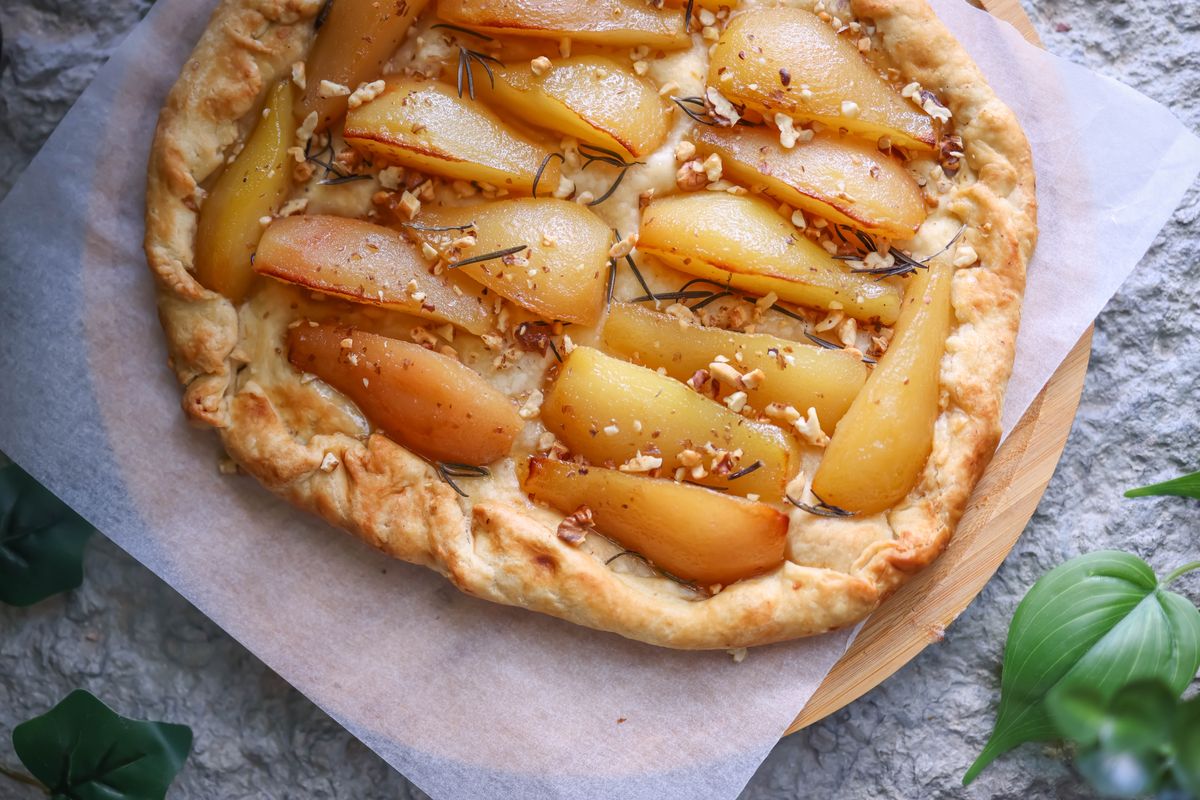
Some desserts demand a steady hand, a piping bag, and the patience to match every last detail. A rustic pear and almond tart takes a considerably more relaxed approach. The fruit stays visible, the pastry folds around the edges, and a little unevenness belongs in the picture. You get the appeal of a beautifully finished dessert without constructing a lattice or mastering decorative crimping.
The format is a free-form tart, often called a galette or, in its Italian counterpart, a crostata. Instead of fitting pastry into a tart pan, you roll out a single crust, add the filling, and fold the border inward. Recipe developer Tara Bench, who publishes as Tara Teaspoon, sums up the appeal: “The edges are folded around the perimeter, no fancy crimping needed.” That’s reassuring for anyone whose pastry skills stop at owning a rolling pin.
Pears and a sweet almond filling make this version particularly inviting. Bench’s recipe places sliced fruit over an almond-paste mixture that puffs slightly as it bakes, creating a nutty layer beneath the pears. The finishing touches are equally straightforward: brush the fruit with warmed apricot preserves and scatter toasted almonds. The oven handles the browning; you handle the pleasantly modest amount of assembly.
The Rustic Shape Is the Whole Point
The great advantage of a galette is that its appearance does not depend on precision. In her guide to fruit galettes,Smitten Kitchen founder Deb Perelman writes, “You don’t need a particular pan or even shape; oblong blobs taste as good and work exactly as well as circles.” It is a useful distinction: this is a dessert built around folded pastry, not perfectly measured edges. A slightly irregular outline does not require an emergency redesign.
That relaxed structure also means fewer pastry components to manage. Perelman notes that a single crust takes less time and effort than a more elaborate pie, and the open center keeps the fruit on display. For a pear-and-almond version, the visible slices provide much of the decoration. You can arrange them neatly without adding an extra project involving pastry leaves, braids, or a second crust.
Bench chooses Bosc pears for her crostata because they hold their texture well during baking, and their brown skins help define the arrangement. She also identifies Red Anjou and Red Bartlett as attractive alternatives. Green Anjou and yellow Bartlett pears work too, though she notes they create less contrast. That gives readers a practical choice rather than the impression that the entire dessert depends on finding one specific pear.
The Almond Layer Makes It More Than Fruit on Pastry
The filling beneath the pears adds another dimension to this tart. Frangipane is an almond-based pastry filling commonly made with ingredients including almond flour, butter, sugar, and eggs. Writing for King Arthur Baking, recipe developer Jessica Battilana describes it as “a baker’s secret weapon.” As it bakes, she explains, it puffs and browns around fruit, adding richness and almond flavor to combinations that include apples and pears.
Bench’s crostata takes a shortcut, starting with store-bought almond paste rather than grinding almonds and adding sugar separately. She blends it with an egg, cornstarch, and salt to make the filling. As Bench explains, “This filling bakes and puffs just a little and creates a sweet, nutty custard right under the fruit.” It is a useful shortcut because it simplifies preparation while keeping a distinct almond layer in the finished tart.
The terminology deserves a little care at the grocery store. Almond paste is the starting ingredient in Bench’s recipe, not a substitute for the entire prepared filling. Battilana also cautions that frangipane and marzipan aren’t interchangeable: marzipan is a denser, stiffer confection often used for shaping decorations. Follow the ingredient named in your chosen recipe rather than grabbing something almond-flavored and hoping it behaves the same way.
Related: 10 Candy Bars From the ’70s That Disappeared but Never Left Americans’ Memories
How to Get the Golden Finish Without Fancy Decorating
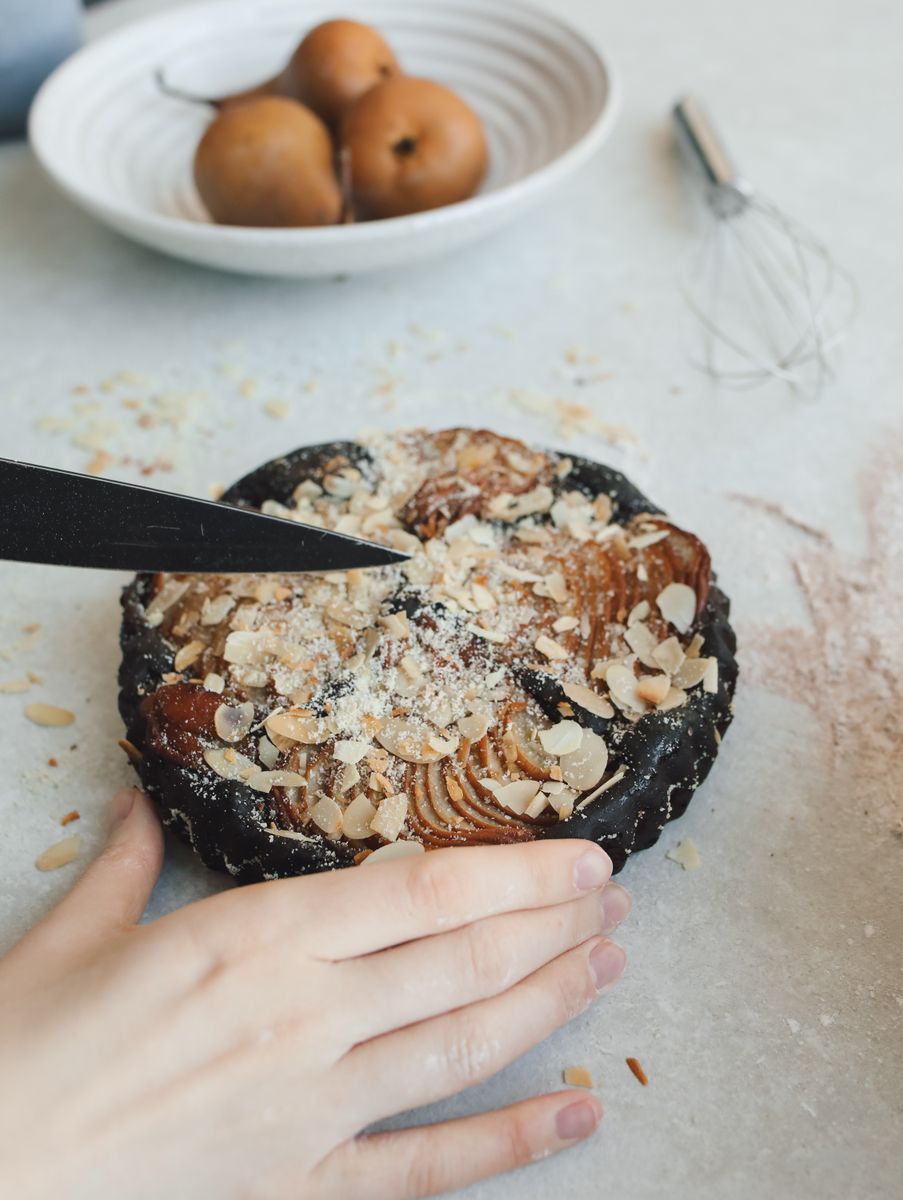
For a concrete version to follow, Bench’s recipe uses one single pie crust, three cored pears cut into ½-inch slices, and 1 tablespoon of fresh lemon juice. The filling combines 4 ounces almond paste, 1 egg, 4 teaspoons cornstarch, and ⅛ teaspoon salt. A second egg is reserved for brushing the pastry. Finally, add 2 tablespoons of apricot preserves and ¼ cup toasted sliced almonds.
Preheat the oven to 375°F and place a rack in the lower third. Blend the filling ingredients in a food processor, then roll the pastry into a circle about 12 to 13 inches across on flour-dusted parchment. Spread the almond mixture over the center, leaving a 2-inch border uncovered. That empty margin has a purpose: it becomes the folded edge that frames the pears and helps contain the filling.
Toss the sliced pears with the lemon juice, arrange them over the almond layer, and fold the pastry border inward, overlapping it in gentle pleats. Transfer the tart, still on its parchment, to a baking sheet and brush the exposed crust with beaten egg. Bake for about 40 minutes, until the pastry is deep golden and the pears are soft. Her instructions call for loosely covering it with foil during the final 10 minutes to prevent overbrowning.
After baking, warm the apricot preserves, brush them over the pears, then add the toasted, sliced almonds. Bench recommends serving the crostata warm or at room temperature, with options including sweetened whipped cream, vanilla ice cream, or crème fraîche. No frosting needs smoothing, and no intricate decoration needs protecting on the way to the table. The golden folds, visible fruit, and almond topping already give this dessert its finished look.