President Donald Trump admitted for the first time on Sunday that a contractor botched part of the Lincoln Memorial Reflecting Pool renovation, a concession that arrived buried inside a Truth Social post still built around accusing a former Olympic athlete of vandalism. Trump wrote that some contractor error occurred because the job was rushed to meet a July 4th deadline, though he described the affected area as relatively inconsequential compared to the pool’s overall size.
The admission followed months of Trump publicly insisting that vandals were responsible for the peeling paint, floating debris and algae blooms in the pool. The problems were later linked to a rushed $6.8 million coating contract that eventually grew past $14 million.
It also came roughly a week after the Department of Justice moved to drop a felony destruction of property charge against David Hearn, the former Olympic canoeist Trump has repeatedly named as the culprit.
Trump admits fault while still naming a suspect
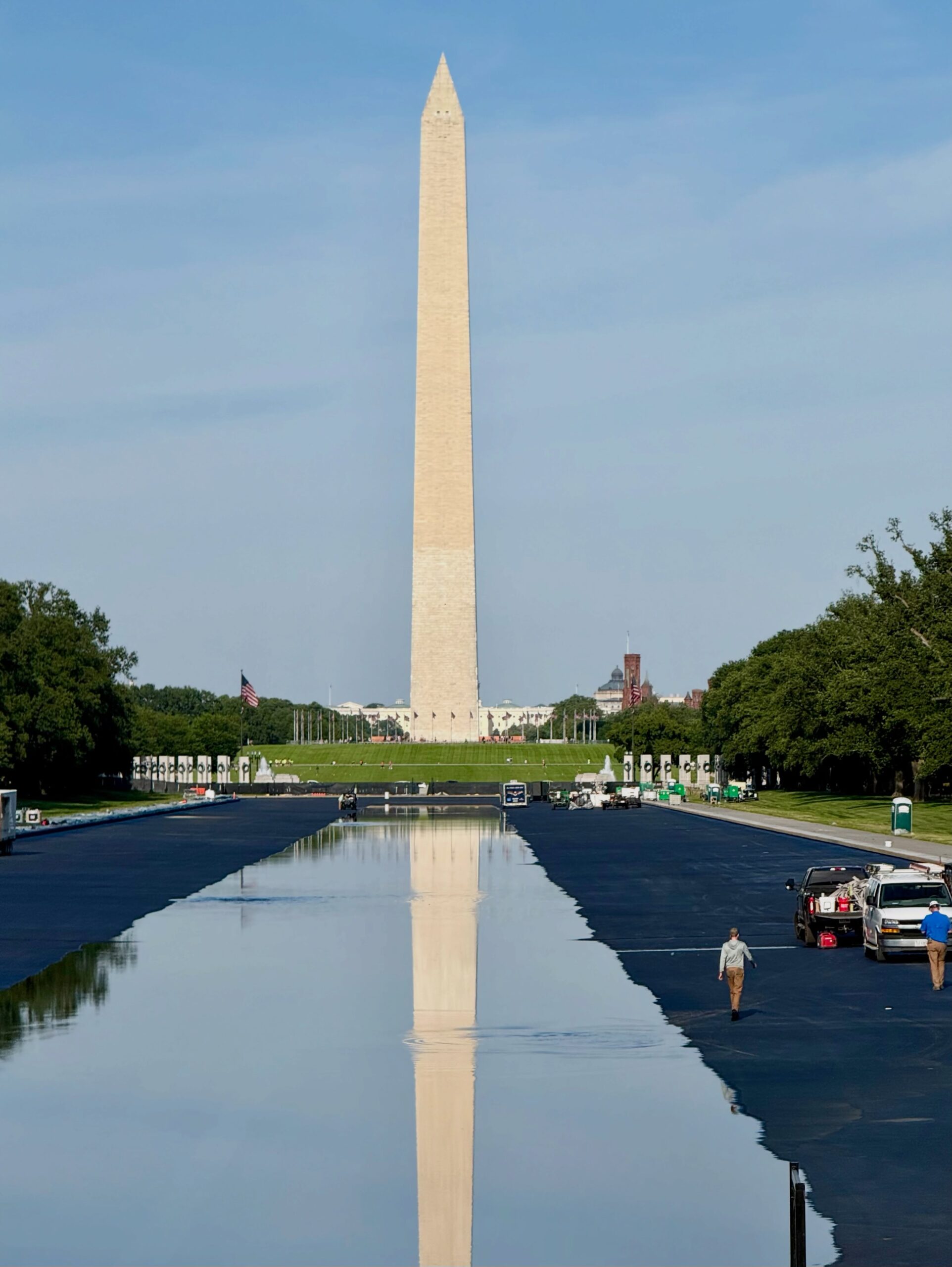
Even as he acknowledged the contractor’s role, Trump used the same post to double down on his claim that Hearn tore at the pool’s coating in broad daylight. He cited an unnamed National Park Service employee he called a highly credible witness, saying that person’s account was passed to the U.S. Attorney’s Office for the District of Columbia in early July.
Trump offered no video or photographic evidence for this specific allegation, writing only that the damage itself served as proof. That absence of visual documentation stands in contrast to the government’s own paper trail on the renovation, which by late July had shifted decisively away from a vandalism narrative.
Justice Department paperwork tells a different story
A July 31 motion filed by U.S. Attorney Jeanine Pirro sought to dismiss the charge against Hearn. It cited newly obtained Interior Department documents showing that the damage stemmed from flawed installation. The work had been rushed ahead of America’s 250th anniversary events. A National Park Service engineer had flagged the likely cause internally in an email weeks earlier, on June 11, well before Trump’s public vandalism claims hardened.
Pirro’s motion noted that a July 20 contractor inspection confirmed overspray and delamination across the coating. A subsequent visual review found damage even in the center of the pool. That area would have been difficult for a vandal reaching from the edge to access. The filing marked a reversal for Pirro, who had told reporters in early July that evidence pointed to a violent, deliberate effort to rip up the sealant.
The price tag ballooned long before the paint began to peel
Scrutiny of the project predates the vandalism dispute by months. Interior Department records show the no-bid contract awarded to Virginia-based Atlantic Industrial Coatings started at $6.8 million. It later expanded to roughly $13.1 million, nearly seven times the $1.8 million figure Trump cited publicly when the work began. A separate no-bid award of $1.74 million went to Ohio-based Green Water Solutions for a nanobubble filtration system meant to control algae, pushing the combined project cost above $ 16 million by mid-June.
A National Park Service profit analysis obtained by the New York Times found Atlantic Industrial Coatings was billing at a 20% margin, well above the 6% to 12% range typical for comparable federal work. That added at least $ 850,000 beyond what a standard contract might have cost taxpayers.
A firm with prior experience on the pool turned the job down
CNN reported that Sika was involved in the pool’s last major reconstruction between 2010 and 2012. The company was approached about the current resurfacing in late March through subcontractor American Concrete Services. Sika declined after conducting a feasibility and risk assessment.
Sika’s earlier project cost roughly 34 million dollars and took nearly two years to complete, a scale and timeline the current rushed job never matched.
It remains unclear why the Interior Department ultimately selected Atlantic Industrial Coatings, a firm working its first federal contract, over a company with direct history on the same pool.
The charge against Hearn has already collapsed
Hearn’s felony case was formally dismissed after prosecutors concluded the evidence could not establish vandalism beyond a reasonable doubt. The government’s own inspections later undercut that theory. Contractor installation records became available and pointed to problems with the work itself. Trump has continued to name Hearn publicly since that dismissal, including in the Sunday post, despite the government’s own filings no longer supporting the accusation.
The pool has a history of struggling to hold its shine even under normal circumstances. Its 2012 reopening after the $34 million rebuild was also marred by algae blooms. The recurring maintenance problem prompted the current nanobubble contract, which was specifically designed to prevent it.
Trump said Sunday that security cameras are now being installed around the site and that the pool will reopen shortly. The Interior Department has not released a public timeline for that reopening or clarified how much of the outstanding contractor work remains unresolved.