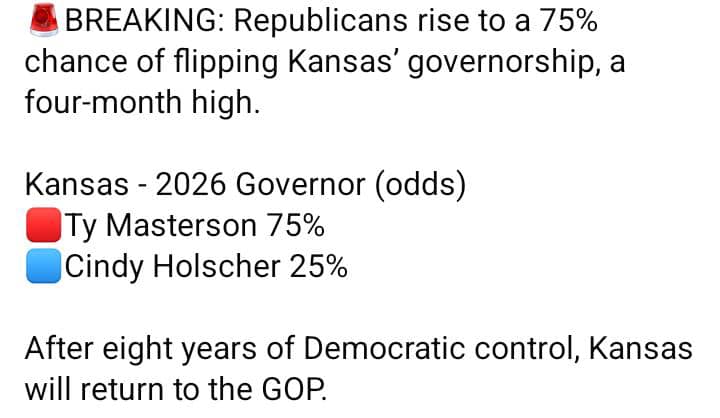
The Kansas governor’s race is becoming one of the most closely watched contests of the 2026 election cycle after market forecasts placed Republicans at 75% to win the governorship, marking a four-month high in GOP expectations.
The prediction does not represent a final outcome or an official election forecast, but it reflects growing confidence among traders who believe Republicans have a strong path to victory in a state that has historically leaned conservative.
Kansas has been led by Democratic Gov. Laura Kelly since 2019. Kelly won two statewide elections, including a 2022 reelection victory, but she is unable to seek a third term because of term limits. Her departure has created an open-seat race that both parties see as a major opportunity.
The question now is whether Kansas voters will choose continuity under Democratic leadership or return the governor’s office to Republican control.
Republicans See An Opening In A Traditionally Conservative State
Republicans have long dominated statewide politics in Kansas, but the governor’s race has been more competitive in recent years. Kelly’s victories showed that Democratic candidates could succeed by appealing to independent voters and moderate Republicans.
The current Republican advantage comes as the party prepares for a competitive primary featuring several candidates, including state officials and former officeholders. One of the leading Republican contenders in prediction markets has been Ty Masterson, the Kansas Senate president, who has received support from some conservative groups and national Republican figures.
Masterson’s campaign has focused on conservative priorities, including taxes, government spending and cultural issues, while other Republican candidates are also competing for the nomination.
The Republican field still has to settle on a nominee before the general election. A strong primary battle could shape the party’s chances in November, depending on whether the eventual nominee can unite conservative voters and appeal to independents.
Democrats are also preparing for a competitive contest. Kelly has backed Ethan Corson, a former Obama administration official and attorney, as a candidate she believes can continue her approach in Topeka.
Kelly has argued that Democratic candidates must connect with Kansas’ large population of moderate voters to remain competitive statewide.
The Kelly Era Changed The Kansas Political Map
Kelly first won the governor’s office in 2018 during a political environment where many Kansas voters were frustrated with the legacy of former Republican Gov. Sam Brownback’s administration, particularly over tax policies that became a major political issue in the state.
After taking office, Kelly presented herself as a practical Democrat willing to work with Republicans in the state legislature. Her ability to win support beyond the Democratic base helped her secure reelection in 2022.
Her second victory was especially notable because Kansas remained heavily Republican in federal elections. The state voted strongly Republican in the 2024 presidential election, showing the challenge Democrats face when competing statewide without an established incumbent.
Republicans believe the open-seat race gives them a chance to reconnect with voters who may have supported Kelly personally but remain aligned with the GOP on national and state issues.
Democrats, however, argue that Kansas voters have shown they are willing to separate local races from national politics. They point to Kelly’s victories as evidence that a strong candidate with a moderate message can overcome the state’s Republican lean.
The 2026 election may ultimately come down to which message resonates more: Republican arguments that Kansas should return to conservative leadership, or Democratic efforts to continue the approach voters supported under Kelly.
Why The Kansas Governor Race Matters Beyond The State
Governors play a major role in shaping state policy, including decisions involving education, taxes, healthcare, economic development and public safety. That makes the Kansas contest more than just a fight for one office.
Republicans view the race as a chance to reclaim a position they traditionally held and strengthen their influence in a conservative state. Democrats see it as another opportunity to prove that their coalition can compete in places where Republicans have long been dominant.
Prediction markets currently show Republicans ahead, but campaigns are still developing, candidates are still competing for nominations, and voter opinions can change significantly before Election Day.
The 75% market probability reflects current expectations, not a guarantee. Elections are decided by voters, and Kansas has already shown that its political landscape can shift depending on candidates, issues, and the national environment.
For now, Republicans appear to have momentum. But the race for Kansas governor is far from over, and both parties will have months to convince voters that their vision for the state deserves another four years in the governor’s office.