The turkey may command the center of the Thanksgiving table, but a casserole crowned with fried onions has a story worth telling.
Green bean casserole is not an heirloom carried unchanged from the earliest American harvest celebrations. Its beginnings are much more modern: a corporate test kitchen, a recipe developer, and a practical assignment using familiar ingredients.
In 1955, Dorcas Reilly helped turn green beans and condensed mushroom soup into a dish that would eventually become part of Thanksgiving tradition. Yet the recipe was not originally designed exclusively for the holiday.
Its journey from an everyday side dish to a seasonal fixture helps explain how American food traditions take shape. Sometimes, an indispensable recipe starts with a much simpler goal: making dinner easier.
Before It Was a Tradition, It Was a Test-Kitchen Assignment
Reilly developed the dish at Campbell’s headquarters in Camden, New Jersey, where she worked in the company’s home economics operation.
As a professional recipe developer, she created dishes home cooks could reproduce. The casserole was one project among many, not a solitary creation that defined her working day.
The Associated Press later reported that Reilly assembled the recipe for an AP feature in 1955. Her other work included tomato soup meatloaf, tuna noodle casserole, and a Sloppy Joe-style preparation called “souperburgers.”
That wider career puts the familiar casserole in perspective. Reilly’s job was to find useful possibilities in products people could buy, then develop recipes around them.
The dish’s original name, Green Bean Bake, was straightforward. It described what would come out of the oven without suggesting that it would become a holiday tradition.
Campbell dates the recipe’s creation to 1955, when it was intended as an everyday side dish. Its Thanksgiving identity developed later.
That distinction matters. Green bean casserole didn’t arrive at the table wrapped in nostalgia. Familiarity would come through cooking, serving, and encountering it again.
Six Ingredients Made the Idea Easy to Repeat
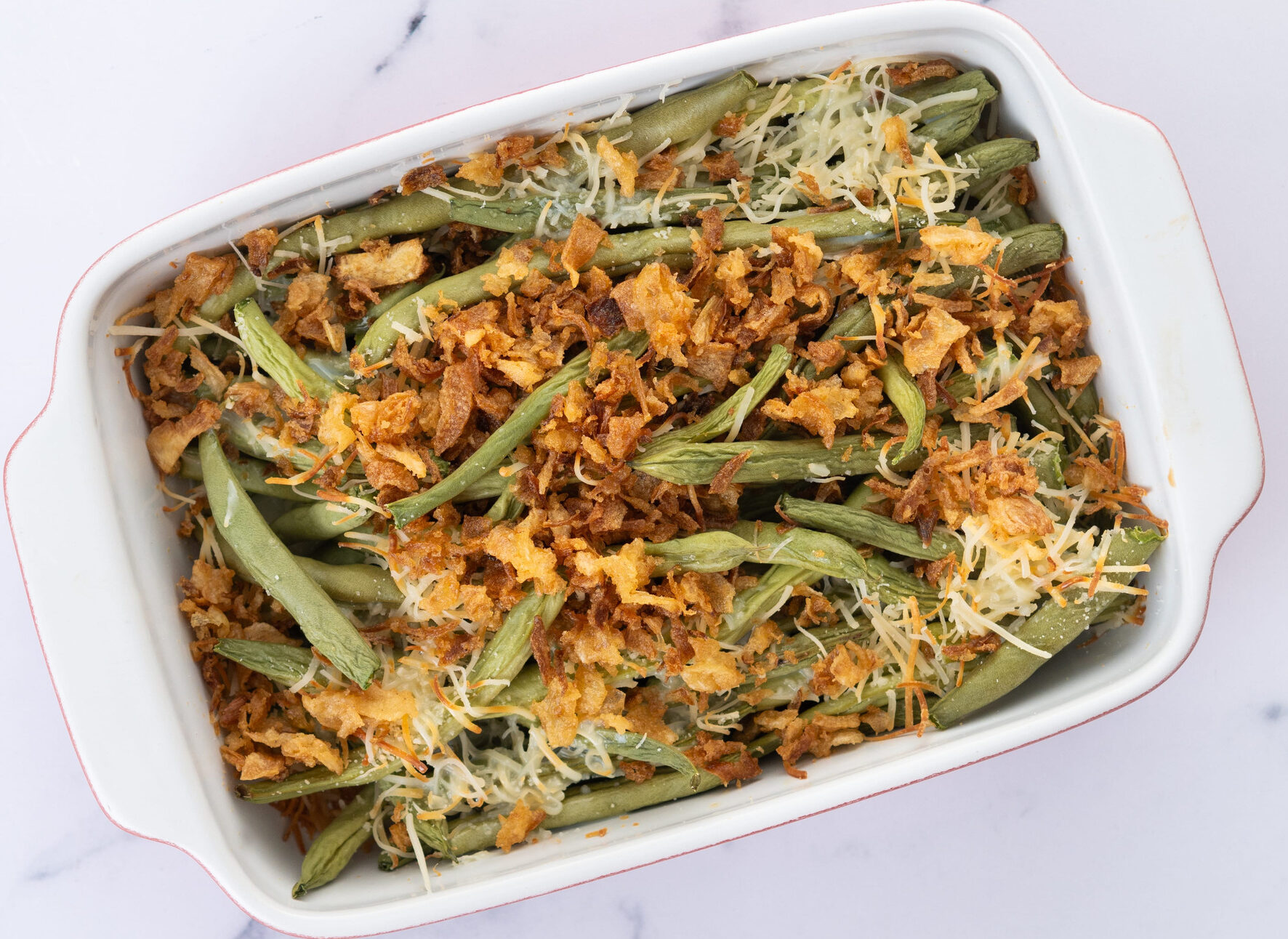
The recipe’s lasting framework is compact: green beans, condensed cream of mushroom soup, milk, soy sauce, black pepper, and French-fried onions.
Each component has a clear role. The beans provide substance, the soup and milk create the creamy mixture, and the seasonings sharpen the flavor. The onions provide a crisp contrast to the soft filling.
The condensed soup is central to the convenience. Instead of requiring a separate mushroom sauce, the recipe starts with an existing product and turns it into part of a baked side dish.
That is a specific kind of kitchen invention. Reilly was not developing every component from scratch. She figured out how available ingredients could work together reliably.
That simplicity took work. Reilly repeatedly adjusted ingredient quantities and baking times before settling on the recipe. In 2002, she and Campbell donated the original recipe document to the National Inventors Hall of Fame.
Behind the short ingredient list was a process of testing and refinement. The finished dish made that work largely invisible to the person preparing it.
This is part of the casserole’s appeal as a cooking idea. It offers a recognizable combination without asking the cook to master several separate preparations.
For a holiday meal with multiple dishes competing for attention, that economy helps explain its usefulness. The recipe offers a defined task rather than an elaborate side project.
Its signature also remains easy to recognize. However, the details change; green beans beneath a creamy filling and an onion topping give the dish a distinct identity.
Related: 14 Strange Thanksgiving Traditions That Everyone Pretends Aren’t Weird
How a Soup-Can Recipe Became a Holiday Habit
A workable recipe still needs a way to reach people. For green bean casserole, food packaging became an important vehicle.
Campbell says the dish gained its Thanksgiving following during the 1960s, after the company placed the recipe on cream of mushroom soup labels.
The arrangement brought the instructions and a central ingredient together. A cook did not need a separate cookbook to discover how the soup could become a casserole.
The label also gave the recipe a repeatable form. Its ingredients and method could travel beyond the test kitchen into household routines.
A food company developed this commercial recipe and circulated it on its packaging. That origin belongs in the story, but it does not fully describe what happened afterward.
Once people prepared the dish at home, it could acquire associations that had little to do with the company behind it.
Reilly later recalled seeing versions of the casserole entered in company recipe contests as family dishes. “It would be Aunt Suzy’s or Grandma’s,” she said in a 2005 interview with The Associated Press.
That observation captures the transition from published recipe to personal tradition. A dish could start on a soup label and later become tied to the relative who brought it to dinner.
Its corporate origin and family identity were not mutually exclusive. The recipe provided a starting point; the person preparing it gave it a place in the meal.
The important change was not simply that more people knew the instructions. The casserole could become familiar enough to feel like it belonged to a particular household.
Related: 20 Odd American Traditions That Confuse the Rest of the World
Why the Casserole Still Leaves Room for Family
The recipe’s structure allows changes without requiring a completely different dish.
Campbell’s published variations include bacon and cheddar. Its historical account also describes early tests with ingredients such as Worcestershire sauce, celery salt, and ham that didn’t make it into the established version.
Those details show early experimentation. Adaptation isn’t necessarily a departure from the recipe’s history; testing helped create the familiar version in the first place.
Still, the core combination gives cooks something recognizable to retain. Change the additions, and the beans, creamy sauce, and onion topping can continue to connect one version to another.
Green bean casserole’s endurance, therefore, is not explained by convenience alone. Ease helped make it practical, packaging helped circulate it, and family use gave it another kind of meaning.
Reilly’s contribution was to develop a combination that people could repeat. What followed was the quieter work of home kitchens, where a published recipe could become somebody’s expected contribution.
The casserole’s story also leaves room for a generous understanding of tradition. A dish doesn’t need ancient origins or an entirely homemade foundation to matter.
It can begin with an ordinary assignment and become meaningful through the people who keep making it.
When a recipe travels from a test kitchen to a soup label and finally becomes “Grandma’s,” what new dish on today’s Thanksgiving table might become tomorrow’s family classic?