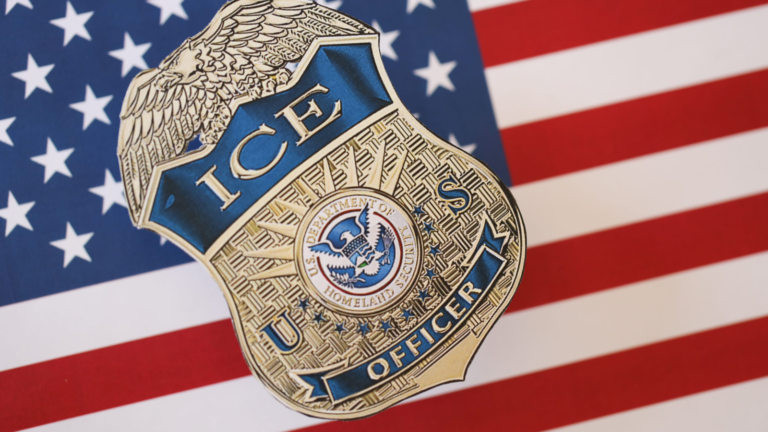
The fight over immigration just collided with the fight over election trust. The Department of Homeland Security has directed Immigration and Customs Enforcement to pursue tougher penalties, including deportation, against undocumented immigrants who illegally vote in American elections, according to a new DHS directive.
That means an illegal vote would no longer be treated only as an election issue. Under the directive, it could become a fast-moving immigration case, too.
For supporters, the message is simple: only U.S. citizens should vote in American elections, and anyone who breaks that rule should face serious consequences.
For critics, the concern is just as clear: a crackdown framed around voter fraud could inflame political fear, sweep too broadly, or deepen distrust before another heated election season.
The directive puts ICE directly into the voting fight.
According to DHS, the new instruction came after General Counsel James Percival directed ICE to enforce stricter consequences for noncitizens who illegally vote or make false claims of U.S. citizenship.
The department said the Immigration and Nationality Act already directs the removal of noncitizens who unlawfully vote. DHS framed the move as part of a broader effort to protect election integrity and prevent illegal ballots from diluting lawful votes.
In its announcement, the department said illegal voting and false claims of citizenship often overlap. The DHS announced directive makes clear that immigration enforcement is now being pushed more forcefully into cases involving unlawful participation in elections.
The law already bars noncitizens from voting in federal elections.
Federal elections are reserved for U.S. citizens, and federal law prohibits noncitizens from voting in races for president, Congress, and other federal offices.
A March White House order on election integrity stated that federal statutes prohibit noncitizens from registering to vote or voting in federal elections and impose criminal penalties for violations. The federal voting rules are at the center of the administration’s argument that the government has a duty to act aggressively.
The complicated part is that voting rules can vary outside federal elections. Some local jurisdictions have allowed certain noncitizens to vote in limited local races, which is why the distinction between federal, state, and local elections matters.
DHS says the punishment should match the violation
The administration’s position is that illegal voting is not a paperwork mistake. It is a direct attack on lawful voters.
That argument is likely to resonate with Americans who already worry about election security, voter rolls, identity checks, and whether the system is strong enough to stop people who should not be casting ballots.
For those voters, deportation may sound like the natural consequence. If someone is in the country illegally and also votes illegally, supporters argue the government should not treat it as a minor violation.
The directive gives ICE attorneys a clearer signal to prioritize those cases.
Critics see a political warning sign.
Opponents are likely to question whether the move is about enforcement or election-season messaging.
The Trump administration has repeatedly tied immigration to election integrity, and that combination carries political power. It also carries risk. When officials speak broadly about illegal immigrant voting, critics argue it can make the problem seem larger than evidence shows.
Reuters reported in May that state audits and independent studies have found illegal immigrant voting is rare, even as the administration has pushed harder for state voter-roll data. The report said the practice is rare, while also noting the Justice Department’s broader effort to obtain voter lists.
That tension is the heart of the debate: one side sees it as a necessary deterrent, while the other sees it as a political spotlight on a limited problem.
Voter-roll data is already part of the fight.
The directive does not stand alone. It comes after months of federal pressure around voter-roll verification and citizenship checks.
The administration has pushed for stronger coordination between federal agencies and state election officials, including the use of federal citizenship and immigration data to identify people who may not be eligible to vote.
That has sparked resistance from some states and voting-rights advocates, who worry that flawed data checks could wrongly flag lawful voters, including naturalized citizens.
The argument is not just about whether noncitizens should vote. Nearly everyone agrees they cannot vote in federal elections. The fight is over how aggressively the government should search for violations and what risks that search entails.
The move gives immigration enforcement a sharper election role.

ICE is usually discussed in the context of arrests, detention, removals, workplace actions, and border-related enforcement.
This directive makes the agency more visible in the election-integrity debate. That will almost certainly draw attention from both immigration hardliners and civil rights groups.
For hardliners, it is overdue. For critics, it raises alarms about using immigration enforcement in a politically charged election environment.
Either way, it means voting violations involving noncitizens may now carry more visible immigration consequences.
The public reaction will likely split fast.
This is the kind of policy that lands differently depending on what people already fear.
Some Americans fear illegal voting, even if proven cases are limited. They see every unlawful ballot as an insult to citizens who follow the rules.
Others fear government overreach. They worry that aggressive citizenship checks could lead to errors, scare eligible voters, or turn election offices into immigration battlegrounds.
Both fears are politically potent. Both are easy to inflame. And both will shape how the directive is received.
The bigger question is trust.
Election systems depend on trust, but trust is fragile. If voters believe illegal ballots are being ignored, confidence drops. If eligible voters believe they could be wrongly targeted, confidence also drops.
That is why this directive matters beyond the number of cases it may produce. It sits at the intersection of immigration, citizenship, voter fraud claims, federal power, and election-year anxiety.
The administration says the goal is to protect lawful votes. Critics will want proof that enforcement stays accurate, narrow, and fair.
The fight now is not just about what happens to undocumented immigrants who illegally vote. It is about whether the government can enforce election law without turning fear into the loudest voice in the room.