A debate over Islamic modesty has erupted online after comments attributed to British Islamic speaker Abu Ibraheem Hussnayn circulated widely, with the preacher reportedly arguing that a woman’s covering should go beyond the traditional hijab and even the face veil.
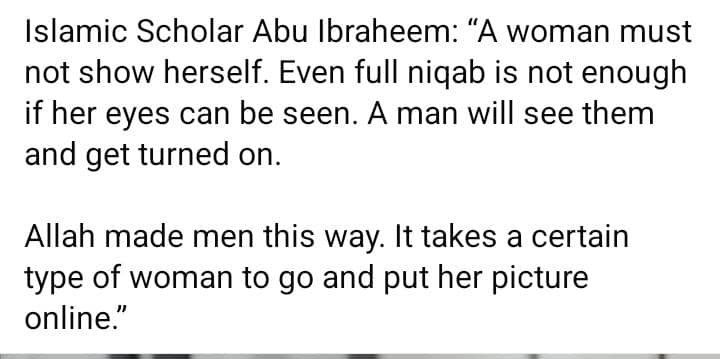
In the viral clip, Hussnayn is quoted as saying that “a woman must not show herself” and suggesting that even a woman wearing a full niqab could still attract male attention if her eyes are visible. He reportedly argued that men are naturally affected by what they see because “Allah made men this way.”
The comments have triggered strong reactions, with some supporters praising the emphasis on modesty while critics question whether such views place too much responsibility on women for managing men’s behavior. The remarks should therefore be understood as statements attributed to Hussnayn through a circulating video clip rather than a completely confirmed transcript.
A Controversial Take on Modesty and the Niqab

The discussion surrounding the comments focuses on one of the most debated areas of Islamic dress: how much of a woman’s body should be covered in public.
The hijab, which commonly refers to covering the hair and wearing modest clothing, is practiced by millions of Muslim women around the world. The niqab goes further by covering the face while leaving an opening around the eyes.
The argument attributed to Abu Ibraheem Hussnayn takes an especially strict approach by suggesting that even visible eyes may create temptation. For supporters of this view, modesty is not only about clothing but about minimizing anything that could draw attention.
Those who disagree argue that this interpretation creates an unrealistic standard where women are expected to remove almost every visible feature of themselves to prevent possible reactions from men.
The debate also touches on a broader question found in many religious and cultural discussions: where does personal responsibility begin and end? While attraction may be a natural human experience, many argue that individuals are still responsible for controlling their own actions and choices.
Islamic Scholars Have Long Debated Face Covering
The idea that a woman’s face must always be covered is not a universally agreed position among Muslim scholars. Islamic legal traditions contain different interpretations about whether the niqab is required, recommended or simply a personal choice.
Some conservative scholars have argued that women should cover their faces in front of unrelated men. However, even within traditions that support niqab, many scholars allow the eyes to remain visible because women need to see while moving through daily life.
For example, some Islamic rulings state that leaving an opening for the eyes is acceptable, particularly when it allows a woman to navigate safely. Other scholars have taken different approaches based on their understanding of Islamic texts and historical practices.
This disagreement has existed for centuries. Different schools of Islamic jurisprudence have developed varying views on women’s clothing, modesty and public appearance.
Because of this diversity, statements about what “Islam requires” often depend on which scholar or legal tradition is being followed.
The niqab debate is therefore not simply a question of clothing. It reflects wider conversations about religious interpretation, cultural expectations and the role of personal choice within faith.
The Quran Also Addresses Men’s Responsibility
One of the major points often raised in discussions about modesty is that Islamic teachings also place obligations on men.
In Surah An-Nur 24:30, the Quran instructs believing men to lower their gaze and guard their chastity before giving guidance to women in the following verse.
The verse directed at women, Surah An-Nur 24:31, discusses modesty, including covering and behavior. Many scholars point out that the two verses together present modesty as a responsibility shared by both men and women.
Supporters of this interpretation argue that men cannot simply blame women for their own reactions. They say religious teachings about self-control exist because people are expected to manage natural feelings and behave responsibly.
Critics of stricter modesty arguments often focus on this point, saying that reducing women’s visibility does not remove the need for men to practice discipline.
The conversation has become especially heated online because it sits at the intersection of religion, gender expectations and personal freedom.
A Viral Quote Opens a Much Bigger Conversation
The controversy surrounding Abu Ibraheem Hussnayn’s reported comments shows how quickly discussions about faith and modesty can spread in the digital age.
For some Muslims, stricter standards of dress represent devotion, dignity and obedience to religious beliefs. For others, such expectations can feel excessive when they move from personal choice into demands placed on every woman.
At the center of the debate is a question that has existed across generations: how should societies balance religious values, individual responsibility and personal freedom?
The answer depends greatly on personal beliefs, religious interpretation and cultural background. What is clear is that discussions about modesty within Islam are far more complex than a single viral statement.
The debate over whether a woman’s eyes should be covered is not just about clothing. It is about how communities understand faith, responsibility, and the relationship between men and women.