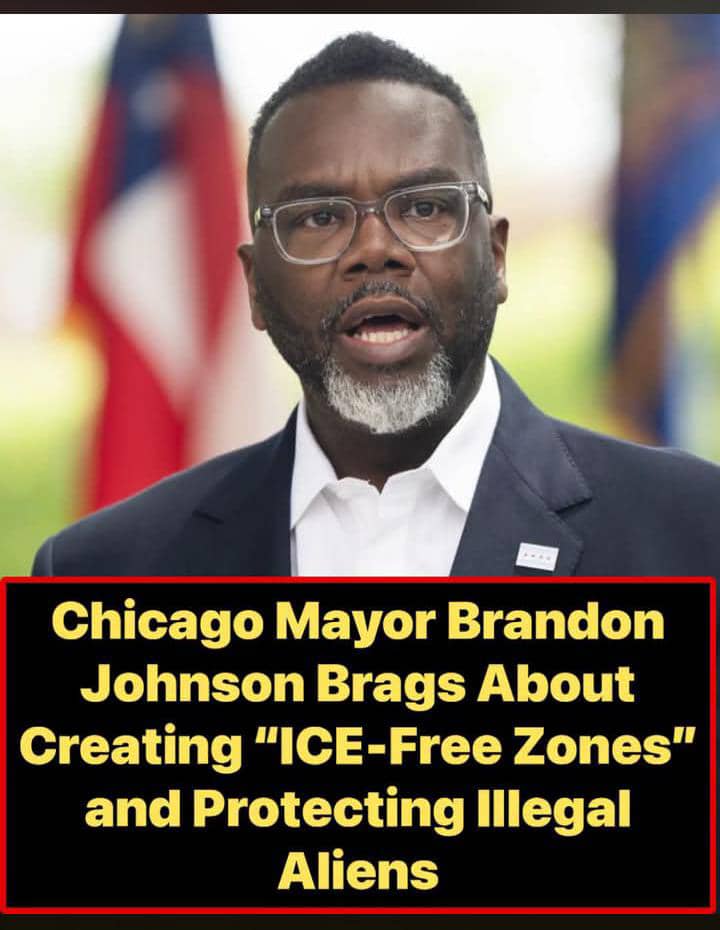
Chicago Mayor Brandon Johnson is not backing away from his confrontation with federal immigration authorities. In fact, he is placing it near the top of his political résumé.
During a recent interview, the Democratic mayor pointed to the executive orders he has signed, including the creation of “ICE-free zones,” while discussing his administration’s commitment to maintaining Chicago’s sanctuary-city policies. The remarks quickly spread through conservative media, where critics accused him of proudly protecting undocumented immigrants at the expense of American citizens.
That interpretation makes for a fiery social media post. The actual policy, however, is more specific. Johnson has not outlawed Immigration and Customs Enforcement operations throughout Chicago. His order primarily blocks federal immigration officers from using city-controlled property as a staging area, processing location or operational base.
What Chicago’s ‘ICE-free zones’ actually cover
Johnson signed the executive order on October 6, 2025, following reports that federal immigration officers had used Chicago Public Schools parking areas and other city-owned lots during enforcement operations.
“The order establishes ICE-free zones,” Johnson said while announcing it. He added that city property and private businesses that did not consent would no longer serve as staging grounds for immigration raids. “Our school parking lots are not for ICE to load their weapons,” he said.
Under the order, Chicago departments must identify municipal parking lots, garages, vacant lots and similar locations that could be used during civil immigration enforcement. Officials may install signs, lock gates or use other barriers to prevent those properties from becoming temporary bases for federal officers.
City workers are also instructed to report attempted violations to the mayor’s office and Chicago’s Corporation Counsel. Private businesses can voluntarily request city-provided signs declaring that their property cannot be used for immigration operations without permission or a valid judicial warrant.
The policy does not create an invisible force field around Chicago. ICE retains federal authority to conduct lawful immigration enforcement, and the city cannot stop agents from operating on federal property, traveling on public roads or carrying out legally authorized duties.
A 2026 analysis from the University of Wisconsin Law School said local governments probably have broad power to decide how their own property is used. However, the report also noted that attempts to punish federal officers or block activities clearly authorized by federal law could face significant constitutional and immunity challenges.
In other words, the order is largely a property rule with a political megaphone attached.
Johnson says the policy protects rights, not criminals
Johnson’s administration argues that the order is about constitutional protections, community trust and preventing city resources from supporting federal operations that local officials consider abusive.
“We will not tolerate agents violating our residents’ constitutional rights,” Johnson said when the policy was introduced. His office said immigration operations involving city property had frightened communities and weakened relationships between residents and local law enforcement.
Johnson has continued promoting the policy nationally. At a January 2026 appearance in Washington, he described the zones as a practical way to prevent immigration raids from being organized in places such as elementary-school parking lots. He also called the signs a powerful symbol of Chicago’s rejection of the Trump administration’s deportation strategy.
The mayor later said he had “used every single tool” available to resist federal immigration tactics. His administration has also distributed “Know Your Rights” information, defended Chicago’s Welcoming City Ordinance and encouraged other municipalities to adopt similar restrictions.
Still, Chicago officials have drawn a line between refusing to assist ICE and physically obstructing federal agents. During the rollout of the policy, then-Police Superintendent Larry Snelling said Chicago officers did not interfere with federal enforcement operations.
“This is not a game. This is not a joke,” Snelling said, stressing that local police remained responsible for maintaining safety and calm throughout the city.
That distinction matters. Chicago police generally do not perform civil immigration enforcement or detain someone solely because of immigration status. But the department can still cooperate with federal agencies on criminal investigations, firearms trafficking and other matters unrelated to civil immigration enforcement.
Johnson himself acknowledged that cooperation while announcing the order, noting that Chicago had worked with federal authorities on efforts to remove illegally trafficked guns from the streets.
The White House sees a shield for dangerous offenders

The Trump administration has offered a dramatically different description of Johnson’s policy.
In an official statement, the White House accused the mayor of abandoning law-abiding Chicago residents and protecting undocumented immigrants with serious criminal records. It called the order a “dangerous intensification” of the Democratic sanctuary-city agenda and listed several people arrested by ICE who had criminal convictions or pending charges.
The Department of Homeland Security has also blamed Johnson and Illinois Gov. JB Pritzker for rhetoric it says encourages resistance against immigration officers. After confrontations involving ICE agents in the Chicago area, DHS Assistant Secretary Tricia McLaughlin accused sanctuary politicians of demonizing federal law enforcement.
Johnson rejects the idea that his administration is protecting violent offenders. His position is that immigration status should not erase constitutional protections and that Chicago should not surrender its property or police department to support federal civil-enforcement operations.
Questions also remain about how much practical effect the mayor’s wider anti-ICE strategy has produced. At a July 2026 City Council hearing, police officials said they had finally created procedures for investigating alleged misconduct by federal immigration agents. The process arrived months after Johnson’s deadline, and officials acknowledged that Chicago had lacked a system for tracking such complaints. No immigration agent had been charged with an on-duty crime in Cook County at the time of the hearing.
So, did Johnson brag about creating ICE-free zones? He certainly presented them as an accomplishment and has repeatedly promoted Chicago’s resistance to federal immigration policy.
But the claim that he created blanket safe havens where undocumented immigrants cannot be arrested goes beyond what the order actually does. Chicago’s policy restricts the use of city property, limits local participation in civil immigration enforcement and invites private owners to deny access without a warrant.
That may be enough to delight Johnson’s progressive allies and infuriate the White House. It is not, however, a citywide immunity card. The real story is a sharp and increasingly complicated fight over who controls Chicago’s property, police resources and relationship with the federal government.