In Expedia’s first Global Best Tourist Survey, more than 4,000 hoteliers worldwide ranked American guests well for trying local food and attempting the language, but docked points for volume and complaining.
The dining table surfaces these frictions faster than a museum line or a beach chair, since a single meal packages together pacing, money, language and unspoken local rules.
Below are eight patterns that keep surfacing in the accounts of servers, tour guides and food writers who work with American travelers overseas.
American diners speak louder than the room around them
Restaurant staff in small European dining rooms notice a raised voice fastest during quiet, multi-course meals, where one table’s volume changes the mood at several others.
Read the room and match the speech volume already set by nearby diners.
Assertiveness reads differently across cultures too, since a wave or a raised hand meant to signal efficiency in the US can come across as pushy in a dining room built around subtlety.
Americans expect restaurant service to match drive-through speed
Travelers often discover that restaurant timing is not measured the same way everywhere. In some countries, a long dinner signals hospitality, conversation, and a relaxed experience. In others, quick service is closely connected with convenience and efficiency.
In Latin America, dining out is more of a luxury, so the experience isn’t rushed. Spanish dinner service compounds the mismatch further, often beginning after 9 pm, hours later than most American restaurants seat their last table.
American-style tipping
A 20% tip feels automatic to many Americans, partly because tipped servers in the US can legally be paid as little as 2.13 dollars an hour before gratuities.
That wage structure has no equivalent in Japan, where tipping can read as an insult to a server’s professional pride rather than a compliment, rooted in the hospitality philosophy known as omotenashi.
Western Union’s global tipping guide notes that gratuities remain uncommon across much of Southeast Asia, including Cambodia, Vietnam and Thailand, even as tourism grows. Overtipping in these markets can single out a table as foreign faster than a raised voice.
Sending dishes back
Substitution requests are one of the most common American missteps, since altering a dish not offered as customizable breaks an unwritten menu structure.
Sending a plate back over taste preference, rather than a genuine problem, carries a similar charge, reflecting a culture where the customer-is-always-right assumption barely exists outside the US.
European kitchens generally reserve remakes for undercooked or contaminated food, not a diner who changed their mind partway through the meal.
Requesting ice-packed drinks
Americans stock up on ice more than most nations, a habit that traces back to 19th-century Boston entrepreneur Frederic Tudor, who built a shipping industry moving pond ice to cities including New Orleans and San Francisco.
American hosts routinely stock ice ahead of a gathering in a way European households rarely do.
Smithsonian Magazine points to the flip side, noting that drinking water with meals became common in Europe later than in the US, leaving little cultural space for ice to attach itself to the glass.
Ordering a cappuccino after breakfast
Italians generally stop drinking cappuccino by mid-morning, and milk-based coffee drinks grow scarce in Italian bars after 10 or 11 am.
The custom is commonly traced to a belief that milk interferes with digestion after a heavy meal.
This is less about a strict rule and more about context. Italians often treat coffee as a series of small rituals: a quick espresso at the bar, a morning cappuccino with a pastry, or a coffee break during the day. Each has its own place.
A visitor ordering a cappuccino after dinner is unlikely to face a serious reaction. At most, it may signal that they are unfamiliar with the local rhythm of coffee culture. The moment highlights a broader travel lesson: everyday habits that seem universal often carry meanings that change from one country to another.
Phones and cameras compete with the meal for attention
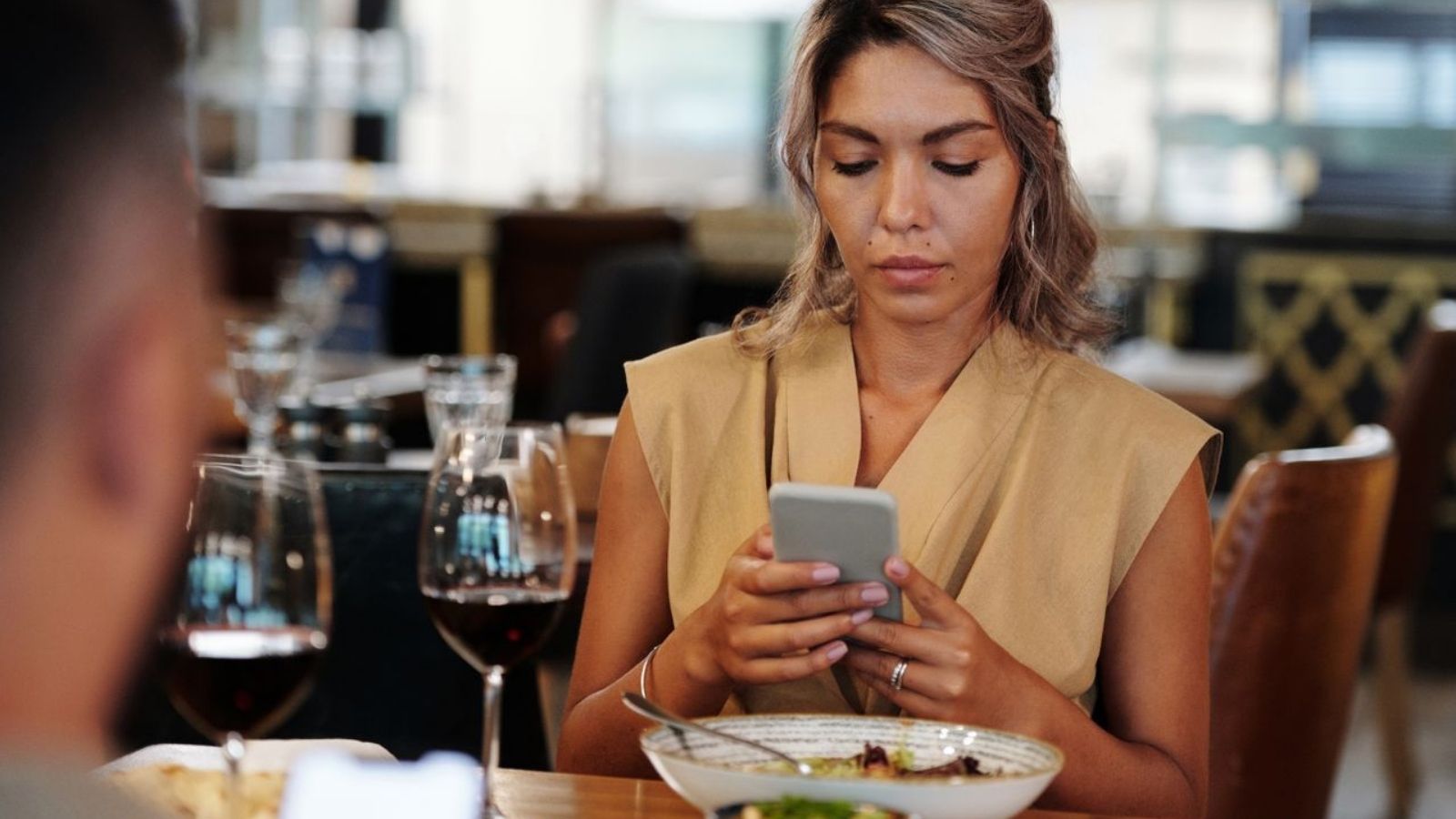
Repeated phone use, video calls, loud notifications, or filming conversations can attract attention not because visitors are unwelcome, but because they change the atmosphere around the table.
In intimate dining rooms, where conversation and the pace of the meal are part of the experience, a glowing screen can stand out more than a foreign accent.
Packs sketchbooks for children abroad specifically to avoid the disruption loud electronics cause in small European restaurants.
Locals eating nearby tend to notice a lit screen or a ringtone before they notice an accent, making it one of the faster ways to be identified as a visitor.
Free refills
American dining habits assume unlimited refills and complimentary tap water, both far less standard abroad. Food Republic reports that European restaurants routinely charge for bottled water and rarely restock a glass without a new order.
Additionally, splitting a bill item by item and waving down a server both register as impatient rather than efficient in much of Europe, where a single tab and a raised hand at the end of the meal remain the norm.
None of these habits reflect bad manners at home. They surface only because they collide with a dining culture built around different assumptions about time, money and attention, one meal at a time.