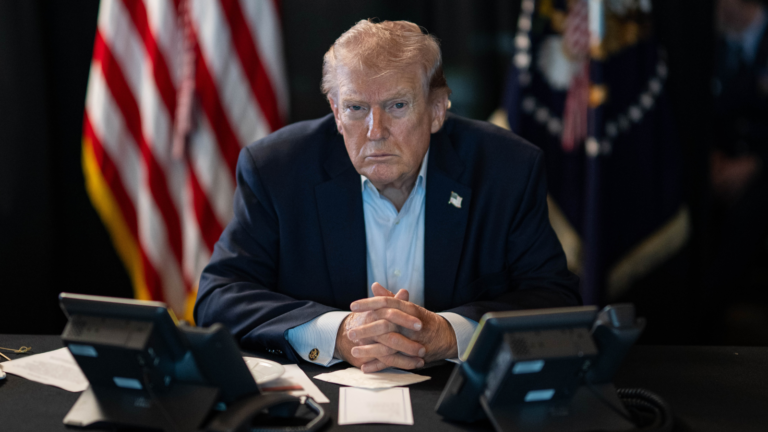
President Donald Trump denied profiting from the presidency after his latest financial disclosure showed his income rose to at least $2.2 billion during his first year back in office, driven heavily by cryptocurrency ventures and licensing revenue.
The 927-page annual filing for 2025 was released by the U.S. Office of Government Ethics, which said the president’s and vice president’s certified disclosure reports are available for public review. The filing has renewed scrutiny of Trump’s business interests, his family’s role in those ventures and the limits of presidential ethics rules.
Crypto Revenue Dominates Filing
Trump’s 2025 income was nearly four times higher than the $622 million he earned in 2024, when he was not president. The increase was largely tied to cryptocurrency, including the Trump-branded $TRUMP coin and a separate crypto business connected to his sons, Donald Trump Jr. and Eric Trump.
The disclosure included $635 million in royalties from Celebration Coins, the entity described in the source material as linked to $TRUMP. It also listed more than $500 million from World Liberty Financial, a cryptocurrency business associated with Trump’s family.
Trump’s crypto-related income exceeded $1.4 billion, making digital assets the central feature of the disclosure. The filing also listed crypto wallet holdings, business entities, royalties, and other investment income across hundreds of pages.
Trump Rejects Profiteering Claims
Trump denied that his finances create a conflict with his public duties. He told reporters that he does not manage his personal finances directly and that investment funds manage them for him.
“I don’t get involved in my personal finances,” Trump said. “We have funds that run my money.”
He added that he made substantial money before returning to the White House and said he does not speak with those managing his investments. His comments were aimed at pushing back against claims that his political position and private income now overlap.
The White House also rejected the criticism. Deputy press secretary Anna Kelly said neither Trump nor his family has engaged in, or would engage in, conflicts of interest.
Ethics Experts Flag Conflict Concerns
The disclosure prompted criticism from ethics experts and presidential historians. Richard Painter, a former chief White House ethics lawyer under George W. Bush, called it a conflict after reviewing the reported income.
Barbara Perry, a presidential historian at the University of Virginia’s Miller Center, said the scale and nature of the income had no clear modern precedent. She said past presidents generally avoided making large private gains while in office because of ethical concerns, even when the conduct was not illegal.
The concern is not limited to the size of Trump’s earnings. It centers on the source of that income.
Cryptocurrency is regulated through federal policy, enforcement decisions, and agency oversight. A president whose family-linked ventures earn large sums from digital assets can face scrutiny when his administration also shapes the rules for that market.
Family Management Does Not End Debate
Trump transferred control of the Trump Organization to his sons before taking office, as he did during his first term. The company has said Trump is not involved in day-to-day operations while serving as president.
Eric Trump has said the company will follow strong ethical standards during his father’s presidency. Supporters argue that the arrangement creates separation between Trump’s official duties and his private business empire.
Critics say family control is not the same as a blind trust. A traditional blind trust places assets under independent management and limits the officeholder’s knowledge or control over specific financial decisions.
That distinction is central to the renewed debate. Trump may not manage daily operations, but he still benefits financially from business structures tied to his name and family.
Blind Trust Norms Return
Modern presidents have often used blind trusts or other distancing measures to reduce concerns about conflicts of interest. Those tools are designed to prevent public officials from making decisions that could affect their personal wealth.
The presidency has unusual legal treatment under federal conflict rules. Presidents are not subject to every restriction that applies to other executive branch officials, leaving ethics norms to carry much of the burden.
Watchdog groups have long argued that the law should be tightened. Proposed reforms have included stricter rules on presidential conflicts, divestment, and independent management of private assets. The problem has become sharper as presidential business interests have expanded beyond traditional investments.
The Brennan Center has described the exemption for presidents and vice presidents as a weakness in federal ethics law, arguing that reform should address presidential financial conflict rules directly.
Crypto Raises New Questions
Trump’s latest filing moves the ethics fight into newer territory. Real estate, hotels, and licensing deals have followed him for decades. Cryptocurrency adds speed, volatility, and regulatory dependence.
A branded digital coin can rise or fall quickly based on attention, investor demand, and policy signals. A crypto company can gain value when regulators take a friendlier approach toward the industry.
That creates a different kind of risk for public trust. A president’s words and policies can influence markets. If those markets are connected to the president’s private income, the appearance of conflict becomes difficult to ignore.
The filing does not prove illegal conduct. It does show that Trump’s income from digital assets expanded dramatically during the same period he returned to federal power.
Real Estate And Royalties Continue
Trump’s older business lines remain active. The disclosure and source material describe continuing income from royalties, licensing arrangements, and business holdings.
Those revenue streams are familiar parts of Trump’s financial profile. But they now sit beside cryptocurrency earnings that appear to have overtaken traditional real estate as the most politically sensitive portion of his reported income.
The Celebration Coins royalty figure alone exceeded $600 million. That amount was larger than many past annual totals associated with Trump’s broader business operations.
The disclosure also showed the scale of the president’s financial network. Hundreds of pages list entities, holdings, and income categories, making it difficult for the public to assess the full picture quickly.
No federal agency has announced a legal finding that Trump violated ethics law in connection with the 2025 disclosure. The filing is a public transparency document, not an enforcement action.
Trump continues to deny wrongdoing. The White House says the president and his family have not engaged in conflicts of interest.
The Office of Government Ethics has made the annual disclosure public, and further scrutiny is likely to come from watchdog groups, congressional critics, and ethics specialists who will review the full filing. The central question now is whether existing presidential ethics standards can address a business empire increasingly powered by crypto, licensing and family-controlled ventures.