A quiet residential street in Stade, a northern German town west of Hamburg, became the center of a national tragedy after a gunman opened fire inside a youth welfare facility, killing six adults and leaving several others injured. The attack, which unfolded Monday at a mother-and-child support center on Dankersstrasse, has shocked Germany not only because of the number of victims, but because of where it happened: a protected space designed for pregnant women, young mothers and children.
Police said the suspected shooter was arrested after the attack, and investigators are treating the case as an act of extreme violence apparently linked to a custody dispute involving a three-month-old baby. The child and the child’s mother survived unharmed, officials said, while the victims were employees of the facility or affiliated youth services.
What Happened in the Stade Youth Welfare Facility Shooting
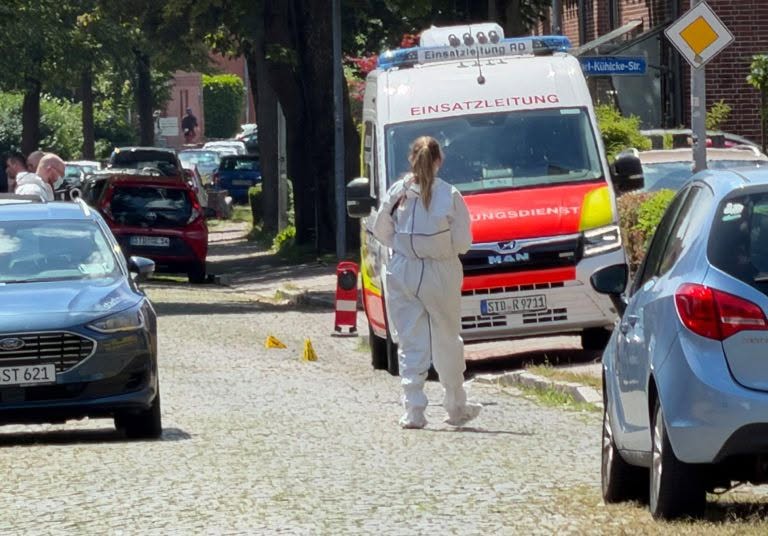
The shooting took place around midday Monday in Stade, a town of about 50,000 people located roughly 25 to 30 miles west of Hamburg. Emergency calls brought a large police and medical response to Dankersstrasse, where officers found multiple people dead inside the building. Five victims died at the scene, and a sixth later died at a hospital.
The facility where the attack occurred provides temporary accommodation and support for vulnerable mothers, pregnant women, and children. That detail has made the case especially disturbing for many Germans, because the building was not a public square, nightclub, or commercial space. It was part of the social care system, the kind of place where families already under pressure are supposed to find protection, structure, and professional help.
Police said the victims were adults. Later updates from German outlets identified the dead as four women and two men, all connected to the center or youth welfare work. Several other people were wounded, some seriously, though authorities had not released a precise final injury count in the immediate aftermath.
Suspected Gunman Arrested After Fleeing the Scene
The suspected shooter was arrested shortly after the attack. German investigators said he is a 45-year-old man from the Hanover area who had gone to the facility for a meeting connected to custody arrangements for his infant daughter. Police said he had no firearms permit, and the weapon used in the attack was seized.
After the shooting, the suspect reportedly fled in a vehicle driven by a woman believed to have close ties to his family. Police stopped the vehicle, and both the suspected gunman and the driver were taken into custody. Officers also placed another person under police measures as investigators worked to determine whether anyone else had a role in the attack.
Officials stressed that there was no ongoing danger to the public once the suspect was detained. Still, the scene remained heavily secured for hours as forensic teams, emergency workers, and investigators moved through the residential area.
Custody Dispute Emerges as Central Line of Investigation
The most important question now is motive. Authorities have pointed to a custody dispute as the likely background of the shooting, while also warning that the investigation remains active. Lower Saxony Interior Minister Daniela Behrens described the attack as an extremely violent, cold-blooded crime, apparently connected to a family custody matter.
Police said the suspect had an appointment at the facility to discuss the future custody situation of his three-month-old daughter. The child and the child’s mother were living at the center and were not physically harmed during the attack. Investigators are now reconstructing how the meeting turned into a deadly shooting and whether warning signs were missed before the confrontation.
That custody element gives the case a painful social dimension. Youth welfare workers often operate at the tense intersection of family breakdown, child protection, legal orders, and emotional crisis. They are expected to protect children, guide parents, document risk, and sometimes enforce decisions that deeply upset adults involved. In Stade, police believe that a fragile environment became the setting for catastrophic violence.
Why the Location Makes the Stade Shooting Especially Shocking
This was not just a shooting in a German town. It was a shooting inside a youth welfare facility, a place tied to child protection, family assistance, and supervised care. The center reportedly housed mothers and young children who needed structured support. For many readers, that changes the story’s emotional weight.
When violence enters a shelter or family support center, it strikes at a public promise: that vulnerable people can be protected when private life becomes unsafe. The people killed were not random bystanders in a crowded street. They were workers connected to the very system designed to help families through crisis.
That is why the Stade attack may quickly become part of a broader German conversation about workplace safety in social services. Youth welfare employees, domestic violence support workers, child protection officers, and family court professionals often face volatile situations. Most do their work quietly, far from national attention. This tragedy has forced that hidden risk into the open.
Germany’s Gun Laws and the Rarity of Mass Shootings
Germany has stricter gun ownership laws than many countries, especially compared with the United States. Legal gun ownership generally requires licensing, background checks, proof of reliability, and a recognized need. Some applicants face additional psychological screening requirements.
That does not mean Germany is immune to gun violence. The country has seen deadly shootings before, including attacks that have led to recurring debates over firearms access, extremism, mental health, domestic violence and public safety. But mass shootings remain relatively rare in Germany, which is one reason the Stade attack has drawn such intense national attention.
In this case, the suspected shooter reportedly did not have authorization to carry a firearm. That will make the weapon’s origin a key part of the investigation. Police will need to determine how he obtained it, whether anyone helped him, whether the weapon had been used before, and whether authorities had any prior opportunity to intervene.
Community in Shock After Deadly Attack Near Hamburg
Stade is not the kind of place normally associated with mass violence. The town sits in Lower Saxony, close enough to Hamburg to be part of the wider regional orbit, but still small enough for a deadly event like this to feel deeply personal. Residents described hearing shots and then seeing the neighborhood rapidly sealed off by police.
Video from the scene showed emergency vehicles, cordons, ambulances, and police units lining the residential street. Schools and nearby facilities were checked, and authorities said there was no wider danger after the arrest. Still, the psychological impact will likely last much longer than the police operation.
For the families of the victims, the center’s staff, the mothers and children living there, and the wider Stade community, the attack has turned an ordinary Monday into a day of grief. Political leaders in Lower Saxony expressed condolences, while investigators asked the public to avoid spreading rumors and to submit any relevant photos, videos, or witness information through official channels.
The Victims Were Doing Difficult Public-Facing Work
One of the most painful details is that the dead were reportedly connected to the facility or youth welfare services. These were people whose work brought them into close contact with families under stress. Their jobs likely involved case discussions, safety planning, documentation, counseling, supervision, and coordination with public agencies.
We often discuss social workers and youth welfare staff only when systems fail. We rarely discuss the emotional and physical risks attached to their work. They meet people during custody fights, domestic conflict, addiction problems, mental health crises, housing instability, and family breakdown. Many of these meetings end peacefully. Some are tense. A very small number become dangerous.
The Stade shooting has now raised an unavoidable question: how can welfare facilities remain welcoming and humane while also protecting staff and residents from violent escalation? The answer will not be simple. Turning every family support center into a fortress could make vulnerable mothers and children feel punished. Leaving workers exposed to high-risk meetings without stronger safeguards is also unacceptable.
Key Questions Investigators Must Answer
The investigation is now focused on the exact chain of events. Police must determine what happened before the shots were fired, who was present in the room, how the suspect entered with a weapon, whether the custody meeting had been flagged as high-risk, and whether any threats had been made beforehand.
Authorities will also examine the suspect’s background, his relationship with the child’s mother, the legal custody situation, the role of the driver, the source of the firearm and whether the suspect acted alone. German investigators have also pushed back against speculation, saying the evidence so far points toward a family-related dispute rather than a political motive.
Those questions matter because the public will want more than a death toll. People will want to know whether the attack was preventable. They will want to know whether youth welfare workers had enough protection. They will want to know whether Germany’s firearm controls failed at a specific point or whether the weapon moved through illegal channels completely outside the licensing system.
A Rare German Shooting With a Deep Social Wound
The Stade shooting is devastating because it combines several layers of public fear: gun violence, family conflict, child welfare, workplace safety, and the vulnerability of mothers and babies under state-supported care. Six adults are dead. Several others are injured. A three-month-old child is now tied to a tragedy she is too young to understand.
As the investigation continues, the story should not be reduced to the shock value of a mass shooting in a quiet German town. At its center are workers who were killed while doing difficult social care work, a facility meant to protect vulnerable families, and a custody dispute that police believe may have spiraled into lethal violence.
Germany will now grieve, investigate, and ask hard questions. Stade will have to live with the memory of a day when a place built for safety became the scene of one of the country’s most disturbing recent acts of gun violence.