If America’s political mood had a dashboard light, this one would be flashing. Rasmussen’s newest national survey finds that just 34% of likely voters believe the United States is heading in the right direction. The measurement covers the week ending August 6, 2026.
That number has slipped for two consecutive releases. The right-direction share was 36% the previous week and 38% two weeks earlier.
Before anyone declares a political emergency, however, there is an important reality check. Rasmussen recorded 33% in early July, so 34% is not even the lowest reading of the summer. Polls bounce around, and a few points of movement should never be treated like millions of voters suddenly changed their minds overnight.
Another detail matters. Rasmussen’s publicly available August 10 page gives the 34% right-direction number, but the exact wrong-track figure remains undisclosed on the free portion of the release. That means it would be inaccurate to subtract 34 from 100 and declare that 66% answered “wrong track.”
So what does 34% really tell us? By itself, only that roughly one-third of Rasmussen’s likely voters gave a positive answer about America’s direction. But other recent surveys provide a much wider view of the mood surrounding that number.
The Economy Is Giving Voters Plenty to Argue About
Money is never far from politics, and several recent polls show that Americans are not exactly dancing through the grocery aisle.
One nationwide poll conducted from July 29 through August 3 found that 37% favored the Democrats as the party with the better approach to the economy, compared with 36% favoring the Republicans. Another 27% either chose another party or were unsure.
That one-point difference is tiny. What makes it notable is the historical shift within that particular polling series: Republicans had generally held an advantage on the economy for years before the gap gradually disappeared. The survey included 4,505 U.S. adults and carried a two-percentage-point margin of error.
The same poll found Trump approval hit 35%, down from 37% in the previous measurement. In a congressional ballot question, 42% backed Democratic candidates, compared with 37% backing Republican candidates.
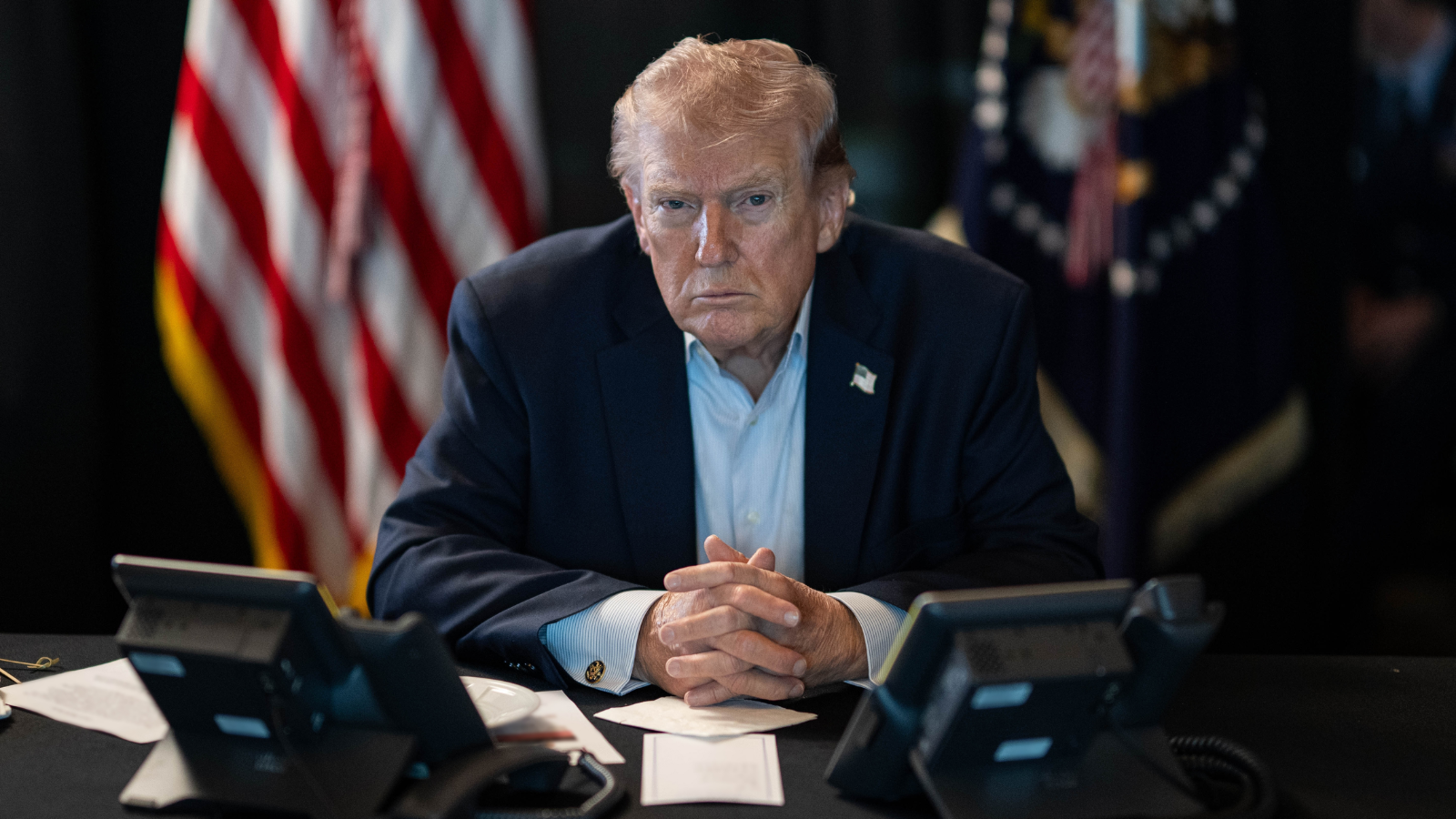
President Donald Trump has pushed back against unfavorable polling. On August 3, before that survey was released, he wrote on Truth Social: “My REAL Polling Numbers, not those made up by the Fake News Media, are the best they have ever been.”
That is Trump’s view of the polling environment. It does not change what the surveys measured, just as the surveys themselves cannot guarantee what voters will eventually do in November.
Economic unease also appears in another national survey conducted July 1 through July 19. Although economic confidence improved somewhat from May, 67% saw the economy worsening, compared with 28% who thought conditions were getting better. Only 22% rated the economy positively as excellent or good, while 44% described conditions as poor.
None of those findings proves that economic frustration caused Rasmussen’s 34% result. They do show that the right-direction number arrived during a period when several independent surveys were detecting significant economic dissatisfaction.
Gas Prices and the Iran War Add Another Layer
The national mood is not being shaped by pocketbook issues alone. A separate July 23-27 survey of 1,165 adults found that only 33% believed the war with Iran had been worth fighting, while 64% said it had not. The poll carried a margin of sampling error of plus or minus 3.7 percentage points.
Partisans saw the conflict very differently. Sixty-one percent of Republicans considered the war worthwhile, compared with just 10% of Democrats. Roughly three in ten adults approved of Trump’s handling of Iran. But one issue produced a more practical concern: gasoline.
Forty percent of Americans called gas costs stressful at the “major” level, compared with 27% doing so in February before the war began. Another 39% in the July survey called gasoline costs a minor source of stress.
A different July survey paints a similar picture of household concerns. Among U.S. adults, 66% worried about goods at the “very concerned” level when asked about food and consumer prices. Another 64% worried about housing, while 60% expressed the same level of concern about gasoline and energy costs.
The partisan breakdown is especially interesting because concern does not disappear simply because a voter wears a red or blue political jersey. Fifty-five percent of Republicans and Republican-leaning independents were very concerned about food and consumer-goods prices, compared with 75% of Democrats and Democratic leaners. On housing, the split was 52% to 73%.
Again, those numbers should not be shoved into Rasmussen’s survey as an explanation Rasmussen itself did not provide. But together they show why a broad question about America’s direction lands in a complicated political environment.
The 34% Number Is a Warning Light, Not an Election Forecast.
This is where polling stories can go off the rails. A country-direction poll is not the same as a presidential approval poll, an economic confidence survey, a generic congressional ballot or a question about war. Each measures something different.
Even the populations being surveyed vary. Rasmussen’s headline number concerns likely voters. Some of the other surveys involve all U.S. adults or registered voters. Different organizations also use different sampling, weighting, and interviewing methods.
That means the responsible way to read these numbers is together but not interchangeably.
One survey says just 34% of likely voters believe the country is heading in the right direction. Another shows economic confidence remains negative. Another finds gasoline expenses are causing stress. Another shows voters nearly evenly divided over which party they trust more on the economy.
Put together, they describe an electorate with plenty on its mind. They do not tell us exactly who will be punished for it.
There is also evidence that pessimism and optimism can exist at the same time. In July, only 23% expected economic improvement over the next year, while 36% expected conditions to worsen and 40% thought they would remain about the same.
Yet economic confidence had actually improved modestly from May to July in another survey, even though it remained firmly negative overall.
That is American public opinion in a nutshell: complicated, occasionally contradictory and rarely willing to fit neatly into a campaign slogan. The safest conclusion from Rasmussen’s latest number is therefore not that Democrats are winning, Republicans are doomed, or voters have collectively turned against one person.
It is much simpler. Only about one in three likely voters in Rasmussen’s latest measurement says America is heading in the right direction. Several independent surveys taken around the same period also find substantial concern about the economy, household costs, gasoline prices and the Iran conflict.
With the November 3 midterms approaching, both parties have reasons to study those numbers carefully. But the voters still get the final word.