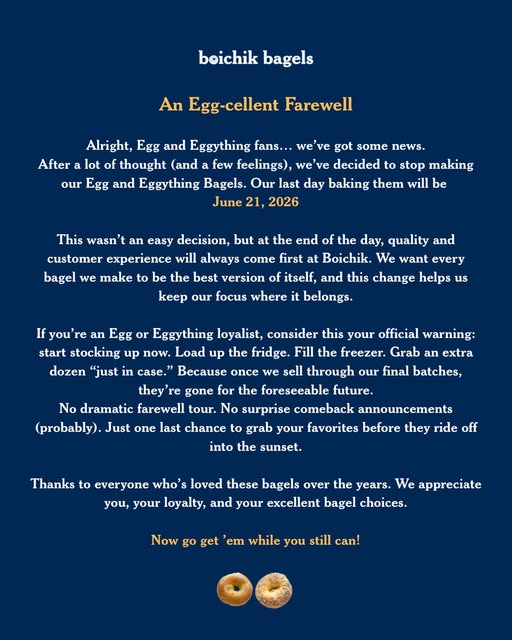
Boichik Bagels, one of the Bay Area’s most talked-about bagel chains, is making a menu change that has landed with real emotional force among loyal customers. The Berkeley-born bagel brand is ending production of its Egg and Eggything bagels, with the final day set for June 21, 2026. For casual customers, this may sound like a small menu adjustment. For Boichik regulars, it feels closer to the disappearance of a favorite ritual.
We are not just talking about another flavor leaving a bakery case. Egg bagels carry a particular kind of nostalgia. They are softer, richer, gently yellow, and tied to a more old-school Jewish deli tradition than the louder, crunchier everything bagel that dominates many modern shops. Boichik’s Eggything bagel made that tradition even more personal by combining the richness of an egg bagel with the savory punch of everything-style seasoning. For many customers, it was not simply a bagel. It was the order.
Why Boichik Bagels Is Removing Egg and Eggything Bagels
The change comes after a federal health inspection at Boichik’s West Berkeley factory, where the company produces bagels for its expanding retail and wholesale business. The issue centers on eggs, which are classified as a major food allergen. Once a bakery uses egg dough on shared equipment, the business must be able to control allergen cross-contact with the level of separation and sanitation that can be difficult to maintain in an artisanal production system.
That is where Boichik’s problem becomes more complicated than a simple recipe decision. The company does not make bagels in a tiny corner bakery anymore. It operates with a larger production setup, including customized machinery and a process built around boiling, baking, boards, baskets, kettles, ovens, and shared handling surfaces. Egg dough can touch far more than a mixing bowl. It can move through the same production flow as other bagels, including products expected not to contain eggs.
For a bakery selling through both retail shops and wholesale channels, this creates a serious compliance challenge. Boichik would need to either fully separate egg-containing production or clean and disinfect equipment in a way that fits federal food safety expectations. In a high-volume bagel operation built around custom production equipment, that is not a quick wipe-down problem. It can require a separate line, separate tools, separate handling space, separate labor, and a separate rhythm.
Why Egg Bagels Are Such a Big Deal in the Bay Area
Egg bagels are not everywhere in San Francisco and the broader Bay Area. Many popular bagel shops lean into plain, sesame, poppy, salt, onion, garlic, pumpernickel, cinnamon raisin, or everything-style bagels, but egg bagels are less common. That scarcity helps explain why Boichik’s decision feels bigger than one bakery removing two items.
When a flavor is rare, customers treat it differently. It becomes a reason to choose one shop over another. It becomes the thing someone tells a friend to order. It becomes the item people freeze, stockpile, or plan a weekend errand around. For Boichik fans who have built a habit around Egg or Eggything, the loss is both practical and emotional.
The Bay Area’s bagel scene has become much more competitive over the last several years, with local bakeries, New York-style specialists, deli-inspired shops, and fast-growing chains all fighting for attention. In that crowded field, signature flavors matter. A plain bagel proves technique, but a cult flavor builds loyalty. Eggything did that for Boichik.
The Real Story Is About Growth, Not Just Bagels
This menu change also tells a larger story about what happens when a beloved local food business grows. Boichik began with the kind of origin story customers love: a founder chasing the memory of a New York-area bagel and trying to bring that standard to California. The brand then grew into a regional name with multiple Bay Area shops, Los Angeles locations, nationwide shipping, grocery access, catering, and wholesale ambitions.
Growth creates opportunity, but it also changes the rules. A bakery serving walk-in customers from a single shop faces one kind of operational pressure. A bakery producing at scale for several locations and wholesale distribution faces another. The bigger the business gets, the more its food safety systems, allergen controls, labeling practices, and production design matter.
That is the uncomfortable reality behind the farewell. Boichik is not dropping Egg and Eggything because customers stopped caring. The opposite appears to be true. The flavors had passionate support. The problem is that customer love does not erase regulatory complexity. A flavor can be popular and still become too difficult to produce safely, legally, and efficiently inside a larger operation.
Why Federal Allergen Rules Matter for Bakeries
Eggs are one of the major allergens recognized under U.S. food labeling and manufacturing rules. For people with egg allergies, accidental exposure is not a minor inconvenience. Food allergic reactions can range from mild symptoms to severe reactions, including anaphylaxis. That is why allergen management is treated as a serious manufacturing issue, especially when packaged or wholesale products are involved.
In a bakery, allergen cross-contact can happen in many ways. Dough can pass through shared equipment. Trays and boards can touch multiple products. Flour dust, residue, wash water, utensils, racks, and workers’ gloves can all become part of the risk chain. Even when a business is careful, regulators need to see controls that are consistent, documented, and effective.
For Boichik, the challenge appears to be the gap between an old-school bagel process and the expectations of modern allergen control. Bagels are mixed, shaped, proofed, boiled, baked, moved, stacked, and sold. When one dough contains egg, and another does not, every shared step becomes a question.
What Customers Should Know Before June 21
Customers who love Boichik’s Egg and Eggything bagels have a narrow window to buy them before they disappear for the foreseeable future. The company has encouraged fans to stock up, which makes sense because bagels freeze well when stored properly. For loyalists, the smartest move is simple: buy early, freeze what you can, and do not assume the final day will feel normal.
When beloved menu items are discontinued, demand often spikes in the final days. Customers who wait until the last morning may face sold-out shelves, longer lines, or limited availability at certain locations. Since Boichik operates across multiple shops, local supply can vary. A customer in Berkeley may have a different experience than someone ordering in San Francisco, Palo Alto, Concord, Larkspur, Santa Clara, Los Gatos, or Los Angeles.
The key point is that this is not a quiet phaseout. Fans know. The deadline is public. The emotional reaction is already part of the story. That usually means the last batches will not sit around.
Boichik’s Expansion Makes the Decision Even More Painful
Boichik has built a footprint that now stretches beyond its Berkeley roots. The brand lists shops in Berkeley, Larkspur, Palo Alto, Santa Clara, San Francisco, Los Gatos, Concord, Los Feliz, and Downtown Los Angeles. That kind of growth proves the strength of the brand, but it also makes any menu change more visible.
A small shop can quietly test, pause, or remove a product. A regional chain has a larger customer base ready to notice. Every flavor has its own following. Every change becomes content. Every announcement can turn into a wave of comments, jokes, complaints, and emotional farewell posts.
That is why this moment matters for the Bay Area food scene. It shows how deeply customers attach themselves to specific local foods. People do not react this strongly to ordinary products. They react when something becomes part of their routine, their identity, or their weekend.
The Eggything Bagel Became a Signature Flavor
The Eggything bagel worked because it combined two powerful cravings. It had the richer, softer character of an egg bagel, but it also carried the seasoning-heavy appeal of an everything bagel. That made it feel familiar and unusual at the same time.
For traditionalists, it nodded toward deli nostalgia. For modern bagel fans, it had enough flavor to stand out in a crowded case. For sandwich lovers, it gave eggs, cheese, smoked fish, or cream cheese a stronger foundation. It was not the safest item on the menu, and that may be exactly why people loved it.
In food culture, the most mourned items are often the ones that feel slightly irreplaceable. A plain bagel can be found elsewhere. A sesame bagel can be compared across shops. But a specific shop’s Eggything bagel carries the fingerprints of that brand’s dough, boil, bake, seasoning, and fan memory. Once it is gone, there is no exact substitute.
The Business Choice Behind the Emotional Reaction
From a business standpoint, the decision is understandable. If Egg and Eggything bagels represent less than a dominant share of production, building an entirely separate allergen-safe process may not make financial sense. A separate line could mean more space, labor, equipment, cleaning validation, supervision, and complexity.
That does not make customers less disappointed. It simply explains the pressure behind the decision. Boichik has to protect the whole business, not only one beloved flavor. If the company wants to keep producing at scale, it must choose systems that work for every store, every wholesale partner, every label, and every customer.
That is the tension at the center of the story: the flavor people love may be exactly the kind of product that becomes hardest to keep as a bakery grows.
Could Egg and Eggything Bagels Come Back?
The door does not appear completely closed, but fans should treat the farewell as real. A comeback would likely require a production solution that satisfies allergen-control requirements without damaging the company’s workflow or economics. That could mean a separate production line, a dedicated egg-bagel schedule, a different facility setup, or another system that makes cleaning and separation more workable.
Still, “possible” is not the same as “planned.” For now, the practical message is that Egg and Eggything bagels are leaving. Anyone who wants one last dozen should act before the deadline.
What This Says About the Bay Area Bagel Boom
The Bay Area has spent years arguing about whether California can make bagels that deserve to be mentioned in the same breath as New York. Boichik has been central to that conversation. Its rise helped prove that a serious West Coast bagel culture could exist without apology.
Now, the Egg and Eggything farewell adds a new chapter. It shows that the region’s bagel scene has matured past novelty. These shops are no longer just cute local bakeries with long lines. They are food businesses navigating scale, regulation, supply chains, machinery, wholesale growth, and loyal customers who notice every change.
That is what makes the story compelling. The heartbreak is not only about eggs. It is about the price of becoming big enough for regulators, wholesalers, and customers to expect more from you.
The Bottom Line for Boichik Fans
Boichik Bagels is removing Egg and Eggything bagels after June 21, 2026, and customers who love those flavors should not wait until the final hours to buy them. The decision appears rooted in allergen-control realities tied to egg-containing dough and shared production equipment, not a lack of demand.