A decades-old diplomatic failure has returned to the center of the Israeli-Palestinian debate.
Video clips of former President Bill Clinton discussing his unsuccessful attempt to broker peace in 2000 are again circulating online. Supporters of Israel say his account proves Palestinian leaders repeatedly rejected opportunities to establish an independent state. Palestinian advocates counter that the proposals contained serious problems involving borders, refugees, settlements and sovereignty.
Both sides draw from real history. However, that history is often compressed into a simple claim that one side offered peace and the other walked away.
Clinton placed responsibility on Arafat

During a 2024 campaign appearance in Michigan, Clinton revisited his negotiations with Palestinian leader Yasser Arafat and Israeli Prime Minister Ehud Barak.
“The only time Yasser Arafat didn’t tell me the truth” was when Arafat promised to accept the proposed agreement, Clinton told the audience. He said the framework would have created a Palestinian state covering 96% of the West Bank, with additional Israeli territory transferred through a land swap.
Clinton also said Palestinians would have received a capital in East Jerusalem and authority in portions of Jerusalem’s Old City. According to his account, Barak and the Israeli Cabinet approved the proposal, but the Palestinian side refused it.
That version supports an argument often made by pro-Israel conservatives: Palestinian leaders have repeatedly rejected territorial compromises because some factions oppose Israel’s continued existence.
Clinton went further by suggesting Hamas did not genuinely want Palestinian statehood. However, Hamas did not negotiate at Camp David. The Palestinian delegation was led by Arafat, who headed the Palestine Liberation Organization and the Palestinian Authority. Clinton’s reference to Hamas connected the failed negotiations with the group’s later rise and its continuing conflict with Israel.
Camp David was not one completed written offer
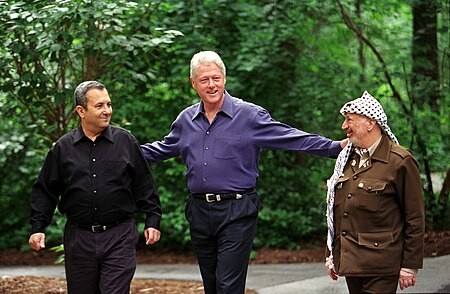
The Camp David summit took place from July 11 to July 25, 2000. Clinton brought Arafat and Barak together for intensive negotiations over borders, Israeli settlements, Jerusalem, Palestinian refugees, security arrangements and the creation of a Palestinian state.
When the summit ended, Clinton announced that the parties had failed to reach an agreement. He praised Barak for taking politically difficult steps but stopped short of describing the outcome as a simple Palestinian rejection.
Clinton said both leaders remained committed to peace and emphasized that the negotiations had addressed permanent-status questions more directly than previous talks. “They will not be able to reach an agreement at this time,” he said, leaving open the possibility of continued diplomacy.
The detailed figures now commonly associated with “the Camp David offer” largely came from the Clinton Parameters, presented on December 23, 2000, five months after the summit.
Those parameters proposed a Palestinian state covering approximately 94% to 96% of the West Bank. Israel would annex settlement blocs containing about 80% of Israeli settlers, while Palestinians would receive a land swap of approximately 1% to 3%. Arab neighborhoods in Jerusalem would become Palestinian, while Jewish neighborhoods would remain Israeli.
The proposal also contemplated Palestinian sovereignty over Haram al-Sharif, Israeli sovereignty over the Western Wall and restrictions on the return of Palestinian refugees to Israel. Israel would temporarily retain military positions and early-warning facilities in parts of the future Palestinian state.
Why historians still disagree over the rejection
Palestinian negotiators did not simply say they opposed statehood. Their written response raised concerns about the absence of a final map, the value and location of exchanged land, territorial continuity, Israeli military access and the treatment of millions of Palestinian refugees.
They argued that undefined settlement blocs could divide Palestinian territory and that Israel’s security demands would weaken the sovereignty of the proposed state. They also objected to any settlement that did not recognize a meaningful right of return for refugees.
Israel and the Palestinians eventually accepted Clinton’s parameters as a basis for further talks, but both attached reservations. That was not the same as signing a final peace agreement.
Negotiations continued at Taba, Egypt, in January 2001. In their official joint statement, both delegations said they had “never been closer to reaching an agreement.” They reported substantial progress on borders, Jerusalem, refugees and security, but said political and time pressures prevented a final settlement.
Barak soon lost Israel’s election to Ariel Sharon. Violence from the Second Intifada intensified, trust collapsed, and the negotiations were never completed.
Clinton’s frustration with Arafat was genuine, and the Palestinian leadership undeniably failed to secure an agreement during a rare diplomatic opening. Yet the record also shows that the proposed borders, refugee arrangements and security terms remained disputed.
That is why the old Clinton clip continues to travel so quickly. It offers a clear villain and a clear missed opportunity. The historical record offers something less satisfying but more accurate: two peoples came remarkably close to an agreement, yet neither leadership could cross the final and most dangerous political distance.