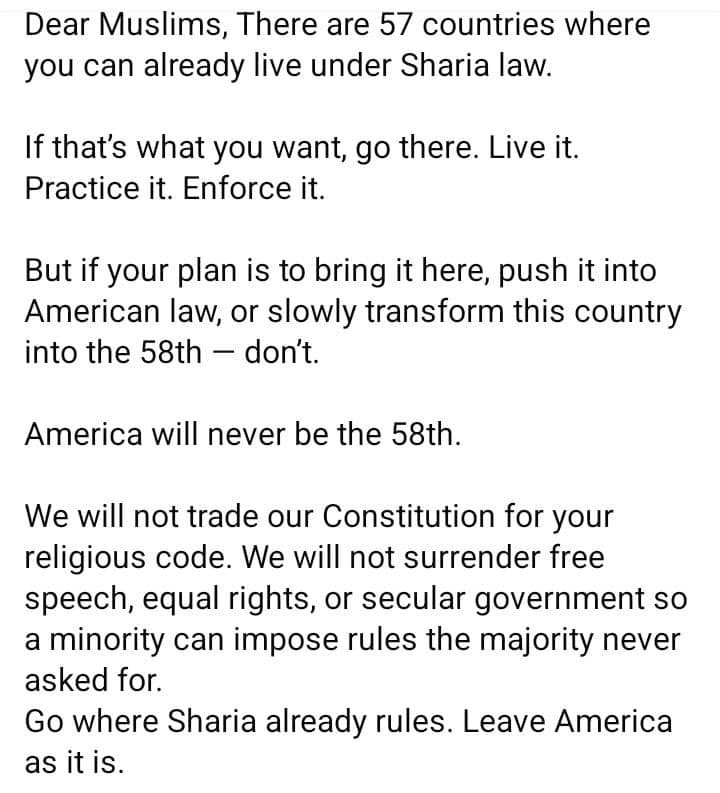
A single sentence shared online can ignite a national debate within hours. That happened after a statement warning Muslims that America would never become the “58th country” under Sharia law spread across social media, sparking arguments about immigration, religion, the Constitution and the future of American identity.
The message behind the viral statement was clear: supporters wanted to emphasize that American law, not religious law, remains the final authority in the United States. But the conversation quickly became more complicated as critics questioned whether the claim accurately described Sharia, Muslim-majority nations and the role of religion in American public life.
The phrase has been linked to Republican Florida Rep. Randy Fine, who used similar language while promoting legislation connected to concerns about religious influence and American law. However, the longer version circulating online, beginning with “Dear Muslims,” has not been independently verified as a direct quote from Fine.
That distinction matters because political debates often move faster than facts. A statement can take on a life of its own online, even when the original source, meaning and context become blurred.
The “57 countries” claim fuels a larger political fight
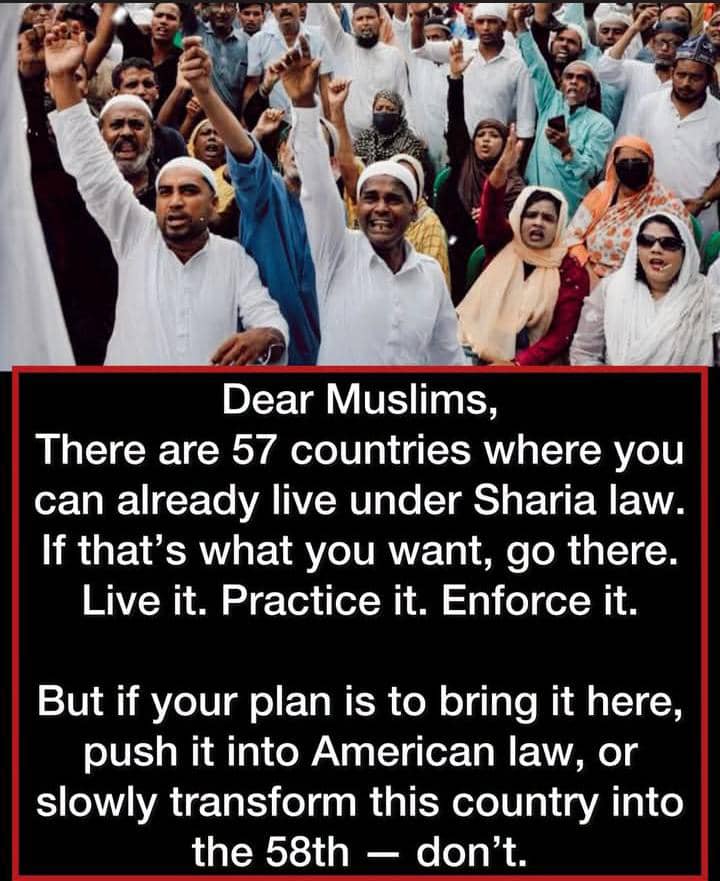
The phrase “57 countries” appears to reference the Organization of Islamic Cooperation, an international body made up of 57 member states. However, membership in the organization does not mean every country follows the same legal system or applies Sharia in the same way.
The countries within the OIC vary widely in government structure, culture, and legal traditions. Some incorporate Islamic principles into parts of their legal systems, while others operate under secular constitutions where religious law has a limited public role.
Sharia is also a broad concept with different interpretations. For many Muslims, it refers to personal religious guidance involving faith, morality, charity, family responsibilities and daily practices. In some countries, governments use parts of Islamic jurisprudence in areas such as family law or criminal law, but there is no single worldwide version of Sharia.
That complexity is often lost during political arguments. Supporters of stronger restrictions argue that any attempt to replace American law with religious law must be rejected. Critics respond that private religious beliefs and practices are already protected under the First Amendment.
The disagreement reflects a much larger American debate about where the line should be drawn between religious freedom and government authority.
Lawmakers say the Constitution remains the ultimate authority
Republican lawmakers who have raised concerns about Sharia law argue that the United States cannot allow competing legal systems to replace constitutional principles.
Rep. Randy Fine highlighted this argument while discussing his proposal known as the “Protecting Puppies from Sharia Act.” The legislation focused on preventing governments from restricting dog ownership and was introduced after controversy surrounding comments about Islamic views on dogs.
Fine argued that American laws must remain based on the Constitution rather than religious rules.
Other Republican lawmakers have also pushed similar arguments. Reps. Keith Self of Texas and Chip Roy of Texas supported the creation of the Sharia-Free America Caucus, arguing that the group was created to defend constitutional law.
Supporters of the caucus say their concern is not about individual Muslims practicing their faith, but about preventing religious doctrines from becoming government authority.
They point to the Constitution’s Supremacy Clause, which establishes federal law and constitutional principles as the highest legal authority in the United States.
Under American law, no religious code can override constitutional protections, criminal statutes or court decisions. Religious beliefs may guide individuals, but they cannot replace the legal system that applies to everyone.
Critics warn against turning religious freedom into a political weapon
Opponents of the Sharia-focused political movement argue that the debate unfairly targets Muslims and creates fears about a threat that does not exist.
Civil rights groups, including the Council on American-Islamic Relations, have argued that American Muslims are protected by the same constitutional rights as followers of other religions.
They maintain that Sharia, for many Muslims, functions similarly to other religious traditions that guide personal behaviour without attempting to control government.
For example, Jewish communities may follow religious dietary laws, and Christian groups may follow faith-based practices. Supporters of religious freedom argue that Muslim Americans should receive the same protections as other religious communities.
Critics also point to previous court cases involving attempts to restrict the consideration of Islamic principles in legal settings. Courts have generally ruled that laws cannot single out one religion for special restrictions while allowing other religious beliefs to receive constitutional protection.
The debate therefore becomes less about whether American law should remain supreme, which is already established, and more about how the country balances national identity with religious liberty.
America’s legal system has already answered the question
The United States Constitution leaves little room for uncertainty about which law governs the country.
The First Amendment protects religious freedom while preventing the government from establishing an official religion. That means the government cannot impose Islamic law, Christian law, Jewish law, or any other religious system as the national legal framework.
At the same time, the government cannot discriminate against citizens simply because of their religious beliefs.
That balance has shaped American law for generations. People are free to follow religious teachings in their personal lives, but public laws are created through the constitutional process rather than religious authority.
The “America will never be the 58th” slogan has become a powerful political message because it taps into concerns about national identity and cultural change. But the reality is more complicated than a viral phrase suggests.
America’s legal system is not designed around replacing one religious system with another. It is built around a Constitution that applies to citizens of every faith and those with no faith at all.
The ongoing debate shows how questions about religion, immigration and identity continue to shape American politics. While disagreements remain intense, the central legal principle has stayed consistent: the Constitution remains the final authority in the United States.