Bill Maher is known for challenging religious beliefs, political movements, and cultural debates on his HBO show Real Time. But during a recent discussion, the comedian turned his attention to a topic that has drawn growing international concern: the deadly violence affecting Christian communities in Nigeria.
Maher, who has often described himself as nonreligious, said he was troubled by what he called the lack of global attention toward attacks on Christians in the country.
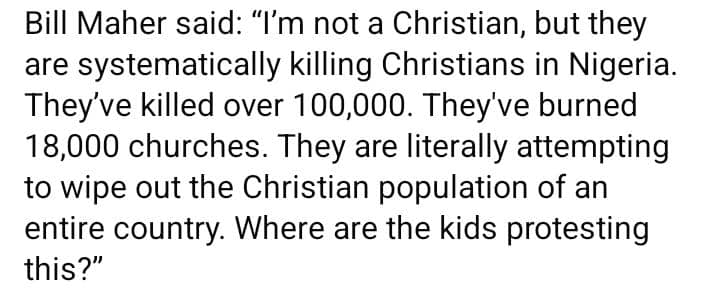
“I’m not a Christian,” Maher said during the discussion. “But they are systematically killing Christians in Nigeria.”
He went on to claim that more than 100,000 Christians had been killed and questioned why the issue had not sparked the same level of public protest seen during other international crises.
“Where are the kids protesting this?” Maher asked, arguing that many activists and media outlets appear to overlook the suffering of Nigerian victims.
His comments quickly spread online, reigniting a larger conversation about religious persecution, media attention and the complicated security crisis unfolding across Africa’s most populous country.
Nigeria’s Christian communities have faced deadly attacks for years.
There is no question that Christians in Nigeria have been victims of horrific violence.
For more than a decade, extremist groups including Boko Haram and Islamic State West Africa Province (ISWAP) have carried out attacks against civilians, churches and communities, particularly in northeastern Nigeria.
Thousands of people have been killed, kidnapped or displaced during the insurgency. Some attacks have specifically targeted Christians because of their religious identity, including the murder of clergy members, attacks on churches and threats against Christian communities.
The United States Commission on International Religious Freedom has repeatedly raised concerns about religious freedom violations in Nigeria. Its reports have documented attacks by extremist groups, criminal gangs and other armed actors that have affected both Christians and Muslims.
The violence has forced millions of Nigerians to flee their homes. Families have abandoned farms, schools have closed, and communities have struggled to rebuild after repeated attacks.
For many victims, the debate over labels does not change their reality. They have lost relatives, homes and livelihoods in a crisis that has continued for years.
However, researchers and international organizations warn that Nigeria’s violence cannot be explained by religion alone.
A complicated crisis involving terrorism, crime and conflict
While some attacks in Nigeria are clearly motivated by religious extremism, the country’s security problems involve several overlapping issues.
In the northeast, groups such as Boko Haram and ISWAP have waged an insurgency against the Nigerian government, attacking civilians and security forces. These groups have used religious ideology to justify violence, including attacks against Christians and moderate Muslims.
In other parts of Nigeria, especially the Middle Belt and northwest regions, violence has also been linked to farmer-herder conflicts, land disputes, criminal kidnapping networks and weak security systems.
Many victims in these conflicts are Christians, particularly in farming communities, but Muslims have also suffered devastating attacks from armed groups.
Security analysts have repeatedly warned against reducing every violent incident in Nigeria to a single religious conflict. The reality is more complicated, with poverty, political instability, criminal networks and competition over resources contributing to the bloodshed.
That complexity has become a major point of discussion following Maher’s remarks.
Supporters of Maher’s comments argue that the suffering of Nigerian Christians deserves more international attention and that religious persecution should not be ignored because the crisis is happening far from Western countries.
Critics, however, say broad claims about the death toll require careful examination because reliable data separating victims by religion is limited.
The debate over the 100,000 figure and the search for accurate answers
The most controversial part of Maher’s comments was his claim that more than 100,000 Christians have been killed in Nigeria.
Various advocacy groups have published high estimates of Christian deaths over many years, but independent researchers have not reached a universally accepted figure confirming that exact number.
The conflict in Nigeria has produced different estimates depending on how researchers count deaths, whether they include indirect deaths from displacement and hunger, and how they classify victims’ religious identities.
The United Nations Development Program has estimated that the Boko Haram conflict caused tens of thousands of direct deaths and hundreds of thousands of additional deaths when indirect effects such as disease and lack of access to services are considered. Those figures include victims from different religious backgrounds.
Human rights organizations have also documented widespread failures by Nigerian authorities to protect civilians and hold attackers accountable.
The Nigerian government has rejected claims that the country is experiencing a coordinated campaign to eliminate Christians. Officials argue that extremist groups and criminal organizations have targeted Nigerians from multiple communities.
Still, critics say the government has failed to do enough to stop repeated attacks and protect vulnerable populations.
The reality is that Nigeria faces a serious humanitarian and security crisis. Christians have suffered targeted persecution, and many communities have endured unimaginable loss. At the same time, Muslims and other Nigerians have also been victims of the same violent groups.
Maher’s question about why the crisis receives limited attention has become part of a wider discussion about which global tragedies receive public outrage and which ones are overlooked.
The challenge now is separating political arguments from the facts on the ground. Nigeria’s victims deserve attention, accurate reporting and meaningful action, regardless of their faith.
The suffering is real. The need for solutions is even greater.