We are witnessing a major shift in how America’s allies deal with President Donald Trump. For years, many foreign leaders treated his public insults, sudden demands, and unpredictable negotiating style as a cost of doing business with Washington. They smiled for cameras, avoided open confrontation, and tried to protect their own national interests behind closed doors.
That approach, however, is beginning to crack.
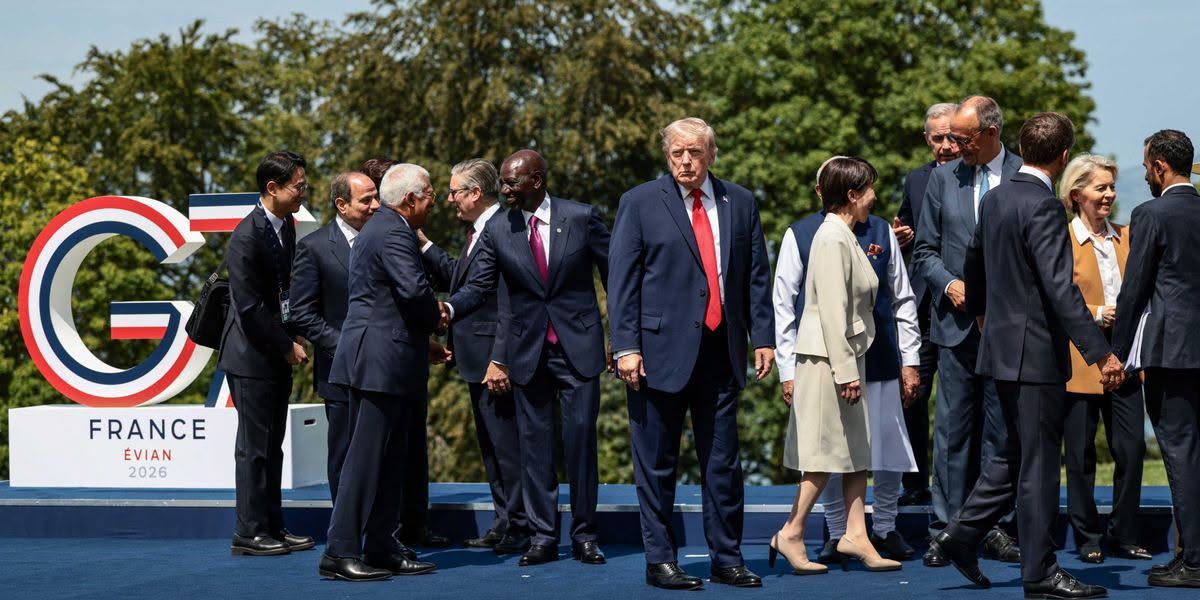
The latest flashpoint came after Trump claimed that Italian Prime Minister Giorgia Meloni had begged him for a photo during the recent G7 summit. Meloni could have ignored the remark. She could have issued a flat denial through an aide. Instead, she responded directly and publicly, rejecting the claim as false and making clear that neither she nor Italy bows for approval.
That moment mattered because Meloni is not a natural enemy of Trump. She is a conservative leader who has often shared political space with the broader nationalist right. If even Meloni feels compelled to push back in public, we should take that as a deeper message: the old alliance habit of quietly absorbing Trump’s theatrics is losing its usefulness.
Giorgia Meloni’s Rejection Was About More Than a Photo
The dispute over a photo may sound petty at first glance. But in diplomacy, symbols are never small. A photograph between leaders is not only a souvenir. It is a signal of status, trust, legitimacy, and political alignment.
Trump’s claim placed Meloni in a position of public humiliation. It suggested she needed his image to strengthen her own. For a sitting prime minister, especially one who built her brand on national dignity and Italian sovereignty, that was not a minor insult. It challenged the very language of political strength she uses at home.
Meloni’s response turned the story around. She did not simply defend herself as an individual. She tied her rebuttal to Italy’s national pride. That made the issue larger than Trump’s personal style. It became a question of whether allied leaders should continue accepting public belittlement from Washington for the sake of preserving diplomatic calm.
We should read that reaction as part of a wider pattern: leaders who once tried to manage Trump through flattery are now learning that silence can carry its own political cost. Domestic audiences are watching. Opposition parties are watching. Markets are watching. Allies are watching one another.
When a foreign leader appears too deferential to Trump, it can look like weakness at home. That calculation is changing the tone of global diplomacy.
The G7 Summit Showed the New Rules of Managing Trump
The recent G7 summit became a live demonstration of the new alliance strategy. Leaders are still engaged with Trump. They still negotiated with him. They still tried to steer him toward common positions on Ukraine, Iran, trade, energy, and global security. But the mood was different.
We are no longer seeing blind confidence in American predictability. We are seeing a new alliance strategy built around managed uncertainty.
European leaders pressed Trump on Ukraine while trying not to trigger a public rupture. They welcomed signs that he was more open to pressure on Russia, but they also moved carefully, aware that his position could shift rapidly. They praised progress where it existed, but they did not surrender their own strategic priorities.
This is the new diplomatic choreography: allies still engage the United States because America remains too powerful to ignore, but they also hedge, prepare alternatives, and defend their own political space more openly than before.
Trump’s personal diplomacy rewards leaders who flatter him. Yet many allied governments now understand that flattery alone does not produce stable policy. One friendly meeting can be followed by a tariff threat. One positive phone call can be followed by a social media attack. One summit handshake can be followed by a public insult.
That volatility is forcing foreign capitals to build a second layer of strategy: cooperate when possible, resist when necessary, and never assume that private reassurance will survive the next public statement. This is why polite language now coexists with deeper caution.
Canada’s Trade Talks Show the Cost of Uncertainty
Canada offers one of the clearest examples of this new reality. Prime Minister Mark Carney has had to navigate a deeply sensitive trade relationship with the United States at a time when Trump has openly questioned the value of the North American trade framework.
For Canada, this is not abstract diplomacy. The U.S. market is central to Canadian exports, manufacturing, agriculture, energy, and jobs. When Trump suggests that the United States may be better off without existing trade arrangements, Canadian leaders cannot treat it as mere political theater. They must prepare for real economic consequences.
That is why Canada’s approach has become technical, disciplined, and cautious. Carney and his team have emphasized detailed trade discussions rather than public drama. Behind that calm language, however, is a harder truth: America’s closest trading partners are being forced to plan around Washington’s unpredictability.
The same pressure applies to Mexico, Europe, Japan, and other U.S. partners. Trump’s approach treats trade deals less as settled frameworks and more as permanent leverage points. That keeps allies at the negotiating table, but it also pushes them to reduce dependence where they can.
We should not mistake polite statements for comfort. In many capitals, the goal is no longer simply to preserve the old U.S.-led order. The goal is to survive its instability—and that is the new reality shaping allied behavior.
Europe Is Learning to Say No Without Breaking the Alliance
Europe’s challenge is especially difficult. European governments still rely heavily on U.S. military power, intelligence support, and diplomatic weight. NATO remains central to the continent’s security. The United States remains a decisive player in Ukraine, the Middle East, energy flows, sanctions policy, and advanced technology.
But Europe is also learning that dependence comes with risk.
Trump’s repeated pressure on allies has strengthened the argument for European strategic autonomy. That phrase once sounded abstract, especially outside Brussels and Paris. Now it feels practical. If Washington can threaten tariffs over Greenland, shift positions on Ukraine, clash with allies over Iran, and publicly mock friendly leaders, then Europe has strong reason to build more independent capacity.
This does not mean Europe is preparing to abandon the United States. It means Europe is preparing for a world in which the United States may no longer act as the alliance manager it once was.
We can see this in defense spending debates, energy security planning, sanctions coordination, and the growing urgency around European industrial policy. Leaders are asking a question that would have sounded more extreme a decade ago: what must we be able to do if Washington becomes unreliable at the worst possible moment?
That question is now shaping policy—and it shows how deeply Trump’s unpredictability is changing allied thinking.
Ukraine Remains the Test of Alliance Discipline
Ukraine is one of the biggest tests of whether allied leaders can still influence Trump. European governments want continued pressure on Russia, continued support for Kyiv, and a settlement that does not reward aggression. Trump has often framed the war through his own promise-making style, suggesting that personal diplomacy can unlock a deal.
European leaders have responded by trying to surround Trump with facts, incentives, and coordinated pressure. At the G7, they pushed for stronger action against Russia’s war economy and reinforced support for Ukraine’s territorial integrity.
That matters because the war in Ukraine is not only in Eastern Europe. It is a test of whether the democratic alliance system can defend borders, punish invasion, and maintain unity under pressure. If Trump moves toward a more pro-Ukraine position, European leaders will welcome it. But they are unlikely to forget how much effort it took to get there.
The lesson for allies is clear. Trump can sometimes be moved, but he must be managed constantly. That is exhausting diplomacy. It consumes political energy. It makes long-term planning harder. It forces allies to spend time managing Washington when they would rather focus on Moscow, Beijing, Tehran, or domestic economic pressures.
Iran Added Another Layer of Friction
The conflict involving Iran deepened the sense that allies cannot simply assume consultation from Washington. European leaders worried about energy prices, regional escalation, and the domestic burden of another Middle East crisis. Some governments signaled frustration at being pulled toward consequences they could not control.
This is where Trump’s style creates a structural problem. He often wants allies to support U.S. moves after decisions have already been made. But allied leaders must answer to their own voters, parliaments, courts, militaries, and economic realities, which makes coordination far more difficult.
When energy prices rise, European prime ministers pay a political price. When shipping lanes are threatened, trade-dependent economies feel it quickly. When military bases become part of U.S. strategy, host governments must weigh sovereignty, legal agreements, and public opinion.
Meloni’s refusal to be treated as a subordinate in the Iran dispute fits this wider picture. The issue was not only whether Italy agreed with Washington. It was whether Italy would be expected to fall in line automatically, and that question is now being asked across allied capitals.
Increasingly, the answer from allies is no, and that refusal is the clearest sign of the broader shift.
Trump’s Personal Diplomacy Is Producing a Collective Response
Trump often prefers leader-to-leader politics. He likes direct calls, personal praise, public displays, and visible signs that other leaders respect his power. That can produce dramatic moments, but it also weakens the ordinary machinery of diplomacy. As a result, allies are responding more cautiously, and the ending of this style of diplomacy is becoming harder to ignore. As a result, allies are responding in ways that are becoming harder to ignore.
Traditional alliances depend on institutions, professionals, predictable processes, and shared assumptions. When policy becomes too personal, every relationship becomes fragile. A leader can be favored one month and mocked the next. A country can be called a friend while its exports are threatened. A summit can end with smiles and still leave allies uncertain about what comes next.
That is why the pushback is becoming collective, even when it appears country by country. Meloni’s response, Canada’s trade caution, Europe’s solidarity with Greenland, Britain’s sanctions on Russia, France’s push for European capacity, and Ukraine’s pressure campaign all point to the same conclusion.
Allies are not walking away from America. They are learning how to protect themselves from America’s mood swings.