Some kitchen tools have a way of making you feel right at home. The gentle turning of a hand crank, the rhythmic clicking of an egg beater, or the familiar sight of a flour sifter can bring back memories of meals prepared with patience and care.
But here’s something interesting: many gadgets associated with older American kitchens haven’t disappeared.
OXO still makes rotary egg beaters and food mills, Farberware sells stovetop percolators in two sizes, and Norpro still lists traditional flour sifters and hand-operated nut choppers.
These tools may look wonderfully old-fashioned, but their practical appeal hasn’t vanished. And while certain vintage models are no longer available, modern versions still carry on their traditions.
Here are eight classic kitchen gadgets that deserve another look.
Rotary Egg Beater: The Little Hand Crank That Keeps Turning
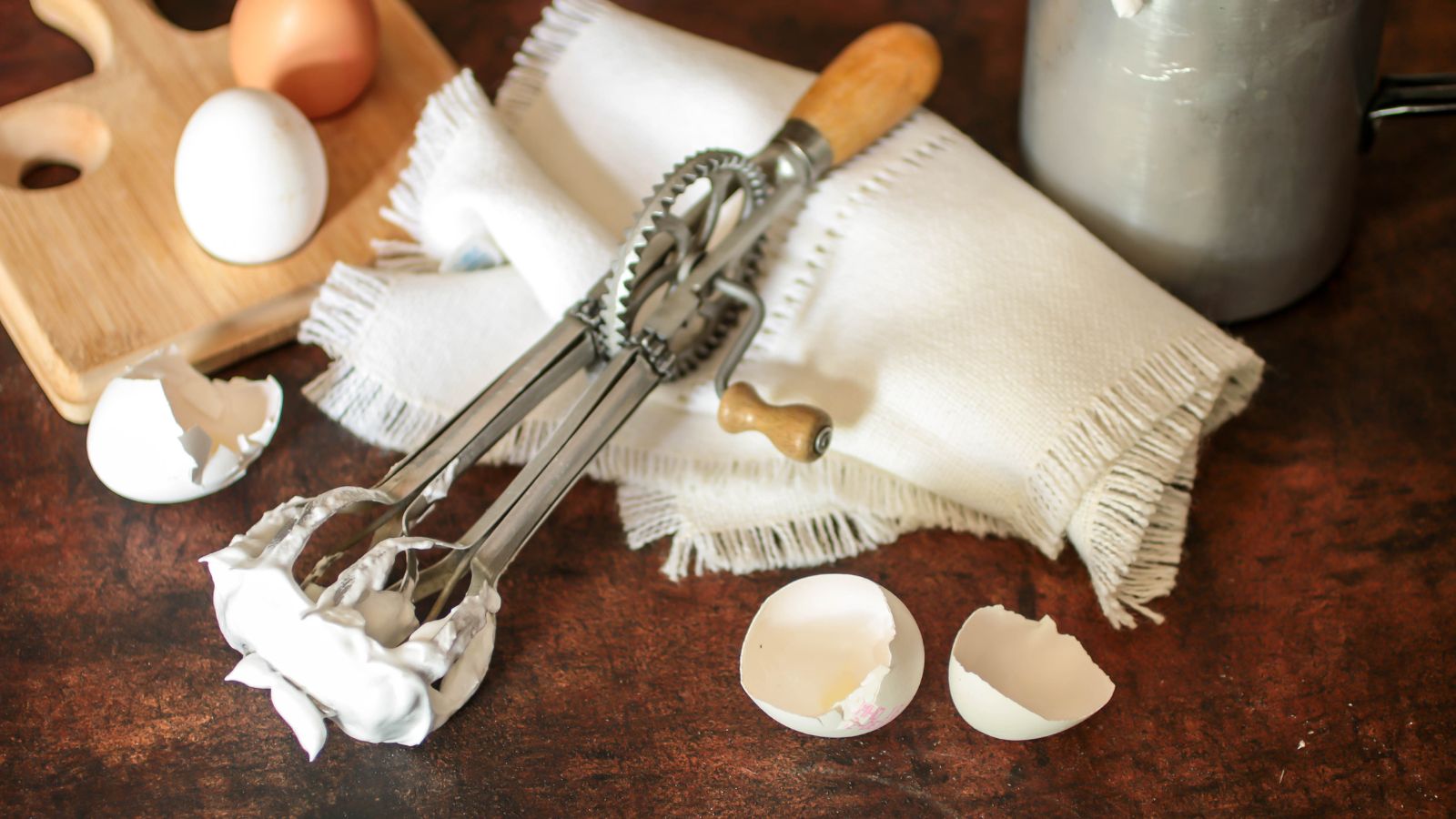
Before electric mixers became familiar kitchen companions, the rotary egg beater offered a wonderfully straightforward way to mix ingredients.
Its design is beautifully simple. Turn the handle, and the beaters rotate, bringing ingredients together without needing a motor.
What’s surprising is that this traditional tool is still being manufactured. According to OXO’s official product listing, its current Egg Beater features removable beaters and a detachable base designed for cleaning.
The company also explains that the tool can operate while resting against the bottom of a mixing bowl.
There’s something satisfying about a gadget that relies on nothing more complicated than a hand crank. It may not replace every electric mixing tool, but its simple mechanism remains appealing.
Hand-Crank Food Mill: A Forgotten Way to Control Texture
Some kitchen gadgets do only one job, but they do it with impressive precision. The hand-crank food mill belongs in that category.
Instead of relying on spinning blades like a food processor, a traditional food mill presses ingredients through a perforated disc.
Different discs create different textures, giving cooks more control over the finished preparation.
OXO’s current food mill includes three interchangeable grinding discs, a stainless-steel inner bowl, and folding legs. The design also features a release mechanism that allows the tool to be taken apart.
For anyone who appreciates hands-on cooking, there’s a certain charm in turning a handle and watching ingredients gradually transform.
It’s an old-fashioned idea that modern manufacturers clearly haven’t abandoned.
Stovetop Coffee Percolator: When Brewing Coffee Was a Ritual
There’s something nostalgic about coffee bubbling away on the stove.
Long before today’s elaborate countertop machines, stovetop percolators offered a familiar way to prepare a pot of coffee. This classic brewing method hasn’t disappeared from modern cookware catalogs.
Farberware still offers its Yosemite stainless-steel coffee percolator in 8-cup and 12-cup versions.
According to the manufacturer’s product page, it features a permanent filter basket and a glass knob. That means cooks who appreciate the process can still enjoy the familiar percolator experience.
One detail is worth checking before buying: although the general description mentions broad stovetop compatibility, the specifications say the product isn’t induction-compatible.
Sometimes even an old-fashioned favorite requires a careful look at the details.
Rotary Flour Sifter: A Simple Tool for Baking Days
Few kitchen sounds are as distinctive as the soft rattling of a hand-crank flour sifter.
The tool brings a familiar rhythm to baking, turning an ordinary preparation step into a small ritual. Despite its vintage appearance, the traditional rotary design remains available.
Norpro currently catalogs its model 136 stainless-steel flour sifter, which holds three cups.
The company notes a two-wire agitator, volume markings, and a hand-operated crank as key features. The manufacturer also recommends washing the sifter by hand.
It’s a wonderfully specialized gadget, designed to screen flour and dust ingredients without an electric motor.
For cooks who enjoy traditional baking routines, that straightforward design remains part of its charm.
Cookie Press: Bringing Beautiful Shapes to Homemade Cookies
A tray of perfectly patterned cookies can make an ordinary baking afternoon feel like a celebration. That’s where the traditional cookie press earns its place.
Rather than cutting individual shapes from rolled dough, the tool pushes dough through patterned discs to create repeated designs. Modern versions still follow that familiar principle.
According to OXO’s current product listing, its 14-piece cookie press set includes 12 stainless-steel patterned discs, a storage case, and a lever-operated dispensing mechanism.
The clear body also allows bakers to see how much dough remains. It’s a specialized tool, certainly, but that’s part of its appeal.
For anyone who enjoys making spritz cookies, a cookie press can turn a simple batch of dough into something wonderfully decorative.
Manual Nut Chopper: Small Gadget, Clever Design
Sometimes the most satisfying kitchen inventions are the ones that make a small job easier. A manual nut chopper offers a particularly clever example.
Its hand crank operates the chopping mechanism while the prepared ingredients collect in a container underneath.
Norpro still manufactures a version of this traditional gadget. Its model 576 Nut Topping Chopper features stainless-steel blades, a glass collection base, and a stated capacity of 1¼ cups.
The company recommends it for chopping nuts, cookies, crackers, and cereal. That’s quite a collection of possible uses for one compact tool.
And because the ingredients collect directly in the glass base, the design combines chopping and collection in a single operation.
It’s a reminder that practical kitchen design doesn’t always require electricity.
Clamp-On Meat Grinder: Old-Fashioned Cooking With a Hand Crank
The clamp-on meat grinder has an unmistakable appearance.
Its sturdy body attaches to a table or countertop, while a hand crank drives the grinding mechanism.
That traditional design still has a place in today’s kitchenware market.
According to Lehman’s current product listing, its manual grinder includes two grinding plates and a sausage-stuffing funnel.
The clamp-on arrangement means the tool doesn’t require permanent mounting. It also operates without electricity.
Lehman’s listed the product as available when the information was checked, although individual retailer inventory can change.
For cooks who want to choose their own ingredients and do the grinding themselves, the appeal is easy to understand.
Sometimes the simplest mechanism offers exactly the control a cook wants.
Electric Carving Knife: A Familiar Tool With Changing Models
Few gadgets are as closely associated with traditional carving routines as the electric carving knife.
Its reciprocating blades offer a distinctive approach to slicing, especially when presenting a large roast at the dinner table. But unlike several other gadgets on this list, one model has a verified example of it disappearing.
Hamilton Beach marks its electric knife set, model 74275Z, as no longer available.
The older set included an eight-inch carving blade set, a five-inch utility blade set, a storage case, and a 120-watt motor.
However, the manufacturer also lists another 120-watt model, the 74277G, with an eight-inch blade and storage case. That newer listing was marked out of stock when checked, not discontinued.
The distinction matters. An exact old model may disappear even while the broader kitchen gadget survives.
Why These Old-School Kitchen Tools Still Matter
Not every useful kitchen invention needs a touchscreen, a complicated motor, or an impressive collection of settings.
Sometimes a turning handle, a simple blade, or a carefully designed container does the job beautifully.
The continued availability of OXO’s egg beater, Norpro’s three-cup flour sifter, and Farberware’s two percolator sizes shows that traditional kitchen designs still have a place in modern catalogs.
That doesn’t prove older generations universally prefer them, or that every vintage gadget was better built.
It simply reminds us that good ideas can outlast changing kitchen trends.
And perhaps that’s the real beauty of these familiar tools. They connect the practical work of cooking with the small, satisfying rituals that make a kitchen feel like home.