We often imagine a wedding sendoff as the glittering last page of a love story. The music softens, the guests cheer, the couple leaves under lights, flowers, and applause, and everyone assumes the hardest part of the day is finally over. For Dave and Jesni Fiji, that final exit was supposed to feel cinematic. They had exchanged vows at The Revere near Dawsonville, Georgia, surrounded by family, friends, faith, and the joy people spend years trying to plan.
Then the night changed, and the celebration gave way to urgency.
The AA Robinson R66 helicopter lifted off with the newlyweds and the pilot, Nikhil Nargundkar, on board. The plan was simple enough on paper: the couple would leave the wedding venue by air, head toward Peachtree-DeKalb Airport, and continue into the first night of married life. Within a short time, the aircraft crashed in a wooded area near Dawsonville. Dave Fiji, a 25-year-old pilot and newlywed groom, died. Nargundkar also died. Jesni survived, injured and trapped in the wreckage for hours. That is why this story has traveled far beyond Georgia. It is not simply a crash report. It is a wedding story, a survival story, a weather story, a faith story, and a painful reminder that aviation does not bend for romance, pressure, or perfect timing.
Dave Fiji and Jesni’s Wedding Was Built Around Faith, Family, and Intention
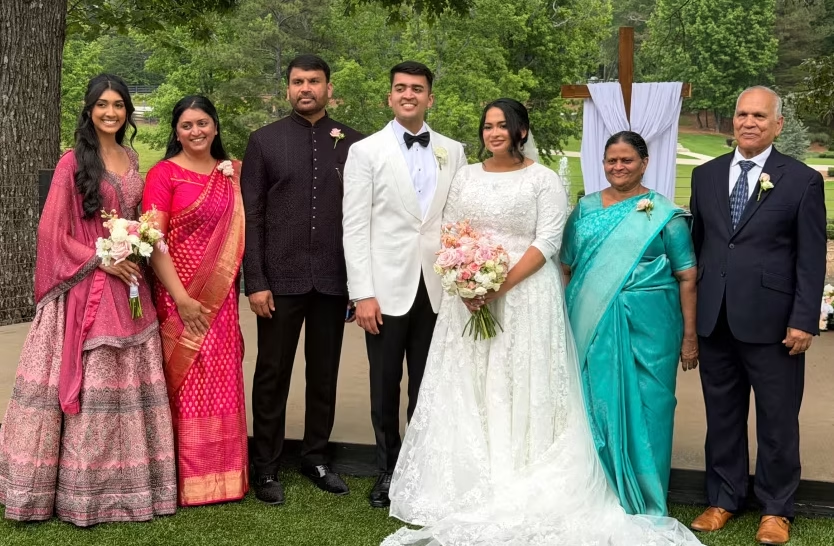
Before the crash became a national headline, the day belonged to two people whose relationship had grown through church, community, and years of connection. Dave and Jesni were not strangers swept into a hurried romance. Family accounts described a couple who had known each other for more than a decade, with their lives linked through faith and shared community ties.
The wedding itself carried deep personal meaning. Dave’s family spoke of a ceremony filled with spiritual emotion, not empty spectacle. The details mattered because they reflected the couple’s beliefs. The setting, the vows, the guests, and the decorations created a day that relatives remembered as complete and beautiful. That matters because tragedies like this are often reduced to the final terrifying minutes.
We should not forget the contrast. Hours before rescuers searched through woods and wreckage, this was a room full of celebration. Guests had gathered to witness two families become one. Parents watched their son begin the life he had dreamed about. A bride and groom stepped into marriage with hope, not fear.
The Helicopter Sendoff Was Supposed to Be a Romantic Grand Exit
Wedding exits are designed to be memorable. Some couples leave in vintage cars. Some run through sparklers. Some choose boats, horses, limousines, or fireworks. Dave and Jesni’s helicopter departure fit the image of a dramatic sendoff, especially for a groom whose life was already tied to aviation.
That detail adds another layer to the story. Dave was not merely a passenger dazzled by the idea of flight. He was connected to aviation professionally and personally. Family members said he had dreamed of flying since childhood, which makes the decision to board the helicopter feel even more complicated to readers. He reportedly understood the seriousness of weather, visibility, and flight risk.
The aircraft was a Robinson R66, a turbine-powered helicopter used in private, commercial, and utility operations. On a clear night, a short repositioning flight from a wedding venue area toward an airport could sound straightforward to many people. But aviation safety is rarely about what sounds simple. It depends on the aircraft, pilot, route, weather, terrain, visibility, judgment, and timing, all lining up well enough to create a safe outcome.
On that Friday night, several of those factors were under scrutiny almost immediately.
Fog, Rain, and Low Visibility Became the Central Questions
Weather now sits at the center of public attention, even though investigators have not announced a final cause. Family accounts described rain and fog in the area before takeoff. Dave reportedly voiced concern about limited visibility before the helicopter departed. Jesni later told family that the pilot intended to climb higher to avoid fog.
That sequence is one of the most haunting parts of the story because it reads like a warning before impact. Still, we have to be precise. A concern before departure does not automatically prove the cause of the crash. Fog can be dangerous. Rain can reduce visibility. Night flight near wooded terrain adds difficulty. But the NTSB investigation must examine the aircraft, engine, systems, pilot decisions, weather data, route, communications, wreckage path, and any available witness or video evidence before reaching a conclusion.
The helicopter went down in a wooded area. Investigators said the aircraft struck tall trees before reaching the ground. They also reported no post-impact fire, and major helicopter components were located along the debris path. These are factual pieces, not final answers. In aviation, the difference matters.
The Crash Site Made Rescue Painfully Difficult
The helicopter did not fall in a parking lot, on a road, or near an easy access point. It crashed in a heavily wooded area near Dawsonville, which made the emergency response more difficult. Reports described crews needing time to locate the aircraft, with responders working through challenging terrain.
That delay is one reason Jesni’s survival has shaken so many readers. She was alive in the wreckage for hours. She had injuries, shock, darkness, debris, and the unbearable knowledge that her husband had not survived. Any one of those facts would be enough to break the heart of a community; together, they create a scene almost too painful to imagine.
We should be careful with the word “miracle,” even though many readers will use it. Jesni survived a crash that killed two others in the same aircraft. Physically, reports indicated she suffered cuts and bruises without broken bones. Emotionally, the wound is beyond measurement. Survival is not the same as escape. She left the wreckage alive, but she did not leave the tragedy behind.
The NTSB Investigation Is Still in the Fact-Finding Stage
The National Transportation Safety Board is leading the investigation, with the FAA also involved. That matters because early public discussion can easily outpace evidence. In the first days after a crash, people naturally search for someone or something to blame. Weather. Pilot judgment. Mechanical failure. Pressure to complete a planned wedding exit. Each possibility may feel persuasive from the outside, but investigators do not work from feelings.
The NTSB’s early work focuses on documenting the scene, examining the wreckage, collecting evidence, studying weather conditions, and reviewing aircraft systems. A preliminary report is expected to provide factual information from the first phase of the investigation. A final report can take much longer because probable cause findings require deeper analysis.
Dave Fiji’s Aviation Background Makes the Story Even More Painful
Dave’s connection to flying gives this tragedy a cruel emotional twist. Family members described him as someone who loved aviation from a young age and built a life around that dream. That kind of passion shapes a person. Pilots often see the sky not as a thrill, but as a discipline. They learn checklists, weather judgment, risk management, and the humble truth that conditions can change faster than desired.
That is why his reported concern about visibility has become such a powerful detail. Readers hear it and feel the ache of a question that may never be easy for the family to carry. What happens when someone senses risk, but the moment keeps moving? What happens when a celebration has already reached its final act? What happens when the safest choice might be the hardest one to make publicly?
We should not turn that pain into speculation. Dave was a groom, a son, a husband, and a pilot. Reducing his final night to one decision would flatten a full life into a single unresolved question. The better way to honor the story is to keep the human being at the center while allowing investigators to do their work.
Jesni Fiji’s Survival Is Also a Story of Trauma
Public attention often treats survivors as symbols of hope, and there is some truth in that. Jesni’s survival is extraordinary. She lived through a crash that killed her husband and the pilot. She endured hours before rescue. She was later hospitalized and began the physical recovery process.
But we should not make survival sound simple. Jesni is not just “the bride who survived.” She is a newlywed who lost her husband on her wedding night. She is a nurse who reportedly understood the severity of what had happened upon regaining consciousness. She is a person whose life was split into before and after in the woods of Dawson County.
The emotional recovery from such trauma cannot be measured in hospital release dates. A person can heal from cuts and bruises while still carrying grief that has no clean timeline. That is the part many headlines cannot fully hold. The body may survive the crash. The heart still has to survive the memory.
The Pilot, Nikhil Nargundkar, Was Also Part of the Loss
In stories centered on newlyweds, the hired pilot can easily become a secondary figure. That should not happen here. Nikhil Nargundkar also died in the crash. He had a family, a name, and a life beyond the aircraft. His role will likely be examined as part of the investigation, but examination is not the same as public judgment.
Aviation accident investigations often study pilot decision-making because the pilot is central to flight safety. They also study aircraft systems, environmental conditions, maintenance records, operational pressures, and external factors. That broad scope is important because crashes usually result from chains of events, not from a single isolated detail.
The public should resist the urge to portray Nargundkar as a villain before the facts are complete. Accountability matters. Evidence matters more. The final report will eventually provide a clearer picture of what happened in the cockpit and in the sky. Until then, the story remains one of multiple families grieving, not one family alone.
The Georgia Helicopter Crash Shows Why “Short Flight” Does Not Mean “Low Risk”
Many people assume a short flight is automatically safer because it covers less distance. Aviation does not work that way. Takeoff, climb, low-altitude maneuvering, weather transitions, and landing phases can carry serious risk. A short night flight in poor visibility can quickly become dangerous, especially around terrain or trees.
That point deserves attention because helicopter rides are often sold as glamorous experiences. They appear at weddings, in tourism packages, in proposals, on city tours, in real estate showcases, and at VIP events. The marketing language can make the flight feel smooth and effortless. The reality is more serious. Every helicopter flight requires disciplined go-or-no-go judgment.
The lesson is not that people should fear helicopters in every situation. It is that special-event aviation needs sober planning. Couples and families should ask direct questions about weather minimums, cancellation rules, pilot authority, alternate transportation, night operations, and what happens if conditions deteriorate. The most romantic safety plan is the one that gets everyone home.
A Stronger Safety Conversation Should Come From This Tragedy
After a crash like this, the public conversation often fades once the first wave of shock passes. That would be a mistake. The deaths of Dave Fiji and Nikhil Nargundkar, and Jesni Fiji’s survival, should push event planners, aviation operators, wedding venues, and families to think harder about high-risk transportation.
A helicopter departure should come with a written backup plan that feels normal, not like failure. Vendors should make weather cancellations clear before the wedding day. Couples should be told plainly that the pilot’s safety decision is final. Families should understand that no photo, video, or dramatic exit is worth pressuring a flight into questionable conditions.