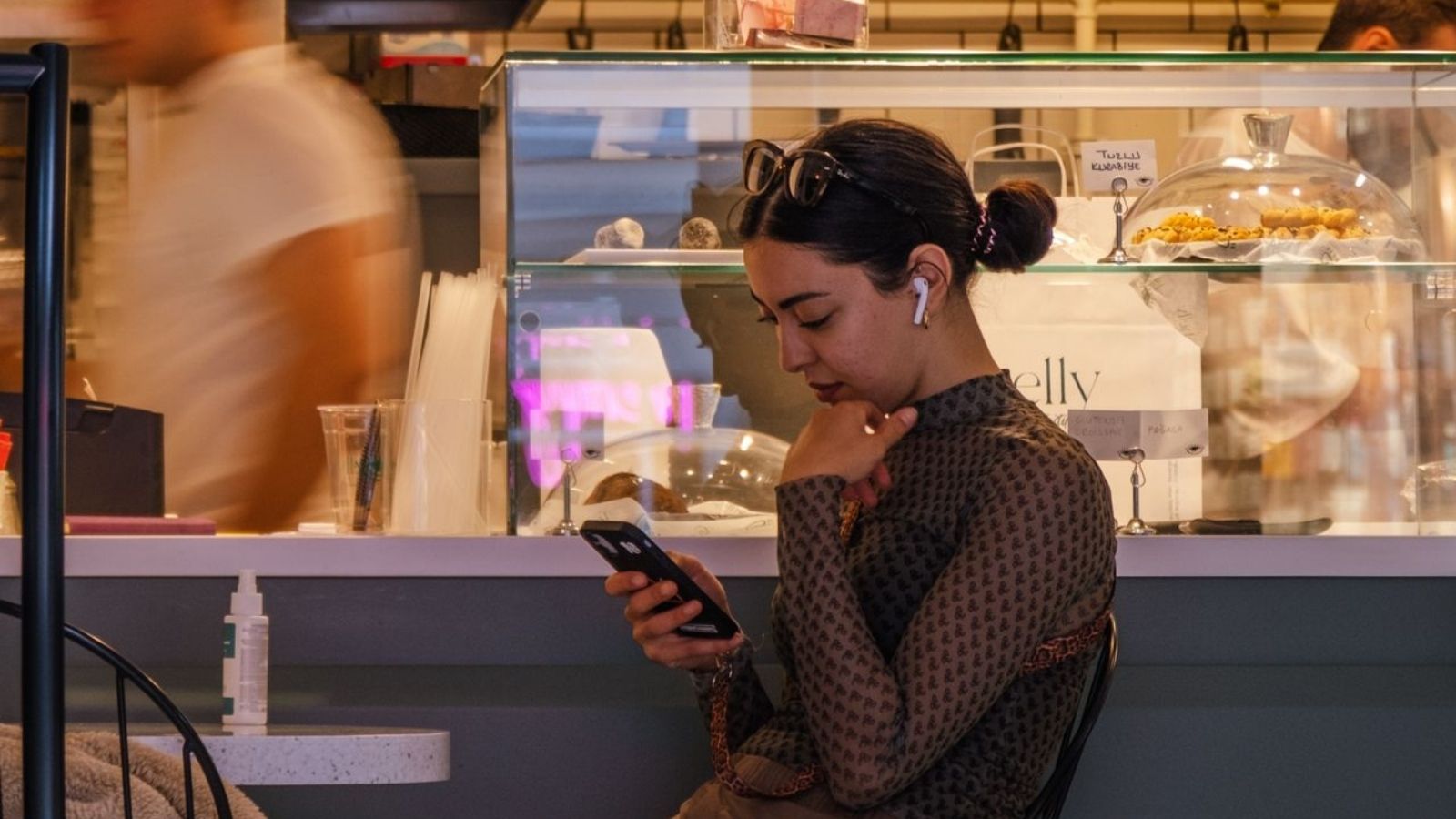
At More Munchies, a cafe in west London, owner Rouz G Habibi says customers now walk through the door with their eyes fixed on a screen, order without looking up and sit down still scrolling. She told the payments platform SumUp that some regulars barely register the person handing them a drink. Her cafe is not an outlier.
Across the food and drink industry, workers describe the same scene playing out several times a shift. A customer stands at the register, phone in hand, physically present but checked out of everything else happening around them.
There is a word for it. Phubbing, a blend of phone and snubbing, means ignoring the person in front of you to focus on a device. What began as a marketing stunt has become a subject of academic research and a daily irritation for people whose job depends on face-to-face contact.
The term traces back to a 2012 advertising campaign
In May 2012, the Australian advertising agency McCann Melbourne coined phubbing for a project tied to the Macquarie Dictionary. The agency built a Stop Phubbing campaign around the word, complete with its own website and a video titled Phubbing: A Word Is Born.
The campaign promoted dictionary licensing, yet the term outlived the brief. By 2013 the movement had spread to Britain and the United States, according to reporting in the Sunday Times. The report cited a YouGov poll showing that 44% of people in Britain spent more than 30 minutes a day on their phones.
Researchers measured the toll on frontline retail workers
Academic interest followed close behind. Researchers Markus Fellesson of Karlstad University and Nicklas Salomonson of the University of Borås surveyed 2,940 frontline retail employees in Sweden. They published their study in the Journal of Retailing and Consumer Services in 2020. Forte and the Swedish Research Council funded the research.
Being phubbed by a customer turned out to be common and employees who experienced it felt ignored and found it harder to deliver good service, Salomonson said in a university statement announcing the findings. Workers who scored high on service orientation tended to tolerate the behavior instead of confronting it, a coping pattern that prior workplace research has tied to greater job dissatisfaction and burnout over time.
Notification overload keeps customers glued to their screens
Part of the explanation lies in how often a phone interrupts in the first place. A survey by the electronics reseller Music Magpie found the average person receives roughly 146 notifications a day. That’s close to one every ten minutes of waking life, as reported by the outlet Tyla. That volume helps explain why a brief counter-exchange struggles to compete for attention.
The academic definition has caught up with the behavior. The journal Computers in Human Behavior Reports has described phubbing as being absorbed in a smartphone while in the presence of others and neglecting interpersonal communication, language that maps closely onto what counter staff say they experience.
Hospitality workers say the habit outlasted the pandemic
Beverly Botha, who runs the Traveling Cupcake in Hampshire, told Tyla that the behavior has grown more common at her counter over time. Contactless ordering systems introduced during the Covid-19 pandemic normalized checking a phone mid-transaction, and the habit appears to have persisted after health restrictions eased.
The pattern lands differently than earlier forms of self-service. Self-checkout and app-based ordering already reduced how often customers and staff speak, leaving the counter as one of retail’s last unscripted human moments. Losing eye contact there changes what little interaction remains.
The pattern shows up beyond the register too
Phone snubbing has also been documented among people in positions of authority. Researchers James Roberts and Meredith David of Baylor University’s Hankamer School of Business surveyed 413 employees and supervisors. They found that 76% of respondents distrusted a manager who had phubbed them, according to HR Dive.
75% of respondents linked the behavior to feeling psychologically unsafe or unavailable around that manager, a dynamic the researchers connected to a measurable drop in engagement. The overlap suggests phubbing erodes trust in similar ways whether the other party is a supervisor or a stranger buying coffee.
Some businesses tried to intervene years before this wave
The original Stop Phubbing campaign did not stop at raising awareness. It produced posters asking customers not to phub for display in shops and restaurants, along with wedding table cards reminding guests to put phones away, according to 2013 Sunday Times reporting.
Campaign founder Alex Haigh said he supported workers who pushed back against the habit. He pointed to a Sainsbury’s checkout employee in London who declined to serve a shopper who remained on her phone throughout the transaction.
More than a decade later, the tension between screen habits and service work has not gone away. It has simply moved to a new set of counters, from coffee shops to grocery checkouts, where a few seconds of attention remains harder to get than it used to be.