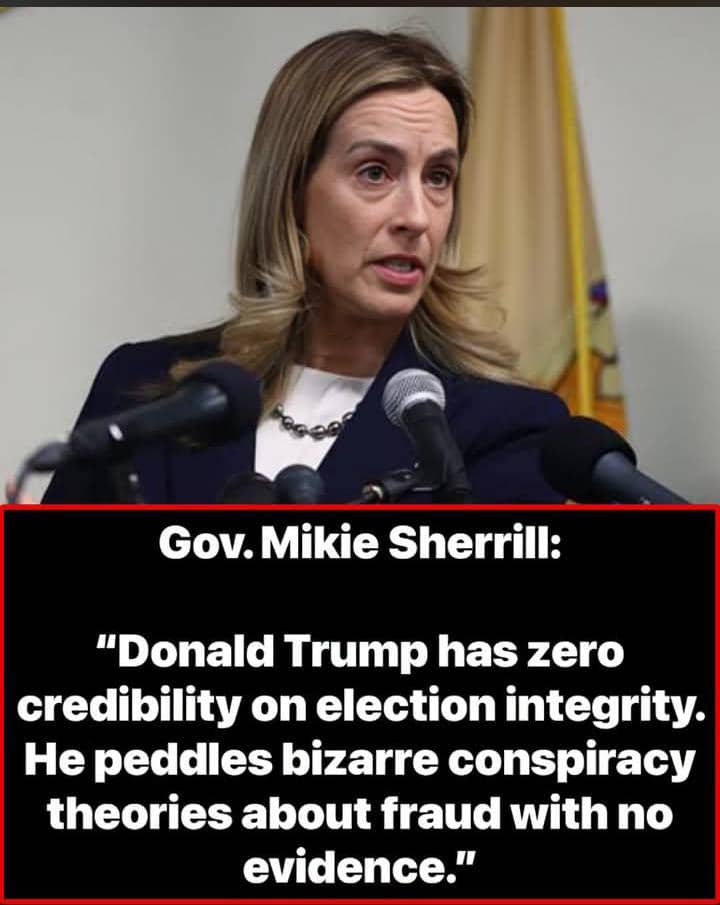
Gov. Mikie Sherrill has accused President Donald Trump of turning election integrity into political theatre, saying he has spent years promoting dramatic claims that are rarely matched by convincing evidence.
But Sherrill’s attack comes in the middle of a genuine and embarrassing problem for her state. New Jersey officials have acknowledged that approximately 6,600 noncitizens were improperly registered to vote because of a Motor Vehicle Commission system failure. Fewer than 400 of them later cast ballots, according to the state’s preliminary review.
That creates a political clash with more layers than a campaign rally sandwich. Sherrill says her administration is exposing and correcting a government mistake. Trump and his allies say the mistake proves they were right to demand tougher citizenship checks.
Sherrill Admits a Serious Failure, Then Turns Her Fire on Trump
Sherrill said the registrations occurred between June 2023 and June 2024, before she became governor in January 2026. The affected residents had reportedly answered “no” when asked whether they were American citizens while applying for driving licenses or identification cards, but the system registered them anyway.
The governor said she ordered an investigation, directed officials to remove the improper registrations and began replacing the vendor responsible for operating the system. Those registered through the error included Democrats, Republicans and unaffiliated voters scattered across New Jersey.
Sherrill did not try to pretend the situation was harmless. She called the failures reckless and said the lack of transparency under the previous administration was unacceptable.
Then she aimed directly at the White House.
“Donald Trump has zero credibility on the issue of election integrity,” Sherrill said, accusing him of repeatedly undermining public confidence in legitimate election results.
She also drew a sharp distinction between her response and Trump’s political approach.
“We investigate it, we fix it, and we tell the public,” she said.
Sherrill said state officials currently have no evidence that the improperly cast ballots changed the result of any election. More than four million ballots were cast in New Jersey during the 2024 presidential election, meaning 400 votes would represent fewer than one in every 10,000 ballots if they had all been cast in that single contest.
Trump Officials Say the Error Proves Their Point
The Trump administration sees the New Jersey disclosure very differently.
The White House called the incident the predictable result of Democratic policies that allegedly fail to verify citizenship properly. It used the controversy to demand passage of the SAVE America Act, which would establish documentary proof-of-citizenship requirements for federal voter registration and impose nationwide voter-identification rules.
“This latest incident underscores the absolute necessity of the SAVE America Act,” White House spokeswoman Abigail Jackson said.
Homeland Security Secretary Markwayne Mullin also criticized New Jersey’s handling of the problem. After Sherrill announced the registrations, Mullin said the matter should have been addressed much earlier and argued that even one unlawful ballot damages the rights of an eligible voter.
The Department of Homeland Security has separately claimed that preliminary reviews identified 35,152 potential noncitizens on New Jersey’s voter rolls and more than 250,000 across New Jersey, California, Nevada and Pennsylvania. The department requested cooperation from election officials in those states.
However, DHS publicly described the figures as involving “potential” noncitizens and did not explain its full matching process in the announcement. Sherrill said New Jersey requested supporting evidence for the larger federal estimate but had not received it at the time of her July 21 remarks.
Assistant Attorney General Harmeet Dhillon has since accused Sherrill of attacking Trump even though she already knew New Jersey was preparing to disclose its registration failure.
“She knew it, and she still went online and called the president a liar,” Dhillon said, adding, “Shame on you, governor.” Dhillon warned that states refusing to cooperate with federal voter-roll requests could face litigation.
A Real Error Does Not Automatically Prove Widespread Fraud
There is no reasonable argument for ignoring 6,600 improper registrations. Election systems are supposed to stop ineligible people before their names reach voter rolls, particularly when they have clearly indicated that they are not citizens.
New Jersey Republican Party chair Christine Hanlon called for a bipartisan investigation, saying the registration and verification process must be improved. She also demanded answers about why the problem was not publicly disclosed earlier.
At the same time, the confirmed New Jersey error does not establish that noncitizen voting is widespread across the United States or that recent national elections were stolen.
Trump has continued to claim that his 2020 defeat involved noncitizen voting, fraudulent mail ballots and manipulated voting machines. Recounts, audits and numerous court proceedings found no evidence of fraud on a scale that could have changed the presidential result. Research reviewed by Reuters has also found that confirmed noncitizen voting cases are rare and frequently involve mistakes or confusion rather than organized fraud.
That does not mean unlawful voting never occurs. Federal prosecutors have charged several noncitizens in New Jersey with knowingly registering or voting illegally. Those defendants are presumed innocent unless convicted, but the cases demonstrate that existing law permits investigation and prosecution when evidence supports it.
The unanswered questions now belong to New Jersey’s investigation. Officials must establish exactly how the registrations were approved, when state leaders first became aware of the problem, whether the vendor or government employees were responsible, and why the public was not informed sooner.
Sherrill may be correct that Trump has repeatedly promoted unsupported election conspiracies. Trump’s administration may also be correct that New Jersey’s failure exposes a weakness requiring serious reform.
Both things can be true.
The public does not need exaggerated claims declaring every election stolen. It also does not require officials to treat hundreds of unlawful ballots as an insignificant technicality. Voters deserve something less exciting but far more useful: verified evidence, transparent investigations, and systems that work before the next ballot is cast.