Iran is not only burying Ayatollah Ali Khamenei. It is staging a message.
Months after the former supreme leader was killed during U.S.-Israeli strikes, Tehran has turned his delayed funeral into a sweeping display of grief, power and defiance. The ceremony is expected to stretch across several days and several holy cities, beginning in Tehran and moving through Qom, Najaf and Karbala before ending in Mashhad, where Khamenei is set to be buried near the shrine of Imam Reza.
For Iran’s rulers, this is not just a farewell to the man who dominated the country’s politics for nearly four decades. It is a carefully choreographed answer to President Donald Trump, Israel and every foreign rival that expected Khamenei’s death to leave the Islamic Republic exposed.
The coffin, the crowds, the chants, and the black flags all carry the same message: the system is wounded, but it wants the world to believe it is still standing.
Tehran turns mourning into political theater.

The body of Khamenei was laid in state at Tehran’s Grand Mosalla, a vast prayer complex that has long been used for major state and religious ceremonies. Around him, Iranian officials placed the coffins of relatives who were also killed in the same attack, adding a deeply personal layer to a national event.
That image matters. It turns the funeral from a political ritual into a family tragedy, and from a family tragedy into a symbol of martyrdom. In Iran’s official telling, Khamenei is not being remembered as a leader defeated by war. He is being presented as a figure who died in confrontation with Iran’s enemies.
The timing sharpens that message. The funeral falls during Muharram, one of the most important periods of mourning in Shiite Islam. It also overlaps with America’s July Fourth weekend, giving Tehran a ready-made contrast between U.S. celebration and Iranian grief.
That is not an accident. Iranian leaders understand the power of timing. They know the funeral will be watched not only by mourners in Tehran, but by officials in Washington, Jerusalem, Gulf capitals and across the wider region.
The route tells its own story.

The funeral route is almost as important as the funeral itself.
Tehran is the seat of state power. Qom is the heart of Iran’s clerical establishment. Najaf and Karbala, both in Iraq, are among the holiest cities in Shiite Islam. Mashhad, where Khamenei is expected to be buried, is home to the Imam Reza shrine and one of the most important pilgrimage sites in the Muslim world.
By moving Khamenei’s body through these places, Iran is linking politics, religion and regional influence in one long procession. It is reminding supporters that Khamenei was not only the head of state. He was also a religious authority, a revolutionary symbol, and a central figure in the network of power Iran built across the Middle East.
The spectacle is meant to overwhelm. Officials have prepared for massive crowds, heavy security, traffic closures, and public mourning on a scale rarely seen in the country. The Guardian reported that Iranian officials have anticipated millions of mourners during the multi-day ceremonies.
For a government that has faced years of protests, sanctions, and public anger, those crowds are politically useful. They allow the state to point to the streets and say, “Look, the revolution still has people behind it.”
Mojtaba’s absence raises questions.
But the funeral also exposes the uncertainty Iran would rather hide.
Khamenei’s son and successor, Mojtaba Khamenei, has not appeared publicly since reportedly being wounded in the same strike that killed his father. AP reported that questions remain around his condition and public absence as Iran moves through this delicate transition.
That absence is not a small detail. In a system built on symbols, visibility matters. A new leader who cannot appear beside his father’s coffin leaves room for speculation, even if officials insist the state remains firmly in control.
Iran wants this funeral to show continuity. It wants the world to see processions, prayers, and disciplined crowds. But the missing figure of Mojtaba complicates that picture. It suggests that even as the Islamic Republic performs unity in public, the machinery behind the scenes may be under strain.
The funeral, then, becomes two stories at once. On the surface, it is a majestic farewell to an old ruler. Beneath that lies a test of whether the system he shaped can move forward without him.
A legacy wrapped in conflict
Khamenei’s legacy is inseparable from confrontation.
He became supreme leader in 1989 after the death of Ayatollah Ruhollah Khomeini and went on to shape Iran’s politics, military strategy and foreign policy for decades. Under his rule, the Revolutionary Guard grew more powerful, Iran expanded its regional alliances, and the country remained locked in hostility with the United States and Israel. AP described his long rule as one marked by nuclear tensions, regional proxy conflicts, and repeated crackdowns on domestic dissent.
To his supporters, he was the steady hand of resistance. To his critics, he was the face of repression, economic hardship, and political suffocation.
That divide will not disappear because of a funeral. If anything, the ceremony makes it more visible. Some Iranians will mourn him sincerely. Others will watch in silence. Some may see the crowds and feel pride. Others may see the same crowds and remember prison, censorship, inflation, and fear.
The message to Trump
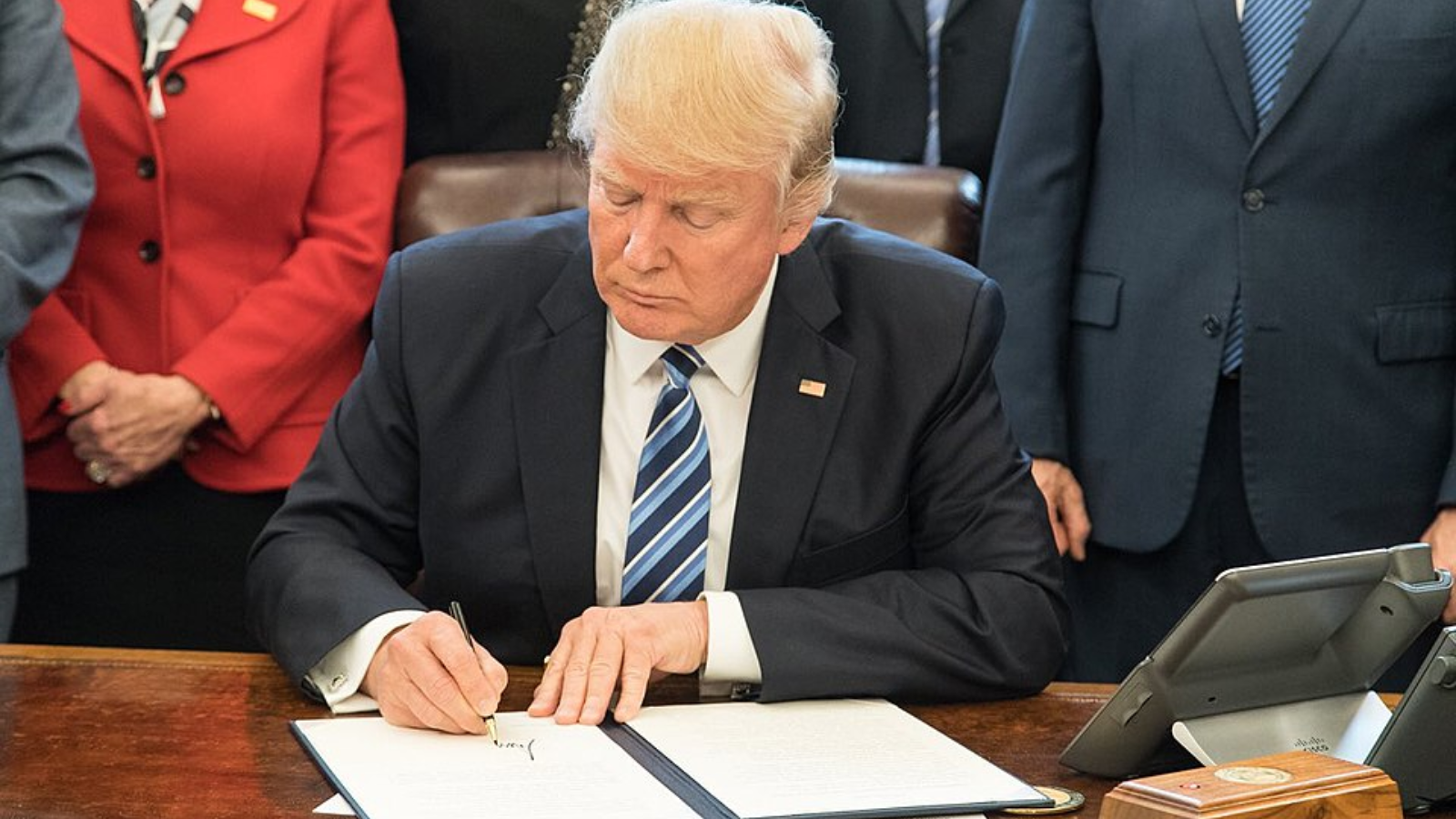
U.S. Air Force photo by Tech. Sgt. Robert Cloys, Public domain, via Wikimedia Commons
For Trump, the funeral is meant to be an answer.
Iran is trying to show that killing Khamenei did not collapse the Islamic Republic. It is trying to turn a devastating military blow into a story of endurance. It says its enemies may strike its leaders, but they cannot erase its institutions, its ideology, or its ability to mobilize people.
That is why the ceremony feels less like an ending and more like a warning.
The black banners are mourning. The crowds are the theater. The route is symbolic. The security is a reminder that power still watches every corner of the street.
Iran is burying Khamenei, but it is also presenting a challenge: the man is gone, the system says, but the machine remains.
Whether that machine is as strong as it looks is the real question.