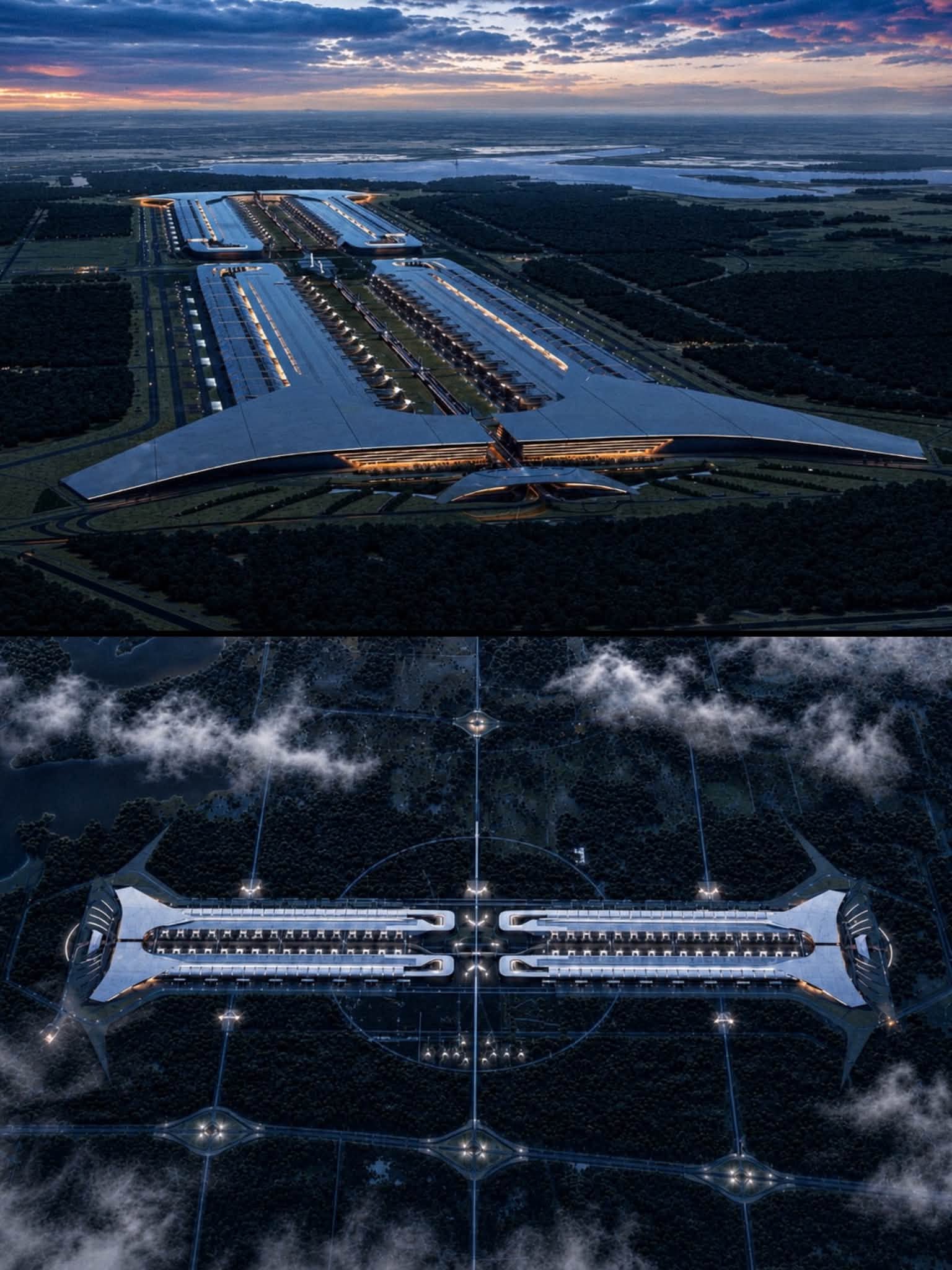
Elon Musk’s newest Texas project is not simply another factory. If completed as planned, it could become the largest building ever constructed.
Tesla and SpaceX are preparing to build a sprawling semiconductor complex in Grimes County, Texas, with an initial investment of more than $16.8 billion. Known as Terafab, the planned facility would cover more than 100 million square feet, according to announcements from SpaceX and Texas Governor Greg Abbott.
That footprint would make Terafab more than five times larger than China’s New Century Global Center, which is widely described as the world’s largest building by floor area. (Hardware, 2026) The scale is difficult to picture. One hundred million square feet equals roughly 1,700 football fields placed side by side.
Yet Terafab’s importance may come from what happens inside the building, not simply its size.
One factory for the entire chipmaking process
Modern semiconductor production often stretches across several companies, facilities, and countries. A chip may be designed in the United States, fabricated in Taiwan or South Korea, packaged elsewhere in Asia, and tested at another specialized site.
Musk’s companies want to compress much of that process into one enormous Texas campus.
SpaceX says Terafab will bring logic-chip production, memory manufacturing, advanced packaging, and testing under one roof. The goal is to shorten development cycles while reducing dependence on outside semiconductor suppliers.
The factory would produce advanced chips for several Musk-led operations. Tesla needs processors for its autonomous-driving systems, Cybercab vehicles, and Optimus humanoid robots. SpaceX expects to need specialized processors for satellites and its proposed space-based computing infrastructure. Musk’s artificial intelligence ventures also require increasingly powerful hardware.
Terafab is designed to produce more than one terawatt of computing capacity each year. That ambitious target reflects how quickly AI companies are consuming advanced processors.
Why Musk wants control of the supply chain
Semiconductors have become one of the world’s most strategically important products. They power vehicles, smartphones, artificial intelligence models, defense systems, communication networks, and data centers.
The global chip shortage that began during the COVID-19 pandemic exposed the risks of depending on a small number of overseas manufacturers. Automakers temporarily closed production lines because they could not obtain enough processors. Tesla navigated that shortage better than some competitors, partly by rewriting software to work with alternative chips, but the experience showed how quickly supply problems could disrupt manufacturing.
Terafab represents Musk’s most aggressive response to that vulnerability.
Instead of waiting for established chipmakers to expand capacity, Tesla and SpaceX plan to build a supply system shaped around their own products. That could give Musk’s companies more control over chip design, production schedules, costs, and technological development.
However, owning the factory does not guarantee success. Advanced semiconductor manufacturing ranks among the most difficult industrial operations in the world. It requires specialized equipment, exceptionally clean environments, experienced engineers, reliable power, large quantities of water, and precise control over thousands of manufacturing steps.
Texas puts public support behind the project.
The first phase of Terafab is expected to create at least 3,000 jobs, including positions for engineers, technicians, plant operators, and other skilled workers. (Elon Musk’s massive Terafab chip-making facility starts to take shape, 2026) The Texas governor’s office has approved a $30 million Texas Enterprise Fund grant for SpaceX.
The development also qualifies for the state’s Jobs, Energy, Technology and Innovation program, which allows eligible large-scale projects to receive property tax incentives.
Supporters see Terafab as a chance to turn Southeast Texas into a major semiconductor center while strengthening domestic manufacturing. The project could attract suppliers, contractors, training programs, and supporting businesses to surrounding communities.
Texas already plays a central role in Musk’s business network. Tesla moved its headquarters to the state and operates its Gigafactory near Austin. SpaceX runs launch operations at Starbase in South Texas, tests rocket engines near McGregor, and manufactures Starlink equipment in Bastrop.
Terafab would deepen that concentration.
Residents still have questions.
The enormous investment also brings concerns about water, infrastructure, taxes, and the effect of rapid industrial growth on rural Grimes County.
Chip factories typically consume substantial amounts of water for cleaning silicon wafers and cooling equipment. SpaceX says the project will draw water from the nearby Gibbons Creek Reservoir instead of relying on local groundwater supplies.
Residents and local officials will still need to examine how the development could affect roads, electricity demand, housing, schools, emergency services, and the surrounding environment. Public incentives may also receive scrutiny because taxpayers and school districts are being asked to support a privately controlled project.
The promise of thousands of jobs carries weight, but communities often want firm guarantees about wages, hiring practices, environmental protection, and long-term public costs.
A bold plan still has to become a working factory.
Terafab remains a planned facility. The $16.8 billion figure applies to its first phase, and completing a semiconductor campus of this size could take years. Costs, construction schedules, technical targets, and production plans may change.
Musk has a history of setting unusually aggressive timelines. Some projects have eventually succeeded after delays, while others have been scaled back, postponed, or abandoned. That makes the distinction between an announced vision and a functioning chip factory especially important.
Still, the project signals where Musk believes the next industrial battle will unfold. Tesla and SpaceX are no longer satisfied with buying the technology behind their vehicles, robots, satellites, and AI systems. They want to manufacture it themselves.
If Terafab reaches its promised scale, Texas will gain more than a record-breaking building. It could become the center of an attempt to reshape how America designs and produces the chips powering its artificial intelligence ambitions.