Imagine being a child, standing in an immigration courtroom, and being asked to explain why you should be allowed to stay in a country you hoped would protect you. You may not speak English, understand the legal paperwork, or even know what happens if the judge orders you to leave. For thousands of unaccompanied immigrant children in the United States, this is becoming a frightening reality as a major federal legal assistance program faces disruption.
The crisis has drawn attention from immigration advocates, lawmakers, and children’s rights supporters, including children’s entertainer Ms. Rachel. But behind the public attention is a complicated funding dispute that has left legal service providers struggling to help children already caught in immigration proceedings. The numbers are troubling, and the consequences could follow these young people for years.
A major legal assistance contract expired in July
The federal government previously relied on the Acacia Center for Justice to coordinate legal services for unaccompanied immigrant children. Its nationwide network included nearly 100 nonprofit legal service providers that offered legal advice, court representation, and help understanding immigration procedures.
The latest one-year contract, which began on August 1, 2025, expired on July 31, 2026. Procurement records identify approximately $356.3 million in obligations associated with the agreement, although that figure should not be confused with independently verified cash payments.
The expiration followed months of disagreements over funding and contract arrangements. Acacia also reported that the government had withheld nearly $65 million in payments for completed work. The organization said disputes over requests for confidential client information contributed to the breakdown in negotiations.
The government, meanwhile, argued that it needed another provider because efforts to establish a replacement arrangement had faced delays. These disagreements created uncertainty for organizations representing children nationwide.
The proposed $150 million replacement never happened

The government initially proposed a one-year agreement worth up to $150 million with Houston-based Burke Law Group. The plan attracted criticism from immigration advocates and lawmakers who questioned the firm’s experience handling immigration cases involving children.
Reports identified approximately 26 employees and suggested that only two people listed relevant immigration experience on the firm’s website. However, that does not prove that the firm had no immigration expertise at all.
There was another important development. Burke withdrew from consideration on August 11, 2026. Six days later, the Department of Health and Human Services formally confirmed that it would not award the agreement to the firm.
Instead, the government awarded Our Rescue a separate emergency contract on August 7. Congressional records list the initial value at $158.1 million, with a potential total of about $244 million.
The arrangement has a six-month base period, with options that could extend it to 18 months. A November 18 Government Accountability Office decision allowed the award to proceed. However, the agency dismissed a challenge to Our Rescue’s qualifications as untimely rather than deciding that particular issue on its merits.
More than 110,000 immigration cases are pending

The scale of the problem becomes clearer in immigration court data.
An October 2026 analysis by the Acacia Center for Justice estimated that more than 110,000 pending immigration court cases involved people identified as unaccompanied children when they entered the system. Some of those individuals are now adults, so the figure does not represent the number of children currently living in shelters.
The same analysis found a major difference in court outcomes based on access to legal representation.
Between January 2017 and August 2026, approximately 78% of initial case completions involving people who had never been represented resulted in removal orders. For those who had received legal representation at some point, the figure was 17%.
The gap was even more striking in 2026. The analysis estimated that 88% of never-represented cases resulted in removal orders, compared with 39% of cases involving representation.
These figures do not prove that having a lawyer alone determines the outcome. They also measure removal orders, not confirmed physical deportations. Still, they show how difficult immigration proceedings can be for people attempting to navigate the system without legal support.
A seven-day deadline shows how difficult court can be
One New York immigration court hearing offered a glimpse into the challenges children face.
On August 5, 2026, 47 children were scheduled to appear before Judge Lisa Ling at the Varick Street Immigration Court. Courtroom reporting described many children appearing without lawyers.
One child reportedly said that a planned call with a lawyer had never happened. Another struggled to understand how to complete an immigration application.
In one case, the judge gave a child an additional week to file paperwork after previous opportunities. Other children received slightly longer periods before their next hearings.
This was a specific courtroom example, not a nationwide rule requiring every immigrant child to submit an asylum application within seven days.
Still, it highlights a serious practical problem. Immigration applications require accurate information, supporting documents, and an understanding of complicated legal requirements. Some children also need interpreters to communicate with the court.
Expecting a child to handle all of this alone is a difficult ask.
New York is trying to fill part of the funding gap
State and local governments have started looking for ways to prevent children from losing access to legal services.
On August 12, 2026, New York State announced $7.25 million in new funding intended to preserve legal assistance for approximately 1,400 children and young people facing active removal proceedings. More than 250 children in that group were detained.
The funding supports a coalition led by the Hispanic Federation, with organizations including Kids in Need of Defense, Safe Passage Project, and Catholic Charities Community Services among the named providers.
New York City has also reportedly allocated close to $17 million toward legal support for unaccompanied minors, according to a statement from its immigrant affairs commissioner.
These efforts matter, but they do not guarantee representation for every child. New York alone reportedly had more than 9,800 relevant pending cases in August 2026, based on Acacia’s estimates.
Ms. Rachel has brought more attention to children’s immigration cases
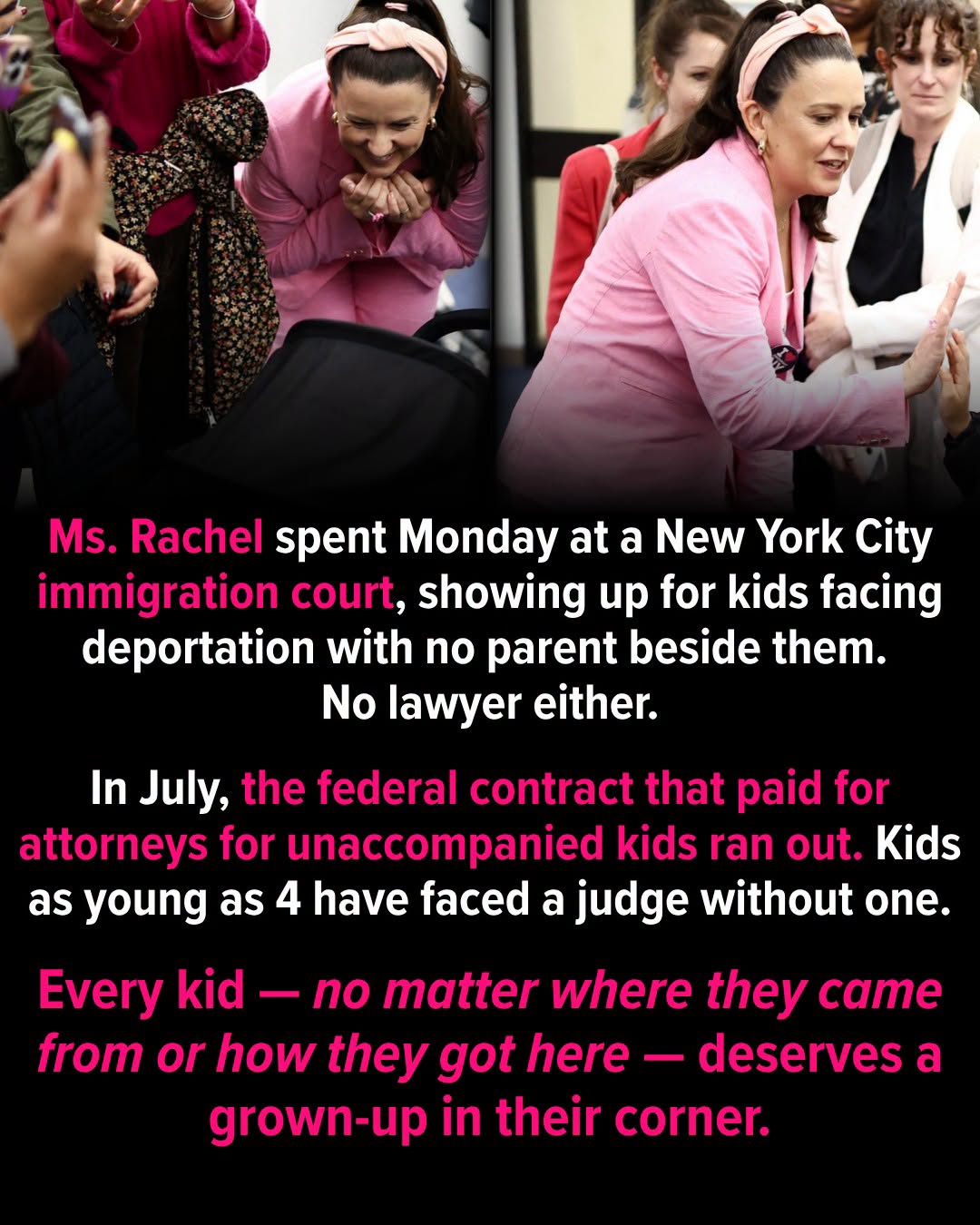
The situation has also attracted attention from Ms. Rachel, whose work usually focuses on early childhood learning and development.
In March 2026, she made video calls with children held at the Dilley Immigration Processing Center in Texas. She later joined advocacy efforts in Washington, carrying children’s letters and drawings to Capitol Hill in June.
Her involvement helped bring public attention to the experiences of immigrant children and families. However, it is important to distinguish Dilley from the shelters used for unaccompanied minors.
Dilley is a family detention facility operated by CoreCivic under Immigration and Customs Enforcement authority. It is not an Office of Refugee Resettlement shelter for unaccompanied children.
A July 2026 report by Senate Judiciary Committee minority staff described concerns raised during a facility visit, including medical care, food, communication, and children’s access to education. CoreCivic has disputed some criticisms and described the educational and recreational services it provides.
These competing accounts make independent oversight and clear reporting especially important.
What happens next?
The central issue is bigger than one expired contract or one replacement provider. The United States has a legal obligation to ensure counsel for qualifying unaccompanied children to the greatest extent practicable under the Trafficking Victims Protection Reauthorization Act.
That obligation does not create a universal public defender system for immigration court. However, it does mean the government must facilitate legal representation for eligible children.
The immediate challenge is ensuring that existing cases do not fall through the cracks while providers adjust to new funding arrangements. Children need lawyers who can explain their rights, prepare applications, communicate with courts, and help them understand what happens next.
For now, the Our Rescue contract remains in place, while providers and advocates continue to raise concerns about service capacity. The real test will be how many children actually receive meaningful legal assistance, not simply how much money appears in a contract.
A child should not have to become an immigration expert just to explain why they deserve a safe future.