For families relying on public health insurance, a deeply personal medical decision may soon come with a much larger financial burden.
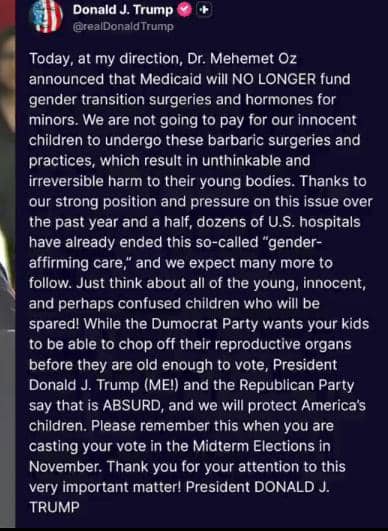
The Trump administration has finalized a rule ending federal Medicaid and Children’s Health Insurance Program funding for puberty blockers, hormone therapy, and gender-affirming surgeries provided to minors.
The rule takes effect on October 13, 2026. However, minors already receiving covered hormone treatments will have a six-month transition period, extending federal support until April 2027.
The policy does not outlaw the treatments nationwide. States may continue covering them with their own money, while private insurers can make separate coverage decisions. Mental health services for gender dysphoria will also remain eligible for Medicaid and CHIP funding.
Still, the change could reshape healthcare options for low-income families and renew a larger national argument: Who should have the greatest authority over medical care involving minors, the federal government, individual states, doctors, or parents?

What the new Medicaid rule changes
Medicaid and CHIP jointly provide healthcare coverage to approximately 35.5 million children across the United States. Although states administer the programs, Washington supplies a significant share of their funding and establishes federal requirements.
Under the final rule, states can no longer claim federal reimbursement for specified gender-transition-related treatments provided to people under 18 through Medicaid. The CHIP restriction applies to patients under 19.
The affected services include puberty blockers, hormone treatments intended to produce sex-related physical changes, and gender-affirming surgeries.
Federal funding will generally stop when the rule takes effect on October 13. Young people already receiving hormone treatment will be covered during a six-month transition period, allowing time for their care to be phased out under the federal program.
Mental health counseling and treatment connected to gender dysphoria are not included in the funding prohibition.
The rule also differs from a nationwide ban. A state that wants to continue covering the affected treatments could use state-only funding, although doing so would shift more of the cost onto state budgets. Families may also look to private insurance or pay out of pocket where the treatments remain legally available.
Why the Trump administration imposed the restriction
President Donald Trump directed Centers for Medicare & Medicaid Services Administrator Dr. Mehmet Oz to implement the change as part of the administration’s broader effort to restrict federal support for gender-transition-related care involving young people.
CMS describes the affected treatments as “sex-rejecting procedures,” language that reflects the administration’s view but is not the terminology generally used by major U.S. medical organizations.
The administration argues that the treatments involve serious health risks and lack sufficiently reliable evidence of long-term clinical benefits for children. It maintains that taxpayer-funded programs should not pay for interventions that can produce lasting physical changes.
“Federal health care dollars should pay for treatments that are proven safe and effective, especially when children are involved,” Health and Human Services Secretary Robert F. Kennedy Jr. said in announcing the final rule.
CMS Administrator Oz said the agency would continue supporting mental healthcare for children experiencing gender dysphoria, while ending federal payments for physical interventions the administration considers unsafe or insufficiently supported by evidence.
CMS estimates the change could reduce federal spending by approximately $235 million over 10 years. The actual amount currently spent on these treatments remains unclear, however, and surgical procedures involving transgender minors are considered relatively rare.
What the change could mean for families
For families enrolled in Medicaid or CHIP, the rule may turn an already complicated medical decision into a financial one.
The impact will vary considerably by location. At least 27 states have enacted restrictions on gender-affirming care for minors, meaning many young people in those states already face legal barriers to receiving puberty blockers, hormones, or surgery.
In states where the care remains legal, officials will have to decide whether to replace the lost federal funding with state money. If they do not, families may need private insurance, charitable assistance, or personal funds to continue treatment.
That distinction matters. The rule does not remove every healthcare option available to transgender young people, and it does not affect every transgender person. It specifically changes federal payment rules for certain treatments provided to minors through Medicaid and CHIP.
A family’s options may depend on the patient’s age, the treatment involved, existing state law, current insurance coverage, and whether the young person was already receiving hormone therapy before October 13.
Critics warn of unequal access and legal challenges
LGBTQ+ advocates and several medical organizations argue that the rule will disproportionately affect low-income families while leaving the same treatments available to wealthier households that can afford private coverage.
The American Medical Association and American Academy of Pediatrics have supported access to gender-affirming care when clinicians provide it under established guidelines and after evaluating an individual patient’s needs.
Opponents say federal officials are using funding rules to override decisions that should remain with families and qualified healthcare professionals. They also argue that the government’s approach could disrupt ongoing treatment and create different standards of care based on a family’s income.
More than 90% of public comments submitted on the proposed rule opposed the policy, according to Reuters. The administration nevertheless moved ahead with the final version.
Legal challenges are widely expected. Opponents may argue that CMS exceeded its statutory authority, discriminated against transgender patients, or improperly interfered with state control of healthcare programs. The administration is expected to defend the rule as a lawful condition on federal spending.
Until courts weigh in, the rule is scheduled to take effect on October 13.
A federal funding fight with national consequences
The dispute reaches beyond the medical treatments named in the rule. It also tests how far a president can use federal healthcare funding to influence services administered by states.
Supporters see the change as a safeguard for children and a responsible limit on taxpayer spending. They argue that lawmakers and health agencies have an obligation to act when treatments may carry permanent consequences.
Critics see a different danger. They contend that political officials are substituting a nationwide funding restriction for individualized medical judgment, limiting the choices of parents who rely on public insurance.
Both sides frame their positions around protecting children. They disagree sharply over what protection means, which evidence should guide federal policy, and who should make the final decision.
For affected families, those disagreements will soon carry practical consequences. The October 13 deadline could determine whether a treatment remains covered, whether a state assumes the cost, or whether parents must find another way to pay.
The question at the center of the fight remains unresolved: When children’s healthcare involves public money, medical expertise, parental judgment, and deeply held social values, who should have the final say?