Utah’s measles fight has now crossed a line public health officials hoped the state would never reach.
More than 680 people have been infected since the outbreak began on June 20, 2025, and cases have reached 22 of Utah’s 29 counties. What started as a public health emergency in one state has become a warning sign for the entire country.
The concern is not only that Utah has recorded hundreds of cases. The deeper concern is that measles has found enough unvaccinated and undervaccinated people to keep moving from one community to another. The virus has appeared in health care settings, restaurants, large retail stores, schools, households, and youth sporting events. This wide pattern of exposure has made the outbreak hard to contain and even harder to predict.
For families, the outbreak has meant more than health department updates. It has meant children being kept home from school, parents receiving exposure alerts, doctors answering worried calls, and communities trying to protect babies, pregnant people, and residents with weakened immune systems. For Utah health officials, it has become a long test of trust, patience, and local cooperation.
Why Utah’s Measles Outbreak Became So Difficult to Stop
Measles is one of the most contagious viruses known to medicine. It spreads through the air when an infected person breathes, coughs, or sneezes. The virus can remain in the air or on surfaces for some time after an infected person leaves a room, making exposure difficult to control in crowded public spaces.
The illness often begins with fever, cough, runny nose, and red or watery eyes. A rash usually appears later, but by that point, a person may already have exposed others. That delay is one reason measles outbreaks can grow quickly before families know they are dealing with something serious.
In Utah, the virus did not remain limited to one setting. It moved through daily life. People were exposed while seeking medical care, shopping, eating out, attending school, and participating in sports. That matters because every public exposure can trigger a chain of contact tracing, quarantine decisions, vaccination checks, and school notifications.
One of the clearest examples came in February, when an exposure at a state high school wrestling championship led to at least 46 cases among attendees. A major youth sports event can pull families from several counties into one crowded indoor setting. After the event ends, those families return to their own schools, homes, churches, teams, and neighborhoods. That is how one exposure can become a much wider community problem.
The Vaccination Gap Behind Utah’s Measles Surge
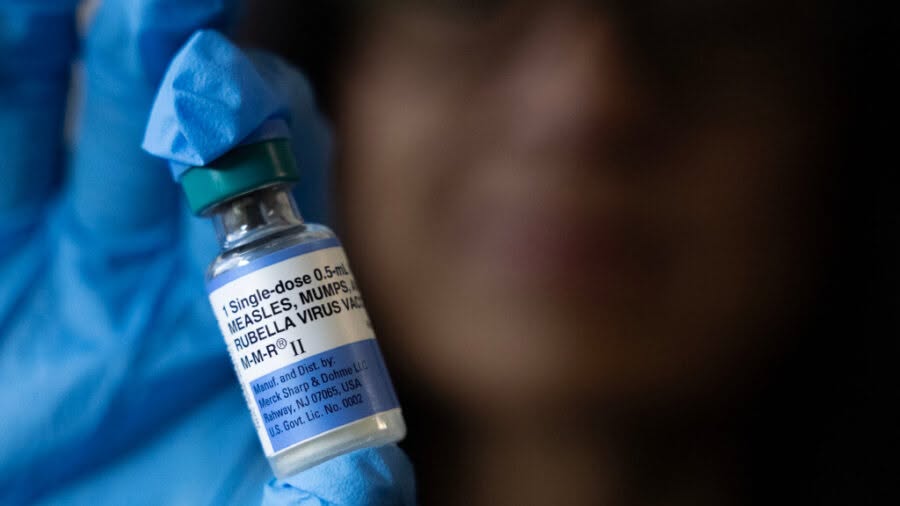
The measles, mumps, and rubella vaccine remains the strongest protection against the disease. Two doses are about 97 percent protective, according to public health guidance. That high level of protection is why measles was declared eliminated in the United States in 2000.
But elimination does not mean measles is gone forever. It means the disease is not spreading continuously within the country. When vaccination rates fall, imported or local cases can spark outbreaks among people without immunity.
Health experts generally point to a 95 percent vaccination level as the threshold needed to prevent measles outbreaks. Utah has fallen short of that mark. According to state data cited in the outbreak reporting, 12.8 percent of Utah kindergarteners were missing their measles vaccine during the last school year. That means the state did not have the level of community protection needed to reliably block transmission.
The risk becomes even greater in counties with larger vaccination gaps. In Daggett, Duchesne, and Uintah counties, a region often described as the TriCounty area, more than 16 percent of kindergarteners were missing measles vaccine documentation or protection during the last school year. That gave the virus more room to spread once it arrived.
The result was visible this spring. The TriCounty Health Department logged 74 measles cases after people who were sickened at the youth wrestling tournament helped spread the virus into schools and households.
Southwest Utah Became the State’s Hardest Hit Region
The worst spread has been in southwestern Utah, where 265 people have become sick since last summer. That region became the center of Utah’s measles burden, but it was not the only area affected.
Measles reached nearly every corner of the state, infecting people in rural and urban settings. That statewide spread is what separates Utah’s outbreak from more geographically limited outbreaks in other states. In Texas, South Carolina, and Arizona, outbreaks have been serious, but Utah’s pattern has been especially difficult because the virus has repeatedly found new communities with enough susceptible people to sustain transmission.
That is the problem with measles. It does not need a large opening. It only needs a small cluster of people without immunity. Once it finds that cluster, it can spread quickly, especially among children, households, and close contact groups.
State epidemiologist Leisha Nolen has warned that Utah’s recent slowdown does not mean the danger has passed. The fear is that fall could create new conditions for another surge. School will restart. Colder weather will push more people indoors. Families will gather more often. A few remaining cases could enter the wrong community at the wrong time, triggering another wave.
That possibility keeps health officials on alert, even when daily numbers appear to improve.
The Human Cost Behind the Case Counts
Measles is sometimes dismissed as a childhood illness that people simply recover from. That view ignores the real risks.
Many people do recover, but measles can cause serious complications. Those complications can include pneumonia, ear infections, diarrhea, dehydration, blindness, and brain swelling. In rare cases, measles can be fatal. Babies too young to be vaccinated, pregnant people, and those with weakened immune systems face higher risks.
There is also a rare but devastating long-term complication called subacute sclerosing panencephalitis, a fatal brain disorder that can appear years after measles infection. That risk is uncommon, but its existence is one reason doctors take measles prevention seriously.
For parents, the fear is not theoretical. A baby in a waiting room cannot choose to be vaccinated. A child undergoing cancer treatment may not have full immune protection. A pregnant patient exposed in a store may face days of anxiety. When measles spreads, the burden falls heaviest on people who have the least control over their own risk.
That is why public health officials often describe vaccination as a community decision, not only an individual one. When enough people are vaccinated, they help protect those who cannot be.
How Utah Health Workers Tried to Rebuild Trust
In the TriCounty region, local officials say their response focused less on punishment and more on prevention. Unvaccinated students were excluded from in-person school when needed. Sick people were told to isolate. Health workers traced exposures, answered questions, and encouraged vaccination.
But the most important part of the response may have been tone.
Health officials said some parents were afraid they would be judged because their children were unvaccinated. One parent reportedly worried that the health department would be angry or critical. Instead, staff tried to show they were there to help, not to shame.
That approach matters in communities where vaccine hesitancy has grown over time. Anger rarely changes minds. Trust sometimes does. When a parent believes a nurse or health worker is listening rather than scolding, a difficult conversation can become a turning point.
Public health depends on that kind of relationship. During an outbreak, officials need families to answer phone calls, report symptoms, follow isolation guidance, keep exposed children home, and consider vaccination. None of that works well when people feel attacked.
Utah’s experience shows that local health departments are not only fighting a virus. They are also fighting misinformation, fear, fatigue, and distrust.
America’s Measles-Free Status Is Now Part of the Story
Utah’s yearlong battle could have consequences beyond the state. Public health experts consider measles eliminated from a country when there is no continuous local transmission for at least one year. When the same chain of transmission continues for 12 months or longer, that status can be threatened.
The United States has held measles elimination status since 2000, but the current national picture is becoming more concerning. The national case count reached 2,104 as of June 18, nearly surpassing last year’s record total. Utah’s outbreak is part of that larger national problem.
International health experts are expected to meet in November to determine whether the United States and Mexico have lost measles elimination status. Canada lost its status last year after ongoing outbreaks.
For the United States, losing that designation would be more than symbolic. It would signal that measles is no longer only arriving through travel and occasional clusters. It would suggest that the country is struggling to stop sustained local spread in under-vaccinated communities.
That would be a major setback for a disease that public health systems once pushed out of regular circulation.
What Parents and Schools Should Watch Before Fall
The coming school year may be the next major test. Schools bring large numbers of children together in classrooms, gyms, buses, cafeterias, and after-school programs. If vaccination gaps remain wide, measles can spread fast.
Parents should check whether their children have received both recommended MMR doses. Schools should ensure vaccine records are up to date before classes begin. Health departments should continue to communicate early and plainly when exposures happen.
Families should also know the symptoms. A high fever, cough, runny nose, red eyes, and a spreading rash should be taken seriously, especially if there has been a known exposure. Anyone who suspects measles should call a medical provider before walking into a clinic or emergency room, because arriving without warning can expose other patients.
The key message is simple. Measles spreads before communities feel ready for it. Waiting until an outbreak arrives is too late.