Before air fryers and modern countertop appliances took over kitchen counters, American families had a different collection of gadgets promising to make everyday cooking easier.
Some were brought out for special occasions, while others earned a permanent spot beside the stove.
Not every household owned all ten, but these appliances capture the convenience-loving spirit of the 1970s. From avocado-green Crock-Pots to electric carving knives, they also bring back memories of family dinners, holiday gatherings, and the unmistakable look of 1970s kitchen appliances.
The Electric Carving Knife
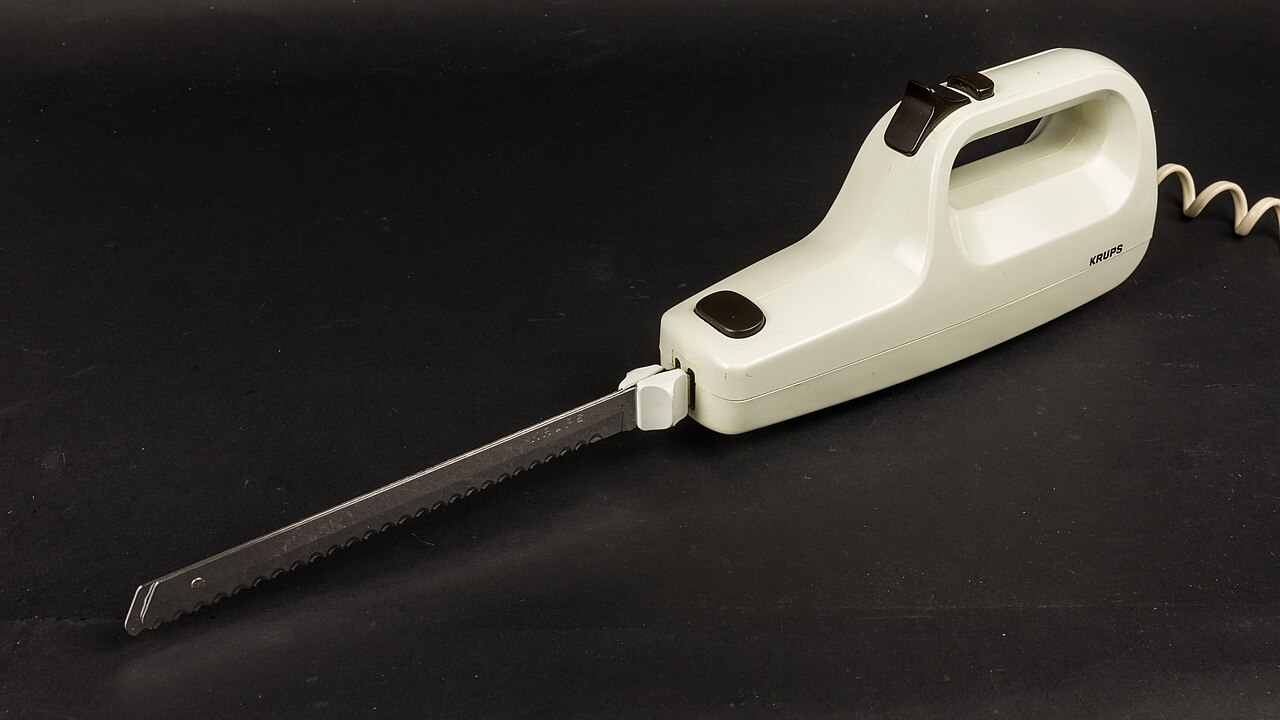
The holiday gadget that made carving dinner feel like an event. Few kitchen appliances were quite as dramatic as the electric carving knife. With two blades moving in opposite directions, it was designed to slice through roasts and other foods with motorized assistance.
Although electric carving knives appeared before the 1970s, they remained memorable household tools during the decade.
They also became part of the equipment associated with family celebrations, when preparing and serving a roast was a special occasion.
The appliance wasn’t marketed exclusively to mothers, either. General Electric promoted electric carving knives to men in the late 1960s, making this one a reminder that kitchen gadget advertising had its own ideas about family roles.
The Rival Crock-Pot
The slow cooker that made dinner a countertop affair. The Rival Crock-Pot became one of the decade’s most recognizable kitchen appliances after its introduction at the 1971 National Housewares Show. Available in colors including Harvest Gold and Avocado, it fit right into the era’s distinctive kitchen style.
Its appeal was straightforward: ingredients could cook in an electrically heated crock without occupying a stove burner.
According to Smithsonian Magazine, Crock-Pot sales grew from $2 million in 1971 to $93 million four years later. That success helps explain why the appliance remains closely associated with 1970s family dinners.
The Countertop Electric Can Opener
Why turn a handle when a machine could open the can? For anyone who remembers an avocado-green appliance sitting beside the toaster, the electric can opener should look familiar.
The Smithsonian preserves a Dazey Model 552 combination electric can opener and knife sharpener, described as manufactured around 1970. Its documented features included a magnetic lid holder, removable cutting wheel, and built-in knife-sharpening groove.
The combination made practical sense for a busy kitchen, even if it meant keeping another appliance on the counter.
It’s exactly the sort of device that belongs among the forgotten household items from the past that can bring back childhood memories.
The Fondue Pot and Its Long Forks
The dinner-party gadget that made everyone participate. If one appliance captured the entertaining side of the 1970s, it was the fondue pot.
Guests could gather around a shared pot, using long-handled forks to dip food into the mixture inside. Suddenly, serving dinner became part of the evening’s entertainment.
Fondue sets were fashionable during the 1960s and remained popular into the following decade. The Smithsonian even holds a circa-1970 Copco fondue pot designed by Michael Lax.
For families who remember cheese fondue and other classic 1970s foods, the pot itself can be just as nostalgic as the meal.
The Electric Skillet
The extra cooking surface that didn’t need a stove burner. An electric skillet was a wonderfully practical idea for a household with several things cooking at once.
Instead of placing another pan on the stovetop, the cook could use a separate electrically heated skillet with its own temperature control.
The appliance was already established before the 1970s, but period models appeared in colors including avocado and burnt orange.
That colorful design helped it fit into the era’s kitchen décor, while its practical value was especially easy to appreciate when preparing a larger family meal.
The Cuisinart Food Processor
The newcomer promised to handle several kitchen tasks. In 1973, Carl Sontheimer introduced Cuisinart’s food processor to the American market, giving home cooks another reason to rethink traditional food preparation.
Unlike gadgets designed for one particular job, the food processor represented a more versatile approach to kitchen equipment. Cuisinart identifies Julia Child and James Beard among the prominent supporters who helped establish the appliance’s reputation.
It was a different kind of countertop investment, one that promised to handle multiple preparation tasks rather than simply automate a single action.
Not every family owned one, but its arrival marked an important moment in the changing American kitchen.
The FryBaby and FryDaddy Deep Fryers
The little appliances dedicated to one cooking job. The 1970s had an appliance for practically every kitchen ambition, and Presto’s countertop fryers fit that enthusiasm perfectly.
The company introduced the FryBaby in 1976, followed by the larger FryDaddy in 1977 and the family-size GranPappy in 1978. The original FryBaby used two cups of oil, was intended for two servings, and automatically maintained its frying temperature.
These specialized machines show how manufacturers approached convenience during the decade. Instead of asking a regular pot to handle the task, they offered a dedicated appliance.
The Hot-Air Popcorn Popper
The gadget that gave homemade popcorn its own machine. Popcorn preparation received a technological makeover when Presto introduced its PopCornNow continuous corn popper in 1978.
According to the company, it was among the first popcorn makers to use heated air instead of oil to pop kernels. That distinction set the device apart from more familiar stovetop methods.
Because it arrived late in the decade, not everyone who grew up in a 1970s kitchen would remember owning one. Still, it represents the growing enthusiasm for specialized kitchen gadgets that continued into the 1980s.
The Stovetop Pressure Cooker
The older kitchen workhorse that kept its place beside newer gadgets. Not every familiar appliance from the 1970s plugged into the wall.
Stovetop pressure cookers had been around long before the decade began, but they continued to occupy an important place in American cookware collections.
Presto reports that its pressure cookers sold steadily throughout the 1970s, and the company introduced a redesigned line of pressure cookers and canners in 1978.
Unlike the slow cooker, a stovetop pressure cooker operated on the stove and served a different cooking purpose. Its continued presence shows that older cookware and modern countertop appliances could comfortably share the same kitchen.
The PrestoBurger Hamburger Cooker
The wonderfully specific machine that cooked hamburgers. Some kitchen gadgets were designed to perform several jobs. Others had one very clear assignment. Presto introduced the PrestoBurger in 1974 as part of a growing interest in smaller, specialized appliances.
According to the company’s history, the PrestoBurger helped launch a series of mini-appliances designed for smaller servings. Presto also reports receiving an Appliance Manufacturers Pioneer Award for the product.
It might seem amusing to have a dedicated hamburger cooker when a skillet could already do the job. But that was part of the decade’s appeal: if a familiar kitchen task could have its own appliance, someone was willing to make one.
And while many of these gadgets eventually gave way to newer equipment, their influence still shows up in the kitchen classics that changed American cooking.
The 1970s kitchen wasn’t just about making dinner easier; it was about discovering how many different gadgets could fit on one countertop.