Ask a group of women what they find most attractive about a man’s physique, and you will probably get several different answers. Some might mention broad shoulders, others will point to muscular arms, while plenty will make a case for a well-defined six-pack.
But what does scientific research actually say?
Interestingly, one study found that the muscles along the sides of a man’s abdomen, known as the obliques, received the highest attractiveness-related development ratings from women. The glutes, abdominal muscles, and biceps followed closely behind.
That might surprise men who spend most of their gym sessions chasing bigger arms and more defined chest muscles.
However, another interesting conversation is worth having. The popular belief that the brain, particularly the frontal lobe, only becomes fully mature at 25 has also been challenged by researchers. And although brain development and attraction are fascinating subjects, science has not established that one causes changes in the other.
Here is what the research really tells us about men’s muscles, physical attraction, and brain development.
The Obliques Came Out on Top in One Interesting Study

If you thought the six-pack was the ultimate winner, researchers found something interesting.
A 2019 study published in Evolutionary Psychology, titled Men’s Bodily Attractiveness: Muscles as Fitness Indicators, examined how people perceived different muscle groups on men’s bodies.
The researchers initially recruited 1,742 adults, but the final analysis focused on 1,445 heterosexual participants, including 503 women.
Women rated 14 different muscle categories based on how developed they preferred them to be.
The obliques received the highest average score, at 4.88 out of seven. The glutes came second with 4.87, followed by the abdominal muscles at 4.79 and biceps at 4.67.
Shoulders also performed well, receiving an average score of 4.66.
So, the muscles around the waist and hips received considerable attention alongside the more familiar upper-body muscles.
However, an important distinction matters. These scores measured preferred muscle development. They were not votes asking women to choose their single favorite muscle.
The study also used one stylized muscular male illustration, so its findings should not be treated as a universal ranking of what every woman finds attractive.
Broad Shoulders and a Smaller Waist Still Matter
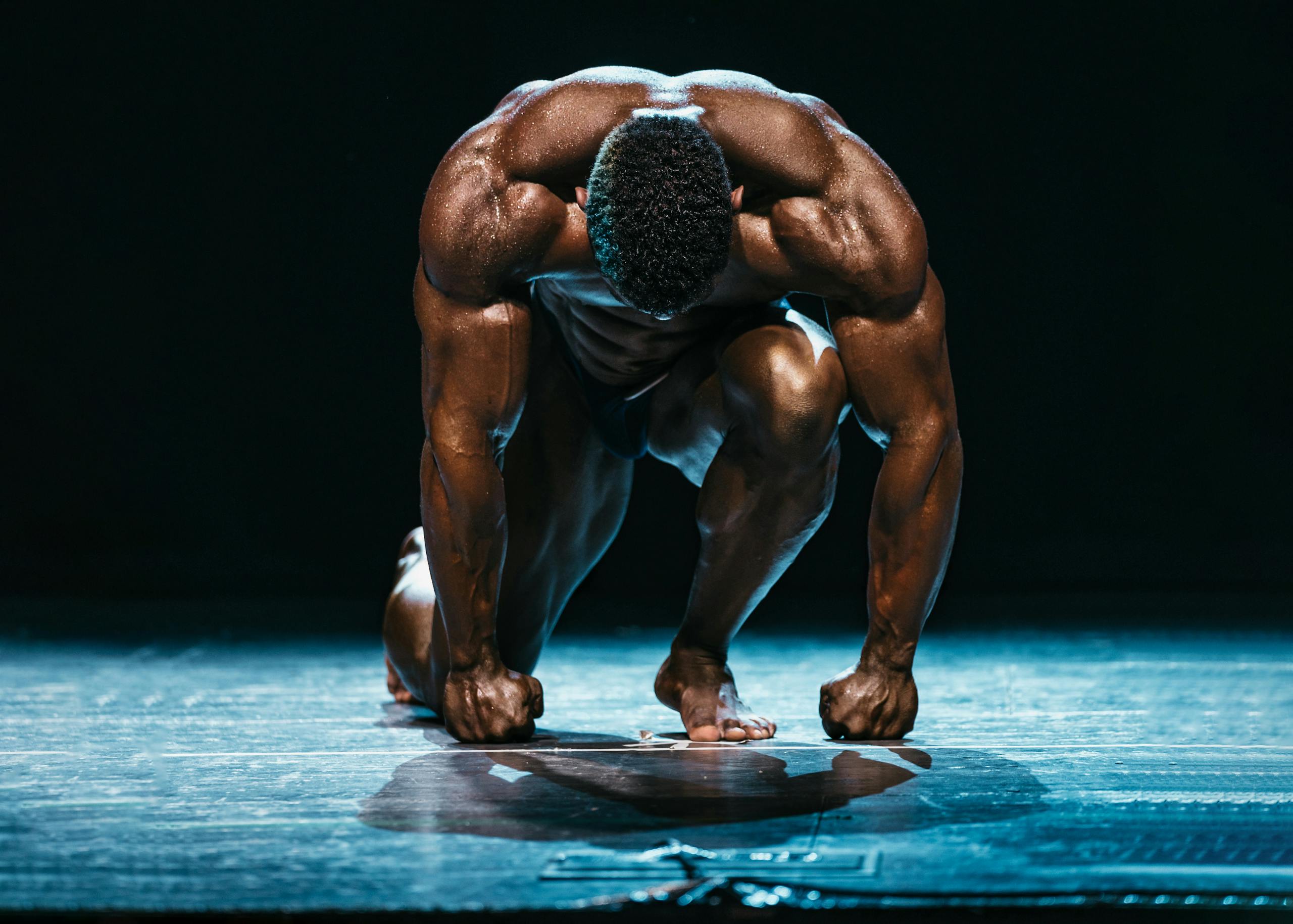
The classic V-shaped male physique gets so much attention for a reason.
A 1999 study published in The Lancet examined how women rated photographs of different men. Researchers looked at measurements including waist-to-chest ratio, waist-to-hip ratio, and body mass index.
The waist-to-chest ratio accounted for 56% of the variation in attractiveness ratings in their statistical model. Body mass index contributed an additional 12.7%.
The preferred appearance generally featured a broader upper torso compared with a narrower waist.
This does not mean men need enormous shoulders or an impossibly small waist. The research examined overall body proportions rather than proving that any one shoulder or chest muscle drives attraction.
In practical terms, it helps explain why a balanced physique can make a strong visual impression.
Bigger Muscles Are Not Automatically Better
Here is where things get interesting for anyone who believes that building as much muscle as possible is the secret to becoming attractive.
Research does not offer a simple answer about whether women universally prefer moderately muscular men or extremely muscular ones.
A 2007 study by David Frederick and Martie Haselton examined women’s preferences for different male body types.
In one experiment involving 141 undergraduate women, the researchers presented six computer-generated male physiques.
The built physique received an average sexual-desirability rating of 6.97 out of nine, while the toned physique received 6.87. The brawny physique scored 6.37.
This suggests that the most extremely muscular depiction did not necessarily win.
However, a 2017 study published in Proceedings of the Royal Society B found that apparent upper-body strength was strongly associated with men’s bodily attractiveness.
Researchers examined photographs of men whose actual strength had previously been measured. Apparent strength explained approximately 73% of the variation in attractiveness ratings for front-view photographs.
That does not mean 73% of women prefer muscular men. It means perceived strength explained much of the variation in the average attractiveness ratings of the photographs used in that study.
The two studies measured different things, which helps explain why their findings were not identical.
The takeaway? Developing strength and muscle can influence physical attraction, but chasing extreme size is not a scientifically established requirement.
Women Do Not All Have the Same Preferences
One of the biggest mistakes people make when discussing physical attraction is assuming every woman likes the same body type.
A 2025 study involving 122 Polish women aged 19 to 70 examined how women of different ages rated men’s physical characteristics.
Researchers used digitally modified images of one 22-year-old male model.
Older women rated the lightly muscular version more favorably than younger women did. However, the study was relatively small and used only one male model.
It does not prove that every woman’s preferences change as she gets older.
Relationship goals can also influence preferences. A 2012 study by Peter Gray and David Frederick found that women in two American samples selected more muscular physiques for short-term partners than for long-term partners.
These findings suggest that attraction is influenced by more than simply the size of someone’s muscles.
Personality, humor, confidence, facial appearance, shared interests, and the nature of a relationship can all contribute to how people perceive potential partners.
Is the Frontal Lobe Really Fully Developed at 25?
Now for another popular scientific claim.
You have probably heard someone say that the human brain is not fully developed until age 25. The statement is often used to explain everything from impulsive decisions to changing attitudes toward relationships.
Some truth behind the idea is that brain development continues into adulthood, but 25 is not a strict biological deadline.
The frontal lobe is the front portion of the brain and contains several important regions. One is the prefrontal cortex, which supports planning, decision-making, prioritizing, and behavior control.
However, these abilities depend on several interconnected brain regions rather than one part working alone.
A 2023 study published in Nature Communications examined executive-function development using data from 10,766 participants aged eight to 35.
Researchers analyzed 23 measures from 17 different tasks.
Their findings showed that performance improved rapidly during early adolescence, with executive-function abilities generally stabilizing toward adult levels around ages 18 to 20 on the tasks examined.
Does that mean the brain stops developing at 20? Absolutely not.
A separate 2011 study published in the Proceedings of the National Academy of Sciences found that certain structural changes in the prefrontal cortex continued throughout the twenties.
Researchers also analyzed more than 123,000 MRI scans in a major 2022 study published in Nature. Different brain structures followed different developmental timelines, with white-matter volume reaching its estimated population-level peak at approximately 28.7 years.
The important lesson is that different brain functions and structures mature at different rates. No single birthday marks when the entire brain suddenly becomes fully developed.
Does Brain Maturity Change What Women Find Attractive?
This is where we need to separate interesting theories from proven science.
Some research suggests that women’s preferences for male muscularity can differ across age groups and relationship goals.
Other research shows that brain structure and executive functions continue changing into adulthood.
However, researchers have not established that prefrontal cortex development causes women to become more or less attracted to particular male muscles.
The studies examining physical attraction did not measure brain maturity. Similarly, the major brain-development studies did not investigate women’s preferences for men’s physiques.
Connecting the two would therefore go beyond what the evidence supports.
Ultimately, there is no scientifically proven age at which women suddenly stop finding muscular men attractive.
So, Which Muscle Should Men Actually Work On?
The research offers an interesting answer: there is no universally agreed-upon winner.
In one notable study, the obliques received the highest preferred-development rating, while the glutes, abdominal muscles, biceps, and shoulders also performed well.
Broader research suggests that overall strength and body proportions can contribute to physical attractiveness.
For men who enjoy working out, the practical approach is to develop a balanced physique rather than obsessing over one muscle group.
Train your upper body, legs, core, and back. Build strength gradually, choose exercises you can perform safely, and give your body enough time to recover.
And remember, looking attractive is not a competition to see who can build the biggest muscles.
Science can offer fascinating clues about physical preferences, but it cannot reduce attraction to a single body part, a perfect waist measurement, or a person’s age.