A small bottle inside Pedro Sánchez’s office has drawn attention far beyond Spain. During a social media tour of his workspace at La Moncloa in April 2026, the Spanish prime minister showed three personal items: incense he lights when he arrives, Don Quixote figures he collects, and a gift from a refugee child from Gaza.
Some viral captions describe the item simply as a child’s drawing. The available video and published reports are more precise. Sánchez showed a bottle containing a message or artwork and called it a “message in a bottle” meant to ensure people do not forget “the suffering they are enduring.”
The distinction is important. Sánchez did not present the object as proof of a particular event or share details about the child’s identity. He described it as a personal reminder of the human cost of the conflict, placed within sight as he carries out his daily work.
A small object with an enormous meaning
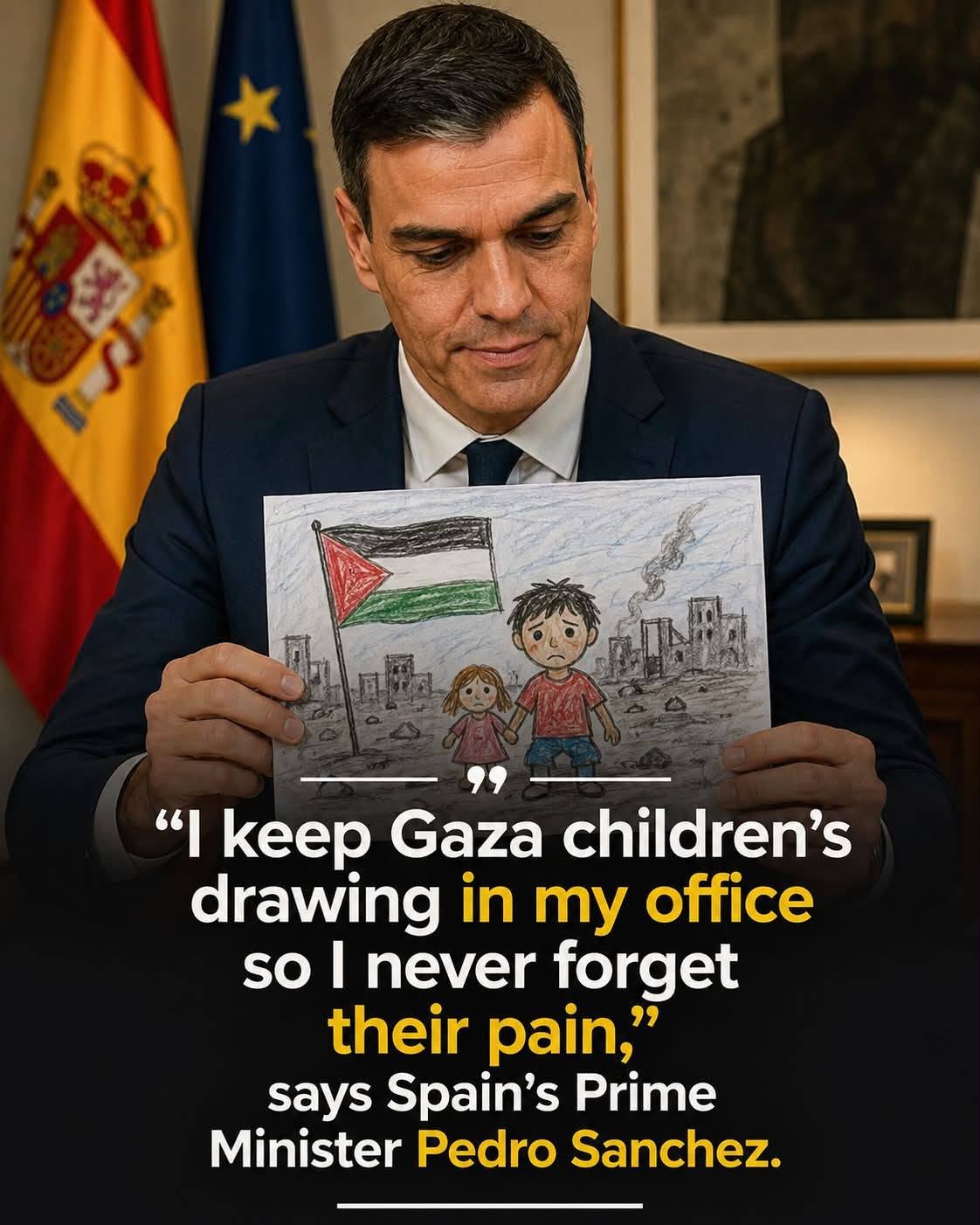
The office video was informal rather than a major policy speech. Sánchez first showed the incense he routinely burns, then the bottle from Gaza, before pointing to several Don Quixote figures purchased from a small shop in Mojácar. The sequence placed an object linked to war beside ordinary habits and personal interests.
Sánchez did not publicly identify the child, provide an age or explain exactly when the gift reached him. Those gaps should not be filled with speculation. What can be verified is that he attributed the bottle to a refugee child from Gaza and said its purpose was to keep the suffering there from being forgotten.
That message carries particular weight because children have paid a devastating price. UNICEF said in an update published July 23, 2026, that more than 64,000 children in Gaza had reportedly been killed or injured. The agency also said more than 56,000 children had lost one or both parents, while displacement, malnutrition, damaged services and severe trauma continued to shape daily life.
United Nations humanitarian officials reported in mid-July that continuing military operations, fresh displacement and worsening access were limiting assistance in Gaza. OCHA also described interruptions to water and sanitation services and heightened risks for families living in displacement sites. Those conditions show why a child’s handmade message can carry such political and emotional force.
The gift reflects Spain’s wider position
The bottle is consistent with the public stance Sánchez’s government has taken since the Hamas-led attacks on Israel on October 7, 2023. Spain has condemned the attacks and demanded the unconditional release of hostages. Sánchez has also affirmed Israel’s right to exist and to protect its security.
At the same time, his government has repeatedly argued that Israel must comply with international humanitarian law and protect Palestinian civilians. Spain formally recognized the State of Palestine on May 28, 2024, alongside Ireland and Norway. Sánchez said the decision was intended to support peace and a two-state solution in which Israel and Palestine coexist securely.
Madrid later adopted stronger measures over Gaza. In September 2025, Spain moved to legally consolidate its arms embargo on Israel, restrict ships carrying fuel for the Israeli military from Spanish ports, and block aircraft transporting military material to Israel from Spanish airspace. The government also announced increased humanitarian assistance for Gaza.
Those policies have deepened tensions with the Israeli government. Israeli officials accused Sánchez’s administration of hostility toward Israel and of using antisemitic rhetoric. Spain rejected those accusations, citing its condemnation of Hamas, its calls for the hostages’ release and its support for Israel’s existence alongside a Palestinian state.
A reminder that statistics represent people
Political debate often reduces war to maps, legal arguments and casualty figures. The bottle offers a different reference point. It represents a message created by a child whose life has been shaped by displacement and violence, even though the public does not know the child’s personal story.
The gesture does not settle arguments over Spain’s foreign policy. Critics may challenge the effectiveness of Madrid’s diplomatic pressure or question the political value of personal social media videos. Supporters may view the object as evidence that civilian suffering remains visible inside the room where decisions are made.
What matters for accuracy is what Sánchez actually said. He showed a bottle given to him by a refugee child from Gaza and described it as a message intended to stop people from forgetting the suffering there. He did not offer a detailed biography of the child, and the available evidence does not justify inventing one.
The object’s power lies in its simplicity. It cannot explain the entire conflict or replace verified reporting, humanitarian access and diplomacy. Yet on the desk of Spain’s prime minister, it keeps one child’s message close to the machinery of government and turns an overwhelming crisis into something personal, visible and difficult to ignore.