A heavy box on the porch in December is one of the season’s small thrills. Inside might be a spiral ham, a set of steaks, a wheel of cheese or a tin of smoked salmon from a relative who lives too far away to visit for the holidays.
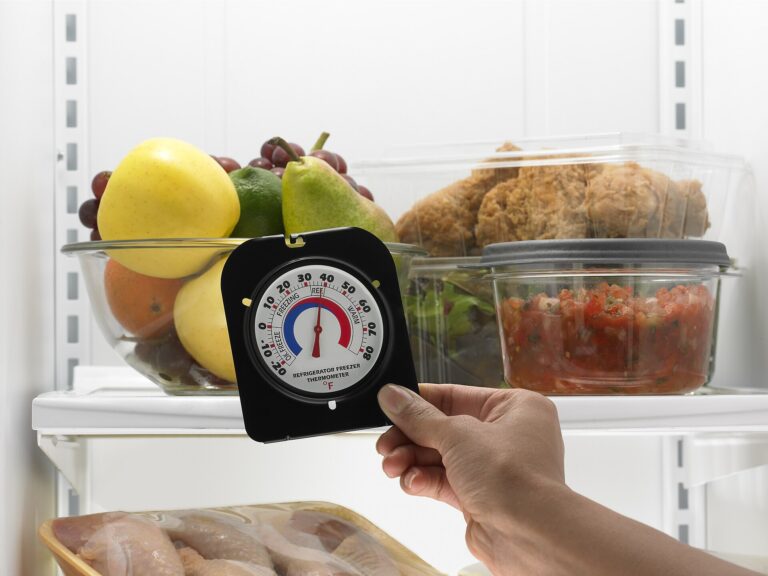
Before anything from that box goes on a plate, the U.S. Department of Agriculture says to check its temperature. Under the department’s guidance for food gifts, perishable items should arrive frozen, partly frozen with ice crystals still in them, or at or below 40°F as measured with a food thermometer. Anything that arrives warmer than 40°F should not be eaten or even tasted, and the recipient should contact the company for a replacement.

What the USDA tells recipients
The advice comes from a USDA post titled “Mail Order Madness: Sending and Receiving Those Food Gifts,” first published in December 2013 and still posted on USDA.gov. It tells recipients to open any perishable gift right away and take its temperature with a food thermometer. The 40°F line matters because that is the upper limit for safe refrigerator storage; the government’s cold food storage chart sets the fridge at 40°F or below and the freezer at 0°F or below.
The USDA is clear that the rule applies even to foods that seem sturdy. Smoked, brined, vacuum-packed and fully cooked items such as hams still need to arrive cold. If a package shows up warm, the department says not to use the food, not to taste it to check, and to notify the company and ask for a replacement shipped with an adequate cold source. Penn State Extension’s current guidance, updated June 1, 2026, gives the same 40°F line, adds that torn or leaking packaging should be reported right away, and says food that has been temperature-abused should be thrown out, since there is no way to tell how long it sat too warm. Anyone paying for holiday orders this season may also want to know the 3 payment methods holiday scammers ask for, which officials say are gift cards, wire transfers and cryptocurrency.
Timing is part of the plan. The USDA says recipients should be home when the gift arrives and that senders should tell them when to expect it. Delivery to an office is a bad idea unless the package lands on a workday and there is refrigerator space to hold it. A box left on a sunny porch or in a mailroom over a long weekend could warm past 40°F even with ice packs inside.
Mail-order meat gifts have a long history. Wikipedia’s Omaha Steaks entry notes that the Nebraska company, founded in 1917, started its mail-order business in 1952 by sending orders by train in cartons packed with dry ice, and still ships in coolers with dry ice. Holiday shipping has its own deadlines, too; the UPS and FedEx last ship dates for Christmas 2026 put UPS 2nd Day Air at Dec. 22 for delivery by Dec. 24.
Gifts that skip the ice packs
The simplest way around the 40°F question is to send foods that do not need refrigeration. The USDA suggests hard salami, hard cheese, country ham and baked goods. Candy and chocolate travel well, too, and even the worst American tourist attractions list includes Hershey’s Chocolate World, proof that chocolate can make a trip. Homemade options work as well; a list of 7 simple cozy crafts for a hygge winter includes DIY mulling spices and infused honey, and a roundup of Christmas party games features a cookie decorating contest that leaves plenty of cookies to box up.
What the USDA tells senders
For anyone mailing food, the USDA list is practical. Pick a company that ships perishables cold or frozen with a cold source, packed in foam or heavy corrugated cardboard, and request overnight delivery when possible. Label both the perishable items and the outside of the box “Keep Refrigerated.” Let the recipient know the delivery date, and avoid shipping to business addresses or anywhere without refrigerator space.
The department also says to mail packages at the start of the week rather than the end, so a box does not sit in a warehouse over the weekend. Homemade gifts should be wrapped well and packed in a sturdy box with frozen gel packs or dry ice.

Handling dry ice safely
Dry ice keeps a box frozen far longer than gel packs, but it comes with rules. The USDA says never to touch it with bare hands, to keep it from touching the food directly, and to write “Contains Dry Ice” on the outside of the box. Wikipedia’s dry ice entry explains that it is the solid form of carbon dioxide, which sublimates at about minus 109°F, turning straight from solid to gas.
That gas is why the U.S. Postal Service’s shipping restrictions page says dry ice may be mailed when used as a refrigerant, but packages containing it must be packed in containers that allow the carbon dioxide to escape. The USPS also notes that perishable items are mailed at the sender’s own responsibility and must be packaged so they arrive before they begin to deteriorate.
When the box arrives
Back on the receiving end, the job is short. Open the box as soon as it arrives, check the food with a thermometer, put it straight into the fridge or freezer if it is at or below 40°F or still frozen, and call the company if it is not. Questions about meat, poultry and egg products can go to the USDA Meat and Poultry Hotline at 1-888-674-6854.
This article was produced with AI assistance and edited for accuracy against the sources linked above.
Image: Peachyeung316 – CC BY-SA 4.0/Wikimedia Commons