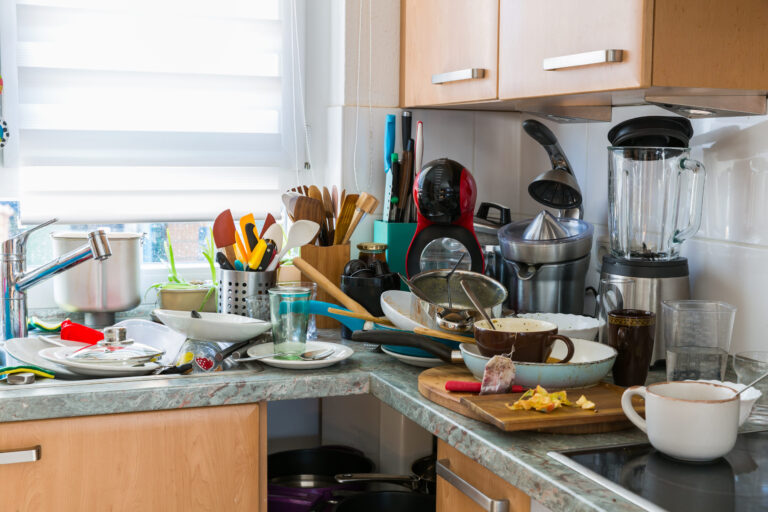
At the end of a long Thanksgiving, the easiest move is to clamp a lid on the stockpot of gravy, soup or mashed potatoes and slide the whole thing into the refrigerator. It feels responsible, and it saves a pile of dishes. According to the U.S. Department of Agriculture, though, a big, deep pot of hot food is exactly the kind of leftover that cools too slowly.
The USDA’s Food Safety and Inspection Service says leftovers should be refrigerated within 2 hours of cooking, or within 1 hour when the air is above 90°F. The agency’s fix for a big batch is simple: divide it into shallow containers and smaller portions so it chills quickly to 40°F or below.

Why a Big Pot Is the Problem
The FSIS guide to leftovers and food safety says hot food should be cooled rapidly so it reaches the safe refrigerator-storage temperature of 40°F or below as fast as possible. A large pot of soup is the agency’s own example of food that cools too slowly when left whole.
The reason is physics more than anything else. Heat escapes from the surface and the sides of a container, and the middle of a deep pot sits far from both. The outside edge may feel cool to the touch while the center stays warm for hours, lingering in the range of roughly 40°F to 140°F that FSIS and other agencies call the temperature danger zone. That is why the shape of the container matters as much as the temperature of the refrigerator. Thanksgiving leftovers are close to a national institution, part of the holiday culture captured in Frenz Hub’s list of odd American traditions that confuse the rest of the world, so the volume of food going into the refrigerator that night is usually large.
FSIS is also clear on a common myth: hot food can go straight into the refrigerator. There is no need to let it sit on the counter to cool first, and leaving it out simply eats into the 2-hour window. Anyone running a holiday kitchen already juggling sink, oven and stovetop can borrow a few habits from a list of things that should never go down a kitchen drain on Thanksgiving, since grease and gravy cleanup tends to land at the same moment.
Divide It Into Shallow Containers
The core of the USDA advice is to divide large amounts into shallow containers. N.C. Cooperative Extension’s guide to how to cool hot foods puts numbers on it: thick foods such as stews, chili or mashed potatoes should go into shallow pans no more than 2 inches deep, while thinner liquids can go up to 3 inches deep. The same guide warns against using the refrigerator or freezer to cool large quantities of hot food in one piece.
In a home kitchen, that usually means swapping one stockpot for several shallow food-storage containers or a couple of baking dishes. Gravy can be split into wide, shallow containers. Stuffing and casseroles can be spread out rather than packed tall. Frenz Hub’s list of clever kitchen tricks for home cooks has more ideas for working faster when the counters are full.
The same logic applies to the turkey. FSIS says large items should be cut into smaller portions before cooling. For a turkey, that means taking the meat off the bone, slicing the breast and leaving the legs and wings whole, then refrigerating it in smaller containers rather than putting the whole carcass in the refrigerator. Planning freezer space ahead helps as well, and Frenz Hub’s guide on how to freeze fresh green beans shows the same flat, portioned approach working for vegetables. The list of kitchen and smoke alarm checks to finish before guests arrive is also a handy place to add a refrigerator thermometer check.
Speed It Up With an Ice Bath
For soups, stocks and gravies that need to cool fast, an ice bath helps. FSIS lists chilling food in an ice or cold water bath as an option before refrigerating. N.C. State’s guide suggests a mix of half ice and half cold water in a large pan or a clean sink, with the pan of hot food set inside and stirred regularly so heat keeps moving out of the center.
Penn State Extension’s guidance for cooking for crowds gives the commercial benchmark behind all this: cooked food should drop from 140°F to 70°F within 2 hours and to 40°F within an additional 4 hours, for a total cooling time of 6 hours. Penn State lists shallow containers, smaller pieces, ice-water baths and cooling wands as the tools for getting there.
Once the containers are filled, giving them room in the refrigerator helps too. Packing hot containers tightly together can slow cooling, so spreading them across shelves for the first few hours makes a difference.

Check the Refrigerator Temperature
Shallow containers only work if the refrigerator is cold enough. The FDA’s guide to refrigerator thermometers says the refrigerator should stay at 40°F or below and the freezer at 0°F. Because few refrigerator controls show an actual temperature, the FDA recommends an inexpensive appliance thermometer for each compartment.
That matters on Thanksgiving, when the door opens constantly and a crowded refrigerator can run warmer than usual. Checking the thermometer after the big meal is a quick way to make sure all those containers are landing in a properly cold space.
How Long the Leftovers Keep
Once properly chilled, FSIS says leftovers keep 3 to 4 days in the refrigerator and 3 to 4 months in the freezer. Frozen food stays safe indefinitely, the agency notes, but it can lose moisture and flavor over time, so 3 to 4 months is about quality. Labeling each container with the date makes the countdown easy to track.
When it is time to eat them, FSIS says leftovers should be reheated to 165°F, measured with a food thermometer. Frozen leftovers can be thawed in the refrigerator, in cold water or in the microwave, and anything thawed in the microwave should be heated to 165°F right away.
The short version for the end of the night: refrigerate within 2 hours, split big pots into shallow containers, use an ice bath for soups and gravy, keep the refrigerator at 40°F or below, and eat or freeze the leftovers within 3 to 4 days.
This article was produced with AI assistance and edited for accuracy against the sources linked above.
Image: Michael W. Kolton – CC BY-SA 3.0/Wikimedia Commons