A drone does not need fear to make a mistake. A targeting system does not need anger to misread a pattern. A military algorithm does not need politics, panic, or prejudice to create a deadly problem. It only needs bad data, weak oversight, a rushed command chain, or a battlefield moving faster than any human can fully understand.
That is the anxiety sitting underneath Sen. Adam Schiff’s Human Authority in Lethal Operations Act of 2026, better known as the HALO Act. The bill is not framed as a ban on artificial intelligence in national defense. It is something more pointed. It asks a sharper question Washington can no longer avoid: when AI helps choose targets, track Americans, recommend force, or shape military decisions, who is actually responsible when something goes wrong?
Schiff’s HALO Act Turns Pentagon AI Weapons Into a Human Accountability Fight
The HALO Act arrives at a moment when artificial intelligence is moving from policy memos into real national security systems. Washington has spent years talking about AI as a battlefield advantage, a surveillance tool, a logistics engine, and a decision support system. Now lawmakers are confronting the harder part. Once AI becomes part of the kill chain, the old comfort of saying “a human was involved” may no longer be enough.
Schiff’s bill tries to turn that vague promise into an enforceable structure. It would require a clear chain of command for autonomous and semi-autonomous weapon systems that use AI in force decisions. That matters because military accountability cannot work if responsibility disappears into a software stack, a vendor contract, or a classified model output. In the HALO Act’s world, a human commander still has to carry ultimate discretion, judgment, and control.
The key tension is simple. The Pentagon wants speed, precision, and technological advantage. Lawmakers want proof that those gains will not come at the cost of constitutional rights, civilian safety, or human responsibility. The HALO Act is built around that collision.

This Is Not a Ban on Military AI
The strongest version of this story is not “Congress wants to stop AI.” That would be too simple and too easy to dismiss. Schiff’s legislation recognizes that AI can support national security, improve battlefield awareness, process massive streams of intelligence, and reduce certain risks when used carefully.
The bill instead focuses on the places where AI becomes most dangerous: target selection, lethal force, domestic surveillance, nuclear decision support, and personal data collection. Those are not ordinary software problems. They involve life, liberty, privacy, and war powers.
That distinction makes the bill more serious. It does not pretend that the Pentagon can operate in 2026 with outdated technology. It also refuses to let the government treat artificial intelligence as a magic shield against accountability. If AI recommends a strike, narrows a target set, ranks threats, or pushes an operator toward action, the bill requires that the system be documented, tested, reviewed, and tied to a responsible human commander.
The Human Commander Rule Is the Bill’s Central Weapon
The HALO Act’s central idea is blunt: a machine should not become the final moral actor in a lethal operation. The bill would require the Pentagon to identify a designated commander for engagements involving covered autonomous or semi-autonomous weapons systems. That commander would remain accountable even when AI contributes to identifying, recommending, selecting, or engaging a target.
This is where the bill moves beyond slogans. “Human in the loop” can sound reassuring, but it can mean very little if the human is overwhelmed, undertrained, poorly informed, or pressured by an interface that makes the AI recommendation look inevitable. A commander who rubber-stamps an algorithm is not real oversight. A commander with the time, information, authority, and power to stop the system is something else.
The bill also requires records of target selection data, decision logic, and human operator actions. That paperwork may sound dull, but it is one of the most important parts of the proposal. After a strike, investigators need to know what the system recommended, what the human saw, what data shaped the decision, and who approved the action. Without those records, accountability becomes theater.
The Real Battle May Be Inside the Defense Bill
The HALO Act’s most important battlefield may not be a Senate hearing room. It may be the National Defense Authorization Act, the annual defense package, where lawmakers often tuck major Pentagon policy changes into legislation too large to ignore. That gives Schiff’s proposal a more practical path than a standalone bill fighting for attention in a crowded Congress.
This detail makes the story more urgent. If parts of the HALO Act are folded into the larger defense bill, the debate over Pentagon AI weapons could move faster than many Americans expect. A bill that sounds technical today could become part of the next major defense policy fight. That is why the timing matters as much as the text.
The politics also become more complicated here. Defense officials may support “human oversight” in principle but resist rigid legal rules that slow acquisitions or limit battlefield flexibility. Civil liberties groups may argue the bill should go further. Tech companies may prefer broad principles instead of enforceable restrictions. The final fight will likely come down to how strong the guardrails remain once defense priorities, industry pressure, and national security urgency collide.
The White House Wants Speed, but Schiff Wants Guardrails
The HALO Act lands just as the White House is pushing faster AI adoption across national security agencies. That timing gives the bill a sharper edge. One side of Washington wants agencies to move quickly, modernize systems, and compete with rival powers. Schiff’s bill asks whether the country is building enough human control before the machinery gets too powerful to govern cleanly.
That does not mean speed and safety must be enemies. A military that moves too slowly can fall behind. A military that moves too quickly can create a different danger. The real question is whether the Pentagon can integrate AI without letting urgency become an excuse for weak oversight.
This is why the HALO Act feels bigger than one senator’s proposal. It exposes the central conflict in America’s defense AI strategy. Washington wants the advantages AI can bring, but it has not yet settled who bears responsibility when a system recommends force, shapes surveillance, or misreads a target.
Existing Pentagon Rules Are Not the Same as Law
The Pentagon already has policy guidance on autonomous weapons, including language on the appropriate role of human judgment in the use of force. That matters, but it does not settle the problem. Internal rules can be revised, reinterpreted, delayed, or softened by future administrations. A law passed by Congress carries a different kind of weight.
That is one of the HALO Act’s most important angles. It tries to take key safety ideas and move them from internal Pentagon policy into statute. The difference may sound technical, but it matters. A directive can shift behind closed doors. A statute is harder to quietly weaken.
That makes the bill a test of whether Congress wants real power over military AI or merely wants reassuring language from defense officials. If lawmakers believe AI weapons and surveillance systems raise constitutional and life-or-death risks, then oversight cannot depend only on internal Pentagon promises.
Domestic AI Surveillance May Be the Part Americans Feel First
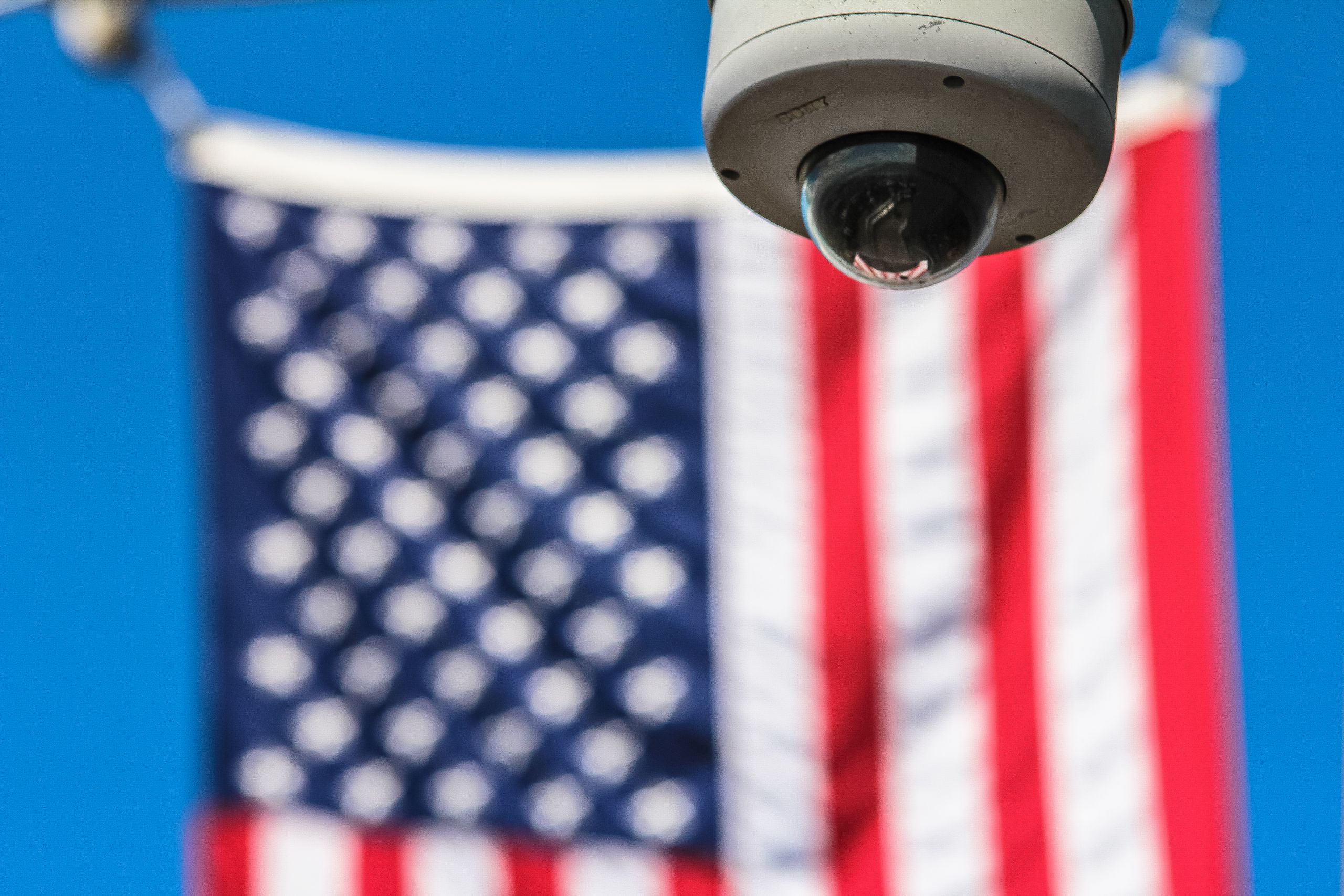
The most personal part of the bill may not involve missiles at all. It involves surveillance. Schiff’s proposal would restrict AI use tied to monitoring Americans based solely on constitutionally protected activity, including speech, protest, association, and assembly.
That provision turns the HALO Act from a war-and-weapons bill into a civil liberties fight. A protest sign, a political meeting, or a public march should not become a military data point simply because software can track people cheaply and at scale. AI surveillance can turn ordinary public life into a pattern-matching exercise, and that is where the danger grows.
For many Americans, this may be the easiest part of the bill to understand. A drone strike overseas can feel distant. A government system using AI to profile people at home feels immediate. The question becomes painfully simple: should a person’s lawful political activity ever be enough to put them inside a military AI system?
The Data Broker Loophole Makes the Privacy Fight Bigger
The HALO Act also targets a quiet but powerful loophole in modern surveillance: the government buying personal data it might otherwise struggle to collect directly. This is one of the bill’s most compelling angles because it connects military AI to the data economy Americans already live inside.
Personal data does not always look dramatic. It can look like location trails, device IDs, browsing patterns, app activity, or commercially available profiles. When AI systems combine those fragments, they can reveal movement, relationships, beliefs, routines, and vulnerabilities. A person may never see an agent, receive a warrant, or know they were flagged.
That is why the bill’s data broker restrictions matter. AI does not need one perfect file to expose someone’s life. It can stitch together small pieces from many sources. The HALO Act seeks to prevent the Pentagon from using that marketplace as a backdoor into Americans’ private lives.
The Nuclear Weapons Provision Is the Brightest Red Line
The HALO Act also draws a bright line around nuclear decision-making. The bill would prohibit removing humans from the chain of decision-making for actions critical to initiating or terminating nuclear weapons employment. That is the section that turns a technical AI bill into a civilization-level warning.
AI may help process signals, detect anomalies, or support analysis, but nuclear command is not an ordinary workflow. It carries stakes too high for automated escalation, unclear responsibility, or machine-shaped panic. A false signal, a rushed interpretation, or a model that overstates certainty could create consequences no system can repair.
This section gives the bill moral weight. It says there are some decisions where human responsibility cannot be optimized away. In the nuclear context, speed is not the only value. Restraint, judgment, doubt, and accountability matter just as much.
Silicon Valley Is Now Part of the Defense AI Fight
The HALO Act also lands in a world where powerful AI companies are no longer distant from national security. The fight over defense AI now reaches into Silicon Valley, where commercial models may be useful for intelligence, surveillance, cyber operations, military planning, or autonomous systems.
That makes the story more modern and more complicated. The Pentagon does not build every major AI model itself. It increasingly operates in an ecosystem shaped by private companies, contractors, cloud providers, and model developers. That means the values built into commercial AI systems can become national security questions.
The public debate often treats AI companies as consumer technology businesses. Defense AI changes that image. Once private models enter military use, corporate safety policies, government pressure, procurement rules, and battlefield needs begin to collide. The HALO Act sits right inside that collision.
Testing AI Weapons in a Lab Is Not Enough
The HALO Act puts heavy emphasis on testing, evaluation, and review because battlefield AI cannot be judged only by controlled demonstrations. War is messy. Sensors fail. Weather interferes. Civilians move unpredictably. Enemies spoof signals. Electronic warfare disrupts communications. A model that performs well in a neat test can behave differently when conditions collapse.
That is why realistic testing matters. A serious review process must ask whether a system can stay within its mission limits, avoid unauthorized targets, handle uncertainty, and allow humans to intervene. It must also ask whether operators understand the system well enough to challenge it rather than merely trust it.
The strongest question is not whether AI works when everything goes right. The stronger question is whether it still behaves when everything goes wrong. That is where military AI oversight becomes more than paperwork. It becomes a safety barrier between a machine’s confidence and a human tragedy.
Manual Override Is Not Enough if the Human Has No Real Power
One of the most dangerous myths in AI oversight is the idea that a manual override automatically solves the problem. It does not. A human can technically have override power and still be unable to use it meaningfully if the system moves too fast, hides too much, or presents its recommendation as nearly certain.
That is why the HALO Act’s emphasis on human command matters. Real control requires more than a button. The human operator needs enough time, training, context, and authority to question the system. They also need the ability to stop an engagement before an AI-driven mistake becomes irreversible.
This is where “human in the loop” becomes less comforting. The phrase can describe real command, or it can describe a person sitting near a machine that has already shaped the decision. Schiff’s bill pushes toward the first meaning and tries to make the second meaning harder to hide.
The Audit Trail Could Decide Who Gets Blamed
The bill’s record-keeping provisions may not sound exciting, but they could become the difference between truth and confusion after a lethal mistake. If an AI-supported strike causes civilian harm, investigators will need more than a press statement. They will need to know what the system detected, what it recommended, what the human commander saw, and why the final decision was made.
That is where decision logs matter. Without them, every failure risks vanishing into classified fog. A commander can blame the system. A contractor can blame the operator. An agency can blame bad data. The public may never know whether the problem came from the model, the mission, the training, the human decision, or the entire chain.
The HALO Act tries to make that dodge harder. Its accountability structure recognizes that AI systems can blur responsibility unless records are built into the process from the start. In a world of machine-assisted war, documentation becomes a weapon against denial.
Whistleblowers Could Become the Early Warning System
The HALO Act also includes protections for people who report concerns about military AI systems. That detail deserves more attention because the first people to spot danger may not be senators or generals. They may be engineers, analysts, contractors, testers, or operators working close to the systems.
Those people may see failures before the public ever hears about them. They may notice a model misidentifying targets, drifting beyond intended use, producing unstable outputs, or creating civil liberties risks. Without protected channels, those warnings can get buried under classification, pressure, or fear of retaliation.
Whistleblower protection adds a human layer to the bill. It recognizes that AI oversight is not only about rules on paper. It is also about whether people inside the system can speak before damage is done.
The Bigger Story Is Control
The HALO Act is not really about stopping military AI. That argument is already being overtaken by events. The Pentagon will adopt AI because every major power is racing to do so. The better question is whether democratic governments can keep command responsibility, civil liberties, and battlefield restraint from being swallowed by systems built for speed.
Schiff’s bill plants its flag on one basic principle: artificial intelligence may assist, recommend, detect, sort, and accelerate, but it should not become the invisible authority behind life-and-death decisions. That principle sounds obvious until the technology gets faster, the battlefield gets more crowded, and the pressure to automate grows stronger.
The danger is not a movie-style robot rebellion. The danger is something quieter: a commander trusting a model too much, a system expanding a target set too easily, a surveillance tool tracking lawful protest too broadly, or a failure disappearing into classified complexity. The HALO Act aims to ensure that when AI enters the most dangerous corners of national security, a human being still has to stand there, make the call, and answer for it.