Some kitchen tools have a way of surviving every new trend. They don’t need touchscreens, complicated settings, or glowing buttons. Just a steady hand, a little patience, and someone who knows their worth.
The Smithsonian preserves a rotary egg beater bearing an October 9, 1923, patent date, while another example features a trademark introduced in 1947. More than a century after that early patent, modern manufacturers still sell similar hand-operated tools.
From the familiar gadgets of 1980s American kitchens to today’s specialty cooking equipment, some older designs have never completely disappeared.
Here are ten old-school kitchen gadgets that continue to prove their usefulness, one crank, squeeze, and satisfying turn at a time.
Hand-Crank Egg Beater: The Little Mixer That Keeps Turning
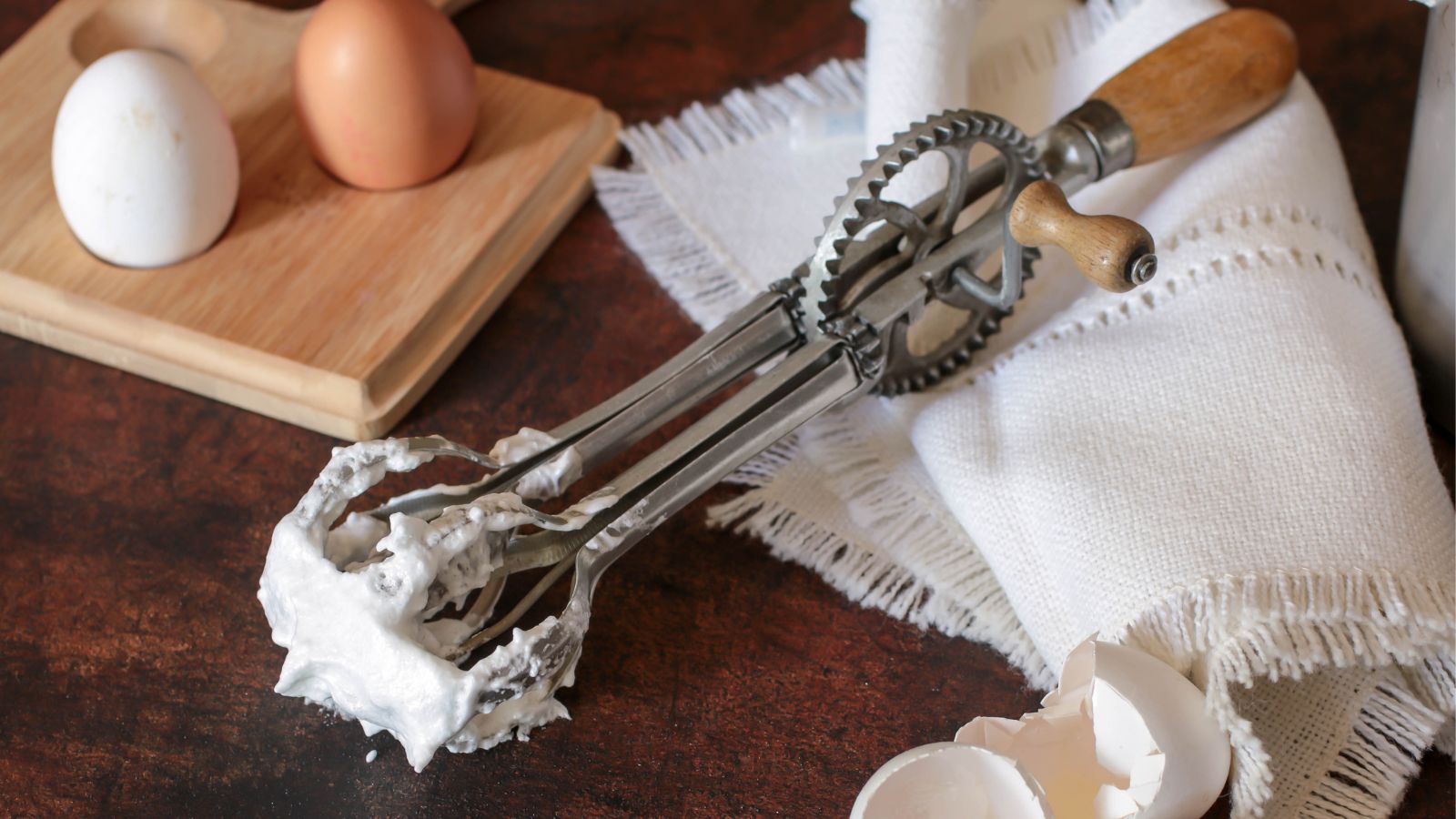
Before electric mixers became familiar kitchen companions, the hand-crank egg beater offered a wonderfully straightforward way to mix ingredients.
The Smithsonian’s National Museum of American History preserves an A&J rotary egg beater marked with an October 9, 1923, patent date. Turning its large wheel activates smaller gears connected to two rotating beaters.
The design wasn’t forgotten. OXO currently offers a manual egg beater with removable beaters and a detachable dishwasher-safe base.
There’s something delightfully satisfying about watching a few turns of the handle bring ingredients together. No motor required, just an old idea that still works.
Food Mill: The Hand-Crank Wonder for Sauces and Purées
A food mill might look like an awkward metal bowl with a handle, but don’t underestimate its talents.
According to OXO’s food-mill instructions, turning the crank pushes food through interchangeable perforated discs. Different discs can produce smooth applesauce, tomato sauce, or mashed potatoes.
The clever part? It can separate unwanted skins and seeds while processing food.
Independent testing by Serious Eats found that the OXO food mill produced smooth tomato passata and potato purée without the gumminess sometimes associated with aggressive processing.
For cooks who enjoy making sauces from scratch, this old-fashioned mechanism still has plenty to offer. Sometimes a gentle turn achieves the texture you want.
Stovetop Percolator: Coffee With an Old-Fashioned Rhythm
Few kitchen rituals feel as nostalgic as coffee brewing in a stovetop percolator.
Unlike an electric drip machine, this traditional brewer relies on heat and a reusable filter basket rather than an integrated electric brewing system.
Farberware still sells its Yosemite stovetop percolator in 8-cup and 12-cup versions. The current model features stainless-steel construction, a glass knob, and a permanent filter basket that eliminates disposable paper filters.
One detail deserves attention: Farberware’s specifications say the model isn’t induction-compatible, despite broader stovetop-compatibility language elsewhere in its description.
For anyone who appreciates the history of classic American kitchen appliances, the percolator is another example of familiar cooking technology that still finds an audience.
Electric Carving Knife: The Holiday Dinner Specialist
There’s something wonderfully ceremonial about bringing out an electric carving knife when a holiday roast reaches the table.
The concept remains practical. According to Hamilton Beach, its electric knives use two serrated stainless-steel blades that move rapidly back and forth.
The company’s current 74277G model features a 120-watt motor, 8-inch carving blades, a 6-inch carving fork, and a storage case.
Although Thanksgiving turkey might be its most familiar assignment, Hamilton Beach also identifies ham, roasts, and bread among its intended uses.
It’s not a forgotten appliance. The electric carving knife is still available for cooks who appreciate a dedicated tool when the big roast makes its entrance.
Hand-Crank Meat Grinder: An Old-School Kitchen Workhorse
Long before countertop appliances offered countless attachments, manual meat grinders were doing a straightforward job with a crank and a sturdy mounting system.
Lehman’s currently sells a No. 10 clamp-on manual meat grinder that attaches to a work surface and operates without electricity.
The process is simple: place meat in the hopper, turn the handle, and collect the ground meat. The retailer also offers bolt-down models, which require a different mounting arrangement.
That distinction matters if you’re considering one for your kitchen. A clamp-on grinder is removable, while a bolt-down version needs more permanent placement.
It’s a specialized tool, but one whose mechanical simplicity still appeals to cooks who want direct control over their preparations.
Flour Sifter: The Baking Tool With a Gentle Touch
A flour sifter doesn’t make much noise. It makes only a soft mechanical whisper as dry ingredients pass through a mesh screen.
Norpro still sells an old-fashioned hand-crank flour sifter with a 3-cup capacity, stainless-steel construction, and a two-wire agitator.
The manufacturer recommends it for sifting flour and creating an even dusting of powdered sugar.
Sifting isn’t necessary for every modern baking recipe, but the tool still has a clear purpose when a recipe calls for finely screened ingredients.
And unlike elaborate gadgets that promise to do everything, a flour sifter has always known its job.
For anyone considering which kitchen gadgets deserve valuable drawer space, that’s a useful quality.
Cookie Press: The Secret Behind Beautiful Little Cookies
Some baking traditions come with their own special equipment, and the cookie press is a charming example.
The tool pushes dough through patterned discs, creating spritz cookies in decorative shapes.
OXO’s current 14-piece cookie press set includes 12 stainless-steel discs featuring designs such as flowers, wreaths, and snowflakes.
In independent testing, Serious Eats evaluated seven cookie presses using spritz-cookie dough, disc changes, cheese straws, and cleaning tests. Its tester particularly liked lever-operated models for their dispensing control.
Not every cookie dough works in a press, but appropriate spritz dough can produce beautifully shaped batches. For holiday baking, this familiar gadget still brings a little ceremony to the kitchen counter.
Hand-Crank Nut Chopper: Small Gadget, Big Personality
A hand-crank nut chopper is one of those delightfully specific kitchen gadgets that makes perfect sense once you understand its purpose.
Norpro’s current nut-and-topping chopper features stainless-steel blades, a glass collection base, and a 1¼-cup capacity.
The manufacturer identifies walnuts, peanuts, cashews, pecans, and pistachios among suitable ingredients. It also suggests chopping cookies, crackers, and cereal for toppings.
Instead of scattering chopped pieces across a cutting board, the tool collects them in its container.
It’s hardly the most elaborate equipment in the kitchen, but that’s part of its charm.
Turn the handle, collect the pieces, and sprinkle them over your favorite creation. Simple tools can still make cooking enjoyable.
Citrus Reamer: A Simple Twist for Fresh Juice
A citrus reamer has one wonderfully uncomplicated assignment: extracting juice from citrus fruit.
No elaborate machinery, no complicated assembly. Just a ridged reamer and a little turning.
OXO’s current small citrus juicer combines the traditional reamer design with a built-in strainer that catches seeds and pulp. The collection container includes measurement markings and a pouring spout.
The manufacturer also identifies the tool as dishwasher-safe.
It’s a practical option when a recipe calls for a small amount of citrus juice rather than a large batch.
Not every kitchen task needs an electric appliance. Sometimes the simplest movement—a firm, steady twist—is exactly what the recipe requires.
Potato Ricer: The Humble Tool Behind Smooth Mashed Potatoes
A potato ricer looks a little like an oversized garlic press, and it works on a similar principle.
Cooked potatoes go into a perforated basket, where a pressing plate forces them through small openings.
Serious Eats tested nine potato ricers while preparing 18 pounds of mashed potatoes. The reviewer found that the models produced smooth, fluffy results, although some were more comfortable and convenient to use than others.
The testers particularly valued sturdy construction, comfortable handles, and uncomplicated designs.
Unlike a food mill, which uses a rotating mechanism, a ricer relies on direct pressure.
For cooks who love carefully prepared mashed potatoes, this dedicated gadget still has a convincing reason to exist.
Sometimes the Old Ways Still Make Sense
These ten gadgets aren’t merely relics from another era. Their continued appearance in manufacturers’ catalogs shows that the designs still serve recognizable kitchen purposes.
The Smithsonian’s 1923 egg beater and today’s modern hand-crank versions share a simple principle: useful cooking equipment doesn’t always need to be complicated.
Not every old gadget deserves permanent space in your drawer, of course. But if a tool regularly helps you prepare something you love, age alone isn’t a reason to replace it.
Sometimes the most satisfying kitchen upgrade is rediscovering what already works.