A Detroit Coney dog arrives with a familiar lineup: a natural-casing frankfurter, a soft steamed bun, beanless meat chili, chopped white onions, and yellow mustard. It needs no silverware or elaborate presentation, though extra napkins are a sensible precaution. What makes it a local icon is everything attached to that combination: immigrant entrepreneurship, the city’s industrial history, generations of neighborhood restaurants, and a rivalry so enduring that choosing a favorite can sound like declaring allegiance to a sports team.
That loyalty isn’t just restaurant marketing. In NPR’s 2012 report on the dish, Coney Detroit co-author Joe Grimm described American Coney Island and Lafayette Coney Island customers “who are beyond middle age who will tell you they’ve never stepped into to the other” shop. The restaurants stand next door to one another downtown, making that refusal particularly impressive. For some customers, the distance between them is not measured in footsteps; it is measured in family habits and strongly held lunch opinions.
The name can confuse newcomers, too. Despite the reference to Brooklyn’s famous seaside destination, Detroit’s chili-topped specialty should not be mistaken for a hot dog invented at New York’s Coney Island. The Detroit Historical Society explicitly calls that a misconception. One explanation connects the name to Greek immigrants who encountered Coney Island while passing through New York, but the society presents that as a story rather than a settled origin. The food’s Michigan identity is clearer than the details of its earliest creation.
A Simple Order With Very Specific Expectations
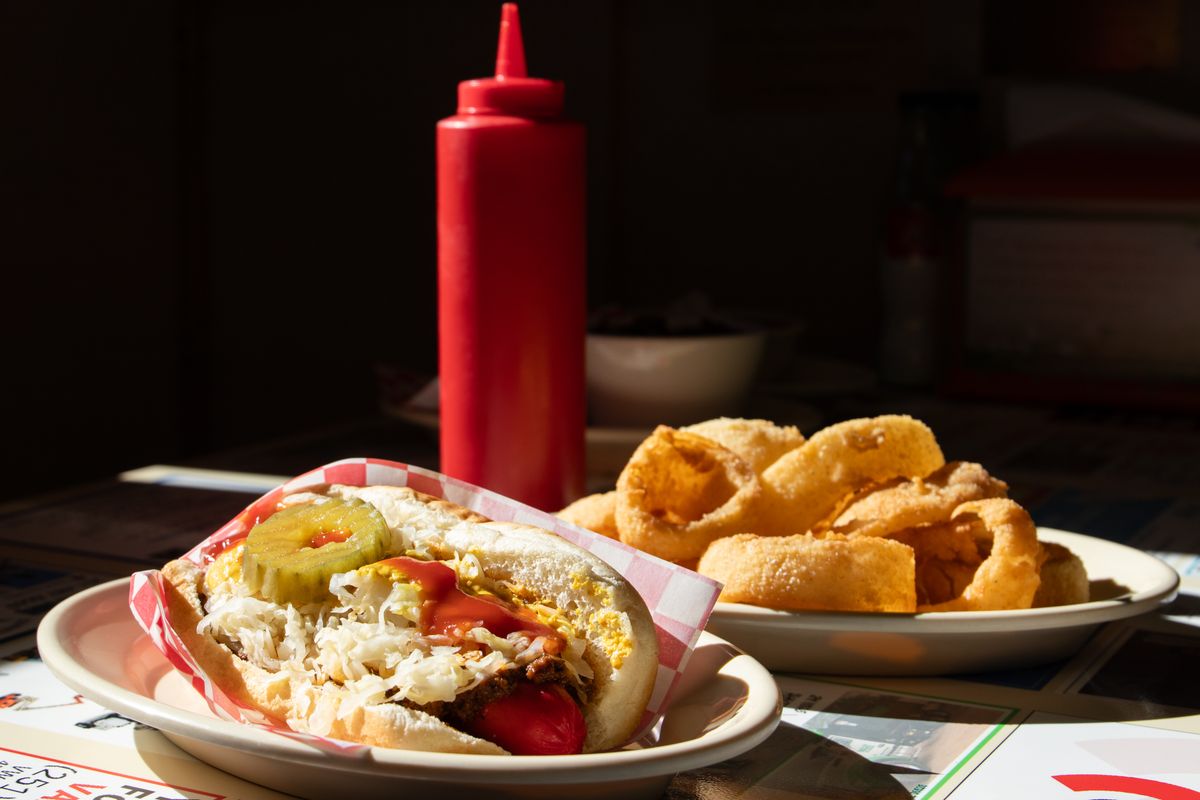
The defining topping is the beanless meat chili, not a bowl of bean-filled chili transferred onto a hot dog. Add diced white onion and yellow mustard, and the result has the recognizable Detroit combination. Even the frankfurter deserves attention: the Detroit Historical Society describes a beef dog, while NPR notes that natural-casing franks may contain a beef-and-pork blend. The consistent feature is the casing, which provides the characteristic bite beneath the soft bun and generous topping.
Detroit PBS’s documentary coverage makes it clear that producers don’t consider the ingredients interchangeable. Dearborn Sausage owner Don Kosch explained that different Coney restaurants have their own hot-dog specifications: “Everybody seems to have a particular taste profile, so you have to stick to what the customers are used to.” That helps explain the loyalty. Two restaurants can serve the same basic combination while delivering enough differences in the frank, sauce, and proportions for regulars to notice immediately.
Then there is the ketchup question. In the same documentary, American Coney Island’s third-generation owner Grace Keros drew a firm distinction between accommodating a customer and changing the house tradition. “As a matter of fact, even today, when people ask for ketchup on a hot dog, I give them the bottle,” she said. “So you put it on; we don’t put ketchup on a Coney dog.” That is restaurant custom, not a law but it illustrates how seriously the familiar order is protected.
Related: ‘Amazing Race’ Alum and Competitive Eating Legend Tim ‘Eater X’ Janus Dies at 49 After Cancer Battle
Immigrant Businesses Fed a Fast-Moving City
The Coney’s history is closely connected to Greek immigrants building businesses in an expanding Detroit. NPR’s account describes the city’s early-20th-century factory boom, when workers needed quick meals and hot-dog restaurants offered newcomers a comparatively inexpensive way to get into business. “They were trying to serve American factory workers trying to come in off a crowded street,” Grimm explained. A meal that could be assembled and eaten quickly fit the pace of a city organized around industrial work.
American Coney Island traces its founding to 1917 and Constantine “Gust” Keros. The Detroit Historical Society identifies his brother William with the neighboring Lafayette business, although published histories differ on the precise chronology of the brothers’ partnership and separation. That uncertainty is a reason to avoid turning a colorful sibling-rivalry story into an indisputable timeline. The better-established point is their importance in popularizing the downtown Coney tradition, not a claim that their restaurants definitively invented every version of the dish.
Michigan’s Coney story also extends beyond Detroit. The Historical Society identifies Todoroff’s Original Coney Island in Jackson, dating to 1914, as predating the famous Detroit restaurants. It concludes that no single place can definitively claim the Coney dog’s birthplace. Flint developed another recognizable version, using a loose-meat topping rather than Detroit’s saucier chili. Calling the Detroit Coney iconic therefore does not require erasing other Michigan traditions or insisting that one city owns the entire category.
The Rivalry Is Famous, but the Tradition Is Bigger

American and Lafayette remain the most recognizable symbols of the debate. According to the Detroit Historical Society, American’s chili is generally described as spicier, while Lafayette’s is beefier. American has remained associated with the Keros family, while Lafayette is no longer family-owned. For a first-time visitor, the key distinction is that these are separate restaurants with different preparations, not two counters selling an identical product. Their proximity makes comparison easy; decades of devoted customers make agreement considerably harder.
But Detroit’s Coney culture is not confined to that downtown corner. The Historical Society documents hundreds of Coney Island restaurants across Michigan, including larger Detroit-area operators such as Leo’s and National. Locally, “Coney” can mean the diner as well as the hot dog itself. NPR also describes how restaurants followed customers into the suburbs, letting the tradition travel with changing neighborhoods rather than stay tied to a single downtown location.
That broader network explains the dog’s loyalty better than any topping list alone. It is a recognizable meal tied to familiar businesses, family routines, and the city’s working history. Keros offered a practical measure of the experience in Detroit PBS’s coverage: “You know a good coney by how many napkins you use.” Grimm supplied the larger point in NPR’s report: “People who think it’s just a messy hot dog … are kind of missing the point.” In Detroit, the mess is part of lunch; the attachment comes from everything surrounding it.
Other Stories You Might Like
- Presley Gerber’s Ex Charlotte D’Alessio Says “You Deserved More Life” in Heartfelt Tribute After His Death
- Taylor Swift Drops “Patient Zero” Surprise, and Swifties Are Already Losing It Over the Zeros