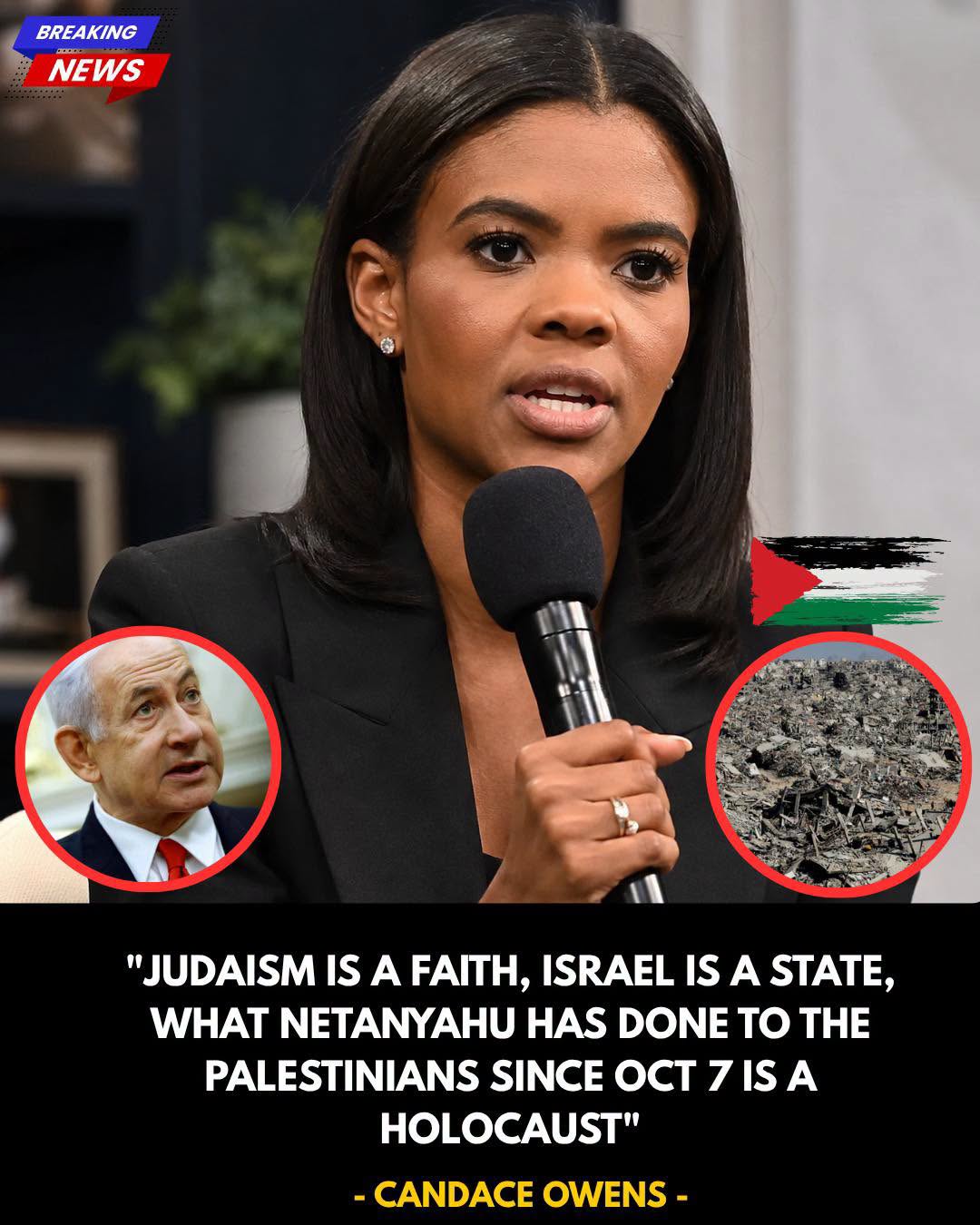
A video of conservative commentator Candace Owens is circulating again online, carrying a blunt message about the line between criticism of Israel and hostility toward Jewish people. But the clip is not new. The remarks come from Owens’ December 19, 2024 appearance on Piers Morgan Uncensored, where the discussion turned to Israel’s war in Gaza and accusations that Owens’ rhetoric had crossed into antisemitism.
“Judaism is a faith. Israel is a state,” Owens said. She then made a far more explosive claim, describing what Israeli Prime Minister Benjamin Netanyahu had done to Palestinians after Hamas’ October 7, 2023 attack as “a holocaust.”
The distinction Owens is making matters, but so does her choice of words
The Holocaust is the name given to Nazi Germany’s systematic persecution and murder of six million European Jews between 1933 and 1945. Using the word for another conflict can therefore be viewed as historically inflammatory or as diminishing the specific character of the Nazi genocide. Owens, however, used it to argue that the scale of Palestinian death and destruction should not be insulated from criticism simply because Israel defines itself as a Jewish state.
The core distinction Owens raises is not, by itself, outside mainstream definitions of antisemitism. The International Holocaust Remembrance Alliance says criticism of Israel comparable to criticism directed at other countries “cannot be regarded as antisemitic.” At the same time, the IHRA notes that targeting Israel as a stand-in for Jews collectively can cross that line. In other words, criticism of an Israeli government policy is not automatically criticism of Jewish people, but language and context still matter.
That distinction is especially important because antisemitism is hatred of or prejudice against Jewish people. Political disagreements with Netanyahu, his coalition or decisions made by the Israeli military are not inherently judgments about Judaism or Jewish people worldwide.
Gaza’s enormous human toll keeps the argument alive
The numbers behind the Gaza war explain why the debate remains so emotionally charged. Hamas-led militants killed about 1,200 people in Israel during the October 7, 2023 attack and took 251 hostages. Israel responded with a massive military campaign in Gaza.
By June 21, 2026, UNRWA, citing Gaza’s Ministry of Health, reported that 73,035 Palestinians had been killed and another 173,368 injured since the war began. UNICEF reported in July that about 1.9 million of Gaza’s roughly 2.1 million residents remained displaced.
A joint assessment by the United Nations, European Union and World Bank also said more than 1.2 million people had lost their homes, while more than 1.9 million had experienced internal displacement. Those figures do not settle every political or legal argument surrounding the conflict, but they make one fact difficult to dispute: Gaza has suffered extraordinary loss of life, displacement and physical destruction.
Owens’ use of the term “holocaust,” however, goes further than simply criticizing Netanyahu.
In September 2025, a U.N. Independent International Commission of Inquiry concluded that Israeli authorities and security forces had committed genocide against Palestinians in Gaza. Israel categorically rejected the finding, calling the commission’s conclusions false and biased.
Separately, South Africa’s genocide case against Israel remains before the International Court of Justice. The court has considered requests for provisional measures, but its case page does not show a final judgment on the merits declaring Israel responsible for genocide.
That distinction matters. Owens’ wording was a political and moral characterization, not a court ruling.
Criticizing a government is different from blaming an entire people
Owens herself has become a deeply controversial figure in the wider antisemitism debate. The Anti-Defamation League has accused her of promoting antisemitic conspiracy theories and Holocaust distortion, allegations that go beyond her criticism of Netanyahu. Owens, meanwhile, has repeatedly rejected the idea that opposing Israeli policy should automatically make someone antisemitic.
That is where the issue becomes more complicated than a viral video can capture.
It is possible to criticize Netanyahu, the Israeli military or Israeli government policy without attacking Judaism. It is also possible for rhetoric about Israel to become antisemitic when it assigns collective guilt to Jewish people or relies on established anti-Jewish stereotypes and conspiracies.
The same principle applies to Palestinians. Palestinian civilians are not automatically responsible for Hamas’ October 7 attack, just as Jewish communities around the world are not responsible for decisions made by Israel’s government. Treating entire populations as extensions of governments or armed organizations wipes away a crucial distinction between ordinary people and institutions exercising political or military power.
Owens’ short formulation, “Judaism is a faith. Israel is a state,” has attracted attention because it puts that distinction into eight words. Her Holocaust comparison makes the rest of her argument much more contentious.
For her supporters, the language reflects outrage over documented mass death, displacement and destruction in Gaza. For her critics, invoking the Holocaust in this context is offensive, historically reckless and particularly troubling given some of Owens’ previous statements about Jews and Holocaust history.
But one principle can survive that dispute: governments can be scrutinized without assigning collective blame to a religion or ethnicity. The argument over Gaza is already fierce enough without treating Jewish identity as interchangeable with the Netanyahu government, or Palestinian identity as interchangeable with Hamas. Accountability becomes clearer, not weaker, when those distinctions are preserved.