Sen. Elizabeth Warren has turned America’s latest mortgage-rate increase into a sharp political attack on President Donald Trump, arguing that his war with Iran is making the dream of homeownership even harder to reach.
“BREAKING: Mortgage rates jumped to the highest level in more than a YEAR thanks to Donald Trump’s war with Iran,” the Massachusetts Democrat wrote on X on August 1. “Trump doesn’t care if you can afford to buy a home.” Warren posted the message after Freddie Mac reported that the average 30-year fixed mortgage rate had climbed to 6.66%.
The rate has since risen again. Freddie Mac’s August 6 survey placed the average 30-year mortgage at 6.69%, up from 6.66% a week earlier and 6.58% two weeks earlier. It was the highest reading since late July 2025. The average 15-year fixed rate, however, slipped slightly to 6.01%.
Warren’s accusation lands at an uncomfortable moment for Trump. He returned to office promising lower borrowing costs, cheaper housing and an economy strong enough to deliver what he once called “Rocket Fuel” through interest-rate cuts. Instead, prospective buyers are once again watching mortgage rates drift toward 7%.
Warren puts the blame directly on Trump
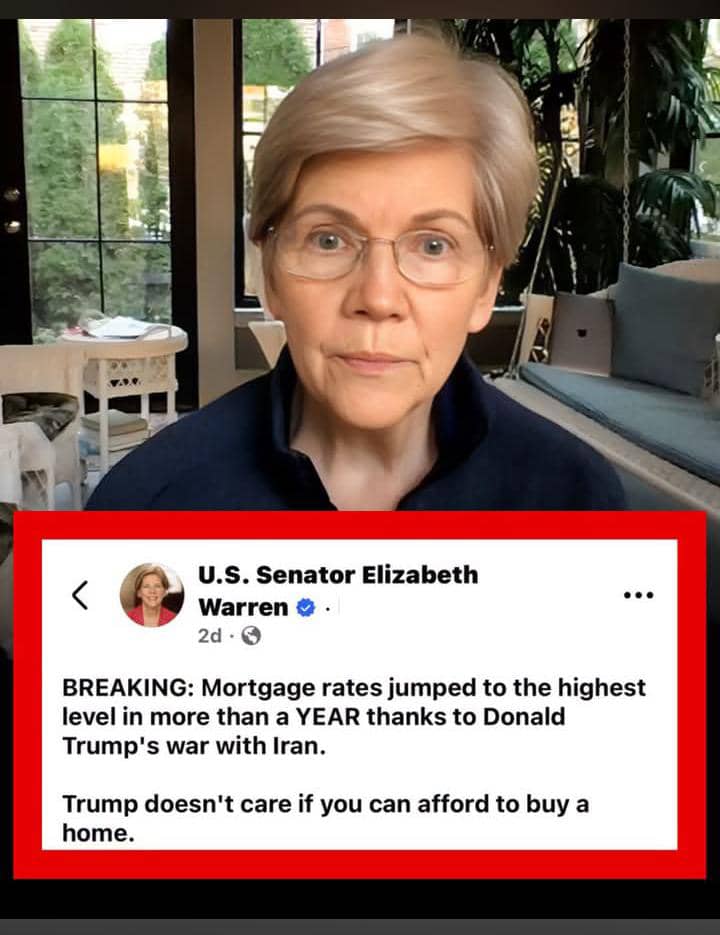
Warren’s post was not a carefully hedged economic analysis. It was a political punch aimed directly at the president.
She has opposed the Iran conflict since it began in late February, describing Trump’s decision to launch military action without congressional authorization as “dangerous and illegal.” In her February 28 statement, Warren argued that the United States was being pulled into “another forever war” while domestic concerns were being neglected.
Her mortgage-rate criticism extends that argument from foreign policy into the family budget. In Warren’s telling, the war is no longer something happening thousands of miles away. It is showing up in oil prices, inflation fears, bond markets and, ultimately, the monthly payment required to buy a home.
The White House rejects the suggestion that Trump does not care about housing affordability. In June, the president proclaimed that his administration was committed to making homeownership more accessible. Trump said he had directed Fannie Mae and Freddie Mac to purchase $200 billion in mortgage-backed securities to help reduce borrowing costs. He also blamed previous federal spending, regulation, institutional investors and immigration for the broader housing shortage.
More recently, White House spokesman Kush Desai argued that Trump’s effort to end the Iran conflict would eventually relieve inflation pressure.
“Oil prices, and thus overall inflation, will plummet again when President Trump forces a successful resolution with Iran, further paving the way for additional interest rate cuts by the Federal Reserve,” Desai said.
Trump has also continued to present the economy positively. “We have the most successful environment that we’ve ever had,” he told his Cabinet on July 31, pointing to investment entering the United States.
The Iran war matters, but it is not the only factor
Warren’s argument has an economic foundation, but describing the war as the sole cause of higher mortgage rates would oversimplify the situation.
Mortgage rates generally move alongside the yield on the 10-year Treasury note. Investors demand higher yields when they expect stronger inflation, tighter monetary policy, or greater economic risk. Lenders then use those yields as a guide when pricing home loans.
Before the Iran war began in late February, the 10-year Treasury yield stood at about 3.97%. By midday on August 6, it had climbed to approximately 4.65%. The conflict has disrupted energy markets and pushed oil prices higher, raising fears that transportation, manufacturing and consumer prices will remain elevated.
That connection helps explain why mortgage rates have reacted to developments involving Iran and the Strait of Hormuz. When markets fear prolonged fighting or restricted oil shipments, inflation expectations rise. When there are signs of de-escalation, bond yields and mortgage rates often ease.
Still, the war is only one part of the story. Inflation, Federal Reserve decisions, global bond selling, tariff uncertainty, government borrowing and investor expectations also affect long-term rates. Mortgage rates are set by financial markets, not directly by the president or the Federal Reserve.
“Markets reflect the higher inflation, policy uncertainty,” economist John Silvia told The Associated Press. “They are the product of events.”
Two major mortgage surveys also produce slightly different numbers because they use different samples and methods. Freddie Mac reported a 6.69% average on August 6, while the Mortgage Bankers Association’s previous weekly survey placed the average contract rate at 6.81%. Both measurements point to the same trend: borrowing costs have moved higher.
Homebuyers are stuck with the bill

The political argument may be loud, but the math facing buyers is louder.
The national median price of an existing single-family home reached $434,900 during the second quarter of 2026, according to the National Association of Realtors. Home prices increased in 80% of the metropolitan areas tracked by the organization.
For a typical existing home purchased with a 20% down payment, NAR calculated an average monthly mortgage payment of $2,199. That was $219 more than during the previous quarter. A typical first-time buyer purchasing a starter home with 10% down faced an estimated payment of $2,158, consuming nearly 36% of the household’s income.
NAR Chief Economist Lawrence Yun said rising incomes had helped improve affordability in some areas, but warned that “the big short-term challenge to affordability is coming from rising mortgage rates.”
The pressure is already visible in loan demand. Mortgage applications fell 2.9% in the Mortgage Bankers Association’s latest weekly survey. Mike Fratantoni, the association’s chief economist, said applications for both purchases and refinancing were running behind the previous year’s pace, indicating that higher rates had weakened demand.
Warren’s statement that Trump “doesn’t care” is a political judgment, not a measurable fact. Her broader warning, however, is supported by the market numbers. The Iran conflict has contributed to the inflation concerns and higher bond yields pushing mortgage rates upward, even though it is not the only force involved.
Washington can debate who deserves the blame. Homebuyers have a simpler concern: every increase in borrowing costs shrinks the house they can afford, raises the payment they must carry, or forces them to postpone buying altogether. That makes mortgage rates more than an economic statistic. They are becoming a powerful political test of whether Trump can deliver the lower costs he promised.