A humanitarian mission intended to help Venezuela recover from a catastrophic natural disaster has become the center of a heated political fight.
Around 100 demonstrators gathered in Plaza Bolívar in central Caracas on July 24, burning American and Israeli flags while condemning the two countries’ involvement in earthquake recovery operations. The protesters also stepped on photographs of U.S. President Donald Trump and Israeli Prime Minister Benjamin Netanyahu as they marched through the capital.
Some participants shouted, “Gringos, go home,” while others carried signs accusing Washington of using humanitarian assistance to expand its influence in Venezuela. Another chant declared, “This is not aid, it is an occupation.” The demonstrators presented the foreign rescue and reconstruction teams as a threat to Venezuelan sovereignty rather than neutral disaster workers.
The protest unfolded exactly one month after two powerful earthquakes devastated northern Venezuela. It also coincided with celebrations marking the 243rd anniversary of the birth of Simón Bolívar, the Caracas-born military leader who helped free several South American territories from Spanish rule. Bolívar was born on July 24, 1783.
Foreign assistance becomes a political flashpoint

The earthquakes struck Venezuela on June 24, with estimated magnitudes of 7.2 and 7.5. They damaged residential neighborhoods, public buildings, roads and other critical infrastructure across northern areas, including Caracas and coastal communities in La Guaira. Government figures cited by Reuters placed the death toll at approximately 5,000, with nearly 17,000 people injured and about 18,000 left homeless.
An early World Bank assessment estimated direct physical damage at $19.6 billion. Reconstruction costs could approach $50 billion once debris removal, safer construction methods and structural improvements are included. Residential buildings accounted for 47% of the estimated damage, while infrastructure made up another 27%.
The United States responded by deploying a Disaster Assistance Response Team and specialized urban search-and-rescue crews. The State Department said the operation included firefighters, doctors, structural engineers, canine teams and logistical support. American military assets were also assigned to help transport personnel, equipment and relief supplies into affected areas.
Israel sent its own delegation after receiving a request from Venezuela’s government. According to Israel’s Foreign Ministry, dozens of officials and emergency specialists worked alongside local authorities to inspect damaged buildings and determine whether displaced residents could safely return. Approximately 20 additional experts based in Israel analyzed information and helped develop a broader national recovery plan.
For Washington and Israel, those missions represent disaster relief. For the protesters in Caracas, however, the arrival of foreign personnel carried deeper political meaning.
Bolívar’s birthday added symbolism to the march
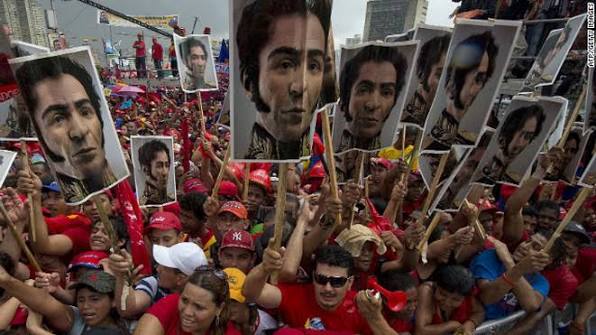
Holding the demonstration on Bolívar’s birthday was no accident. Participants gathered near places closely associated with Venezuela’s independence hero, using his legacy to frame their opposition to foreign involvement.
Bolívar remains one of the most powerful political symbols in the country. Former President Hugo Chávez placed his image and ideas at the center of his socialist political movement, which became known as the Bolivarian Revolution. Chávez’s supporters regularly portrayed resistance to American influence as part of Bolívar’s unfinished struggle for regional independence.
Several organizations involved in the July 24 protest described the American and Israeli presence as “imperialist.” Reports identified participants as Chavista activists, community organizations and members of popular political movements. A photographer working with AFP estimated the crowd at roughly 100 people.
The protesters’ decision to burn flags created the rally’s most dramatic images. Videos showed demonstrators carrying banners, chanting against Trump and Netanyahu and setting Israeli flags on fire. Reuters Connect carried footage supplied by Anadolu Agency, though Reuters noted that it had not independently verified or endorsed the material.
The demonstration also revealed tension inside Venezuela’s broader Chavista movement. Some activists believe cooperation with the United States and Israel crosses a political line, even during a national emergency. Their argument is that foreign governments can use relief operations to build lasting military, economic, or diplomatic influence.
A disaster response caught between need and distrust
Venezuela urgently needs international assistance. Thousands of families have lost relatives, homes or livelihoods, while reconstruction could take years. The World Bank warned that delayed investment could weaken the country’s productive capacity and keep economic output below pre-earthquake levels until at least 2036.
At the same time, the Caracas protest demonstrates how difficult it can be to separate humanitarian work from geopolitics. Rescue teams may arrive with engineers, medical supplies and search dogs, but citizens often judge them through decades of political history.
The rally did not represent every Venezuelan’s opinion, and its relatively limited size should be kept in perspective. Still, the burning flags delivered a clear message from one vocal segment of the population: even after a devastating earthquake, foreign assistance will not automatically overcome Venezuela’s deep suspicion of outside power.