A mother of six is challenging assumptions about who can homeschool after explaining that she never graduated high school, has no teacher training, and relies on a prepared curriculum to educate her children from preschool through 12th grade.
Kighley says her children are in 12th, 7th, 5th, 3rd, and 2nd grade, as well as preschool. She teaches world history, U.S. history, grammar, math, Latin and writing. In a TikTok video, she responds to someone who questioned her teaching experience, then opens the books and teacher guides she uses to manage lessons across several grade levels.
Her teaching method starts with someone else’s lesson plan
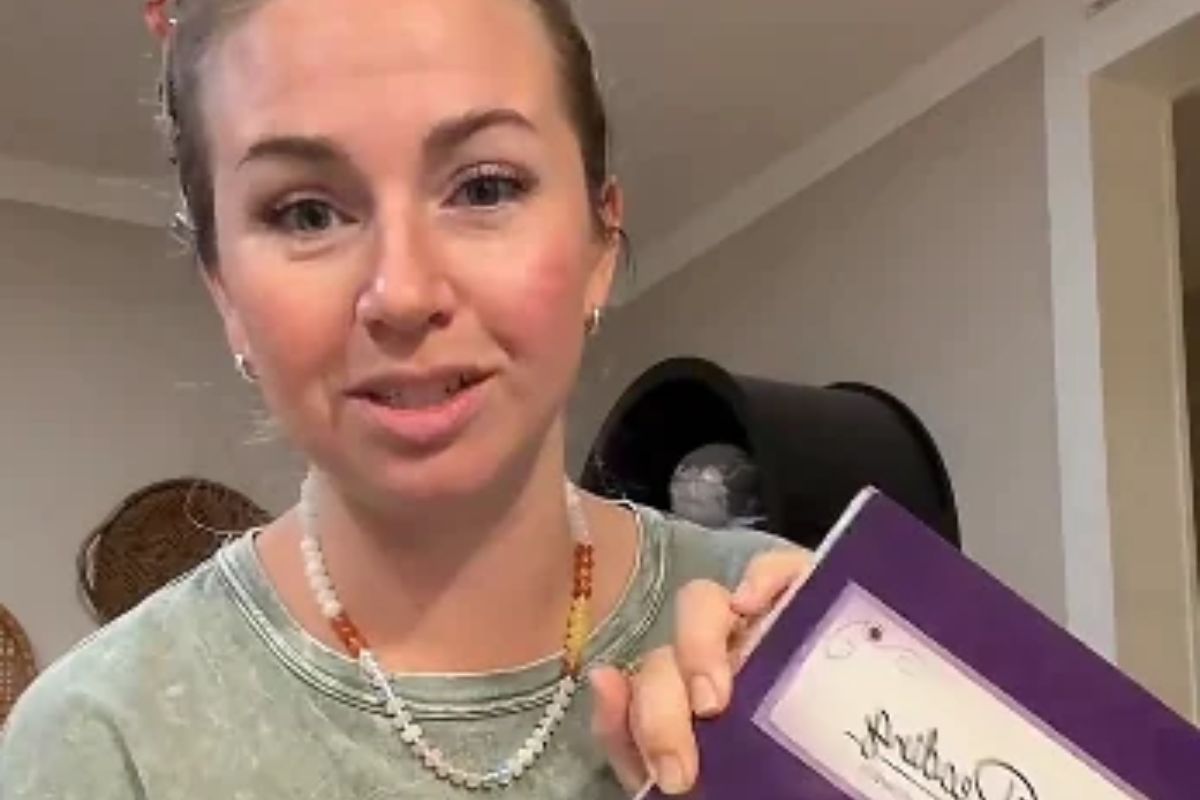
Kighley’s reading curriculum walks her through phonics rules and letter sounds. She demonstrates a phonogram exercise in which the parent identifies the first sound in a word beginning with S-I, mixes in other cards and practices until the student can identify the sounds accurately.
Her math example builds on multiplication facts a child already knows. The workbook uses five times six, which equals 30, as a stepping stone toward solving six times six. The parent reads the prompt and asks the child how the known answer can help with the next calculation.
For Latin, Kighley displays a teacher’s edition that explains how to present the lesson. A grammar guide offers similar support, while another curriculum has students read a lesson at the start of the week and practice it over the following days. An answer key lets the parent check the work.
Kighley says she buys some resources and prints others for free. She is not writing courses from scratch; curriculum authors have prepared the lessons and exercises. Her role is to follow the guide, work through the material and supervise the student.
Homeschooling remains a substantial part of the U.S. education picture
The National Center for Education Statistics reported that 3.4% of U.S. students ages 5 to 17 were homeschooled in 2023. A broader measure found 5.2% received instruction at home, up from 3.7% in 2019; that figure also includes 1.8% enrolled in public or private schools receiving full-time virtual instruction.
More recent state reporting suggests participation is still increasing in some places, although more slowly. Angela R. Watson of the Johns Hopkins Institute for Education Policy reported in September 2026 that 17 of the 22 states with available 2025–26 figures had higher homeschool counts than the previous year. Across those states, growth fell from 6.3% in 2024–25 to 1.5% in 2025–26. Five states reported declines, including Minnesota, down 10.8%, and North Carolina, down 7.5%.
The figures are not a complete national count. Thirty states, including Washington, D.C., publish annual homeschool numbers, and only 22 had reported 2025–26 figures when Watson conducted her analysis. Montana recorded a 27.7% increase, while North Dakota rose 18.8%.
Parents cite reasons beyond the mechanics of instruction. In the 2022–23 school year, 83% of parents of homeschooled students rated concern about the environment at other schools as an important reason. Moral instruction was cited by 75%, family life by 72%, and dissatisfaction with academic instruction by 72%. The most important single reason, selected by 28%, was concern about the school environment. The findings describe other families’ motivations, not Kighley’s, which she does not detail.
A curriculum can guide a lesson, but it cannot make every teaching decision
Kighley’s central claim is that “If you can read, you can teach your children.” Prepared materials can reduce the burden of choosing topics, sequencing exercises and preparing explanations. They give parents a route through subjects they may not have studied in depth.
The weakness in her slogan is that reading instructions and diagnosing a child’s misunderstanding are different skills. A parent still has to recognize when a child has misunderstood a concept, decide whether to repeat a lesson, identify gaps a workbook does not address and know when outside help is needed. Those demands become more complicated in a household with six children at different educational stages.
A teacher’s guide is a resource, not an independent assessment of learning. Kighley’s video shows how she presents selected lessons; it does not provide test results or outside evidence of what her children have mastered.
A 2026 systematic review in the Peabody Journal of Education counted 24 studies comparing academic outcomes: 15 reported positive results for homeschoolers, four found no difference, four were mixed and one favored conventionally schooled students.
The review included Brian D. Ray, president of the National Home Education Research Institute, among its authors. Its authors also cautioned that family background, parental involvement and other factors are difficult to separate from the effect of schooling itself, so the findings do not prove homeschooling causes higher achievement.
State rules and educational oversight still matter
The U.S. Department of Education says it does not regulate elementary and secondary homeschooling; states and localities set curriculum requirements and oversight. Its state-by-state guidance reflects differences in notification, recordkeeping, assessment and other requirements. Without knowing Kighley’s state, viewers cannot determine which rules apply to her family.
A parent’s lack of a teaching credential does not, by itself, establish whether a family is meeting state requirements. Buying a curriculum also does not prove that a child is receiving an adequate education.
Kighley acknowledges she has seen educational neglect in both homeschool and public-school settings. Her personal observations do not establish how often neglect occurs. Still, they point to a question that gets lost in arguments about school choice: the child’s actual learning and the safeguards around it matter more than assumptions about the setting.
She says she is not trying to persuade every parent to homeschool. She wants to show how she uses structured materials without a teaching degree or a curriculum she created herself. Her video makes the process look more accessible; the harder question for any family is whether the child is progressing and whether the parent can recognize when the lesson plan is no longer enough.