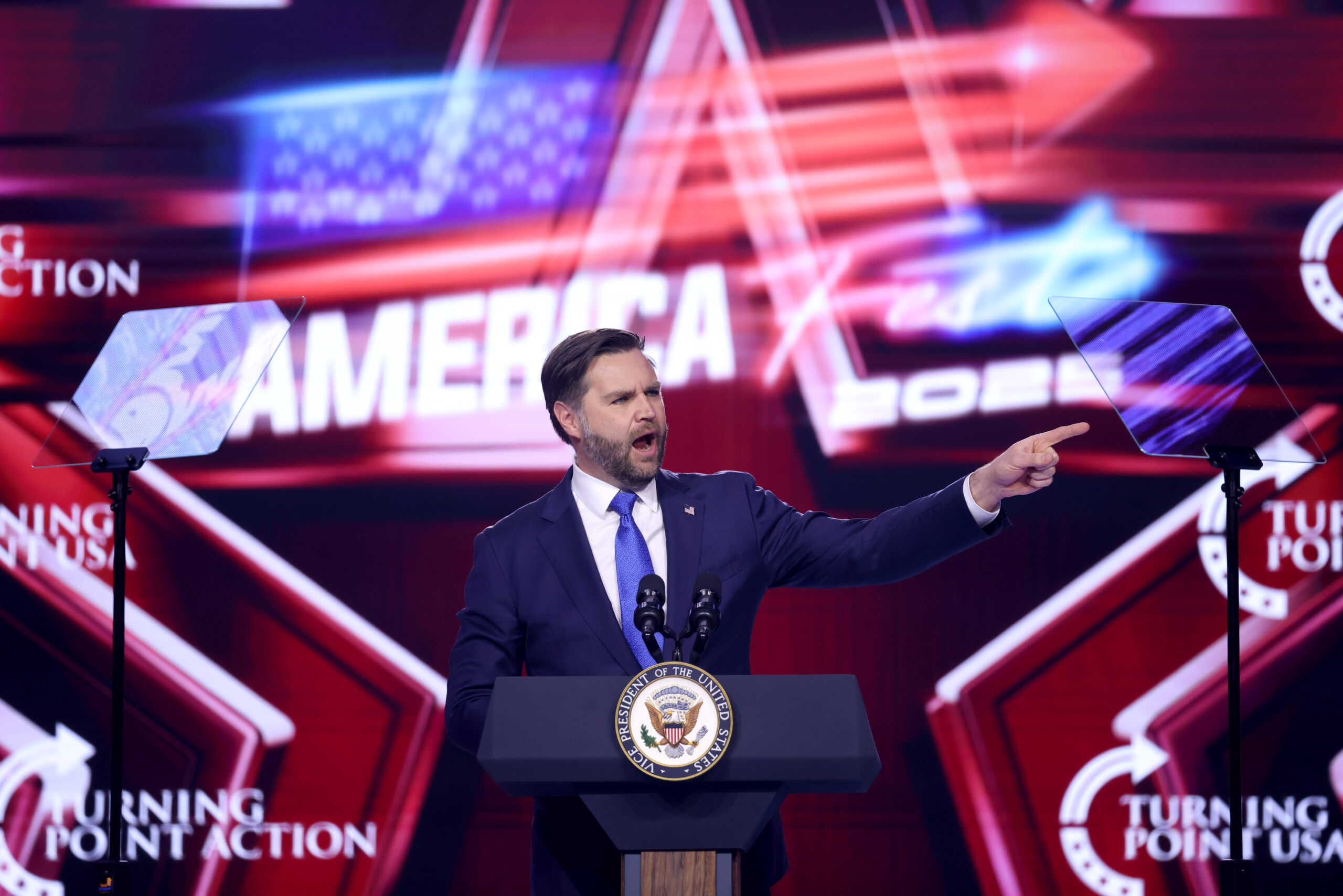
Vice President JD Vance attacked Michigan Democratic Senate nominee Abdul El-Sayed on Wednesday, August 5, over his economic and immigration positions. Vance argued that El-Sayed’s agenda could weaken the state’s auto industry and reduce wages for American workers.
The criticism followed El-Sayed’s narrow Democratic primary victory in Michigan. The former public health official will face Republican nominee Mike Rogers in November for the seat held by retiring Sen. Gary Peters.
During a television interview with Laura Ingraham, Vance branded El-Sayed a “limousine socialist”. He accused progressive Democrats of emphasizing wealth redistribution instead of industrial growth and economic self-sufficiency.
“They’re not promising you industry,” Vance said. “They’re not promising you good jobs.”
The comments established an early Republican argument against El-Sayed. Michigan’s economy, automotive workforce and position as a battleground state make that message central to the coming campaign.
Vance focuses on wages.
Gage Skidmore from Surprise, AZ, United States of America via Wikimedia Commons licensed under CC BY-SA 4.0,
Vance linked El-Sayed’s immigration views to lower pay for working-class Americans. He claimed increased immigration would place more low-wage workers into the labor market and weaken existing workers’ bargaining power.
The vice president presented that outcome as certain but did not cite a specific wage study during the interview. Immigration’s effect on pay can differ across occupations, industries and regions.
Vance also accused El-Sayed of opposing trade policies designed to protect American manufacturing. He credited President Donald Trump’s tariffs with preserving Michigan auto jobs and encouraging domestic production.
El-Sayed’s campaign did not provide an immediate response in the original coverage of Vance’s comments. The candidate has promoted a progressive agenda centered on health care, campaign finance changes and stronger limits on corporate influence.
The disagreement gives Republicans a direct line of attack. Rogers can present himself as a defender of Trump’s trade policies, tighter immigration controls and private industry.
El-Sayed can counter that workers need affordable health care and political reforms alongside factory investment. His ability to make that case beyond the Democratic base could shape the general election.
El-Sayed survives close contest.
El-Sayed won Michigan’s Democratic nomination after defeating Rep. Haley Stevens by fewer than 15,000 votes. His margin stood just below one percentage point after more than 1.5 million ballots were counted.
Election officials and analysts waited until Wednesday morning before calling the contest. El-Sayed had not declared victory during his Tuesday night gathering because the result remained too close.
Stevens entered the primary with backing from several prominent Michigan Democrats. Her supporters included Gov. Gretchen Whitmer, Peters and Senate Democratic Leader Chuck Schumer.
She emphasized manufacturing and her experience working on federal auto policy. El-Sayed instead ran as an outsider challenging corporate influence and the Democratic establishment.
His platform included Medicare for All, campaign finance reform and ending military aid to Israel. Sen. Bernie Sanders and Rep. Alexandria Ocasio-Cortez supported his campaign.
El-Sayed also overcame more than $60 million in outside spending during the primary. Much of that money supported Stevens or funded advertising opposing his candidacy.
Stevens conceded Wednesday and pledged to support El-Sayed against Rogers. Michigan Democrats also began efforts to reunite after a primary that exposed sharp ideological divisions.
Tariffs enter Senate campaign.
Trump introduced a 25% tariff on imported passenger vehicles and light trucks in April 2025. His administration later applied duties to certain imported automotive parts.
A later policy adjustment maintained a 25% tariff on other automobile imports. It also created temporary offsets for some parts used in vehicles assembled inside the United States.
The administration said the system would encourage American assembly and reduce dependence on foreign manufacturing. It also tied the trade measures to national security and supply-chain resilience.
Vance went further by saying the tariffs had saved Michigan’s auto industry. The available employment figures present a less uniform result across the sector.
Tariffs will remain a defining issue because Michigan depends on both vehicle assembly and parts manufacturing. Workers in those industries may experience economic changes differently, even within the same region.
Rogers is likely to defend Trump’s policy as necessary protection against foreign competition. El-Sayed will face pressure to explain which trade measures he supports and how his approach would protect domestic plants.
Employment numbers remain mixed.
Michigan had 46,500 vehicle manufacturing workers in June 2026. That represented an increase of about 500 positions from June 2025.
The state’s motor vehicle parts industry employed approximately 109,600 people during the same month. That total was 4,000 lower than one year earlier.
National auto employment also declined over the 12 months. Motor vehicle and parts manufacturing employed about 949,600 workers in June, down approximately 21,400 from June 2025.
The figures do not prove that one policy caused every gain or loss. They show that final vehicle manufacturing and parts production have moved in different directions.
That distinction could become important during the campaign. Vance and Rogers can highlight the increase in Michigan vehicle manufacturing jobs.
El-Sayed can point to supplier losses and argue that broader worker protections remain necessary. The candidates will need to explain how their proposals affect assembly plants, parts companies and household costs.
November race takes shape.
Rogers, a former congressman, secured the Republican nomination without a primary opponent. He has Trump’s endorsement and support from national Republican groups.
El-Sayed now has about three months to expand his coalition beyond progressive primary voters. Nearly half of Democratic voters supported Stevens, making party unity an immediate concern.
Republicans will continue portraying El-Sayed as too far left for Michigan. Democrats will try to connect his economic program to health costs, wages and corporate accountability.
The next major test will come when the candidates present detailed positions on manufacturing and trade. Updated state automotive employment figures are scheduled for release on August 21.
Michigan voters will choose between El-Sayed and Rogers in November. The result could affect control of the U.S. Senate and the direction of federal industrial policy.