Posting as @httpmyal under a TikTok video, she made a claim that her TikTok comment packs into a few blunt sentences: cheating usually runs in families because of how the brain’s reward system is wired. If one or both parents were serial cheaters, she says, expect the same thoughts to show up in you.
She said the topic surfaced when her boyfriend waved off a remark she remembered Ethan Klein making about working hard not to turn into his father. That remark could not be independently confirmed, so it stays her recollection. Her closing warning was that anyone with that family history should never take even one step down the path, because chasing the high once means craving it for life. No study reviewed for this story tests that last part.
One in five married American men and 13% of wives report cheating
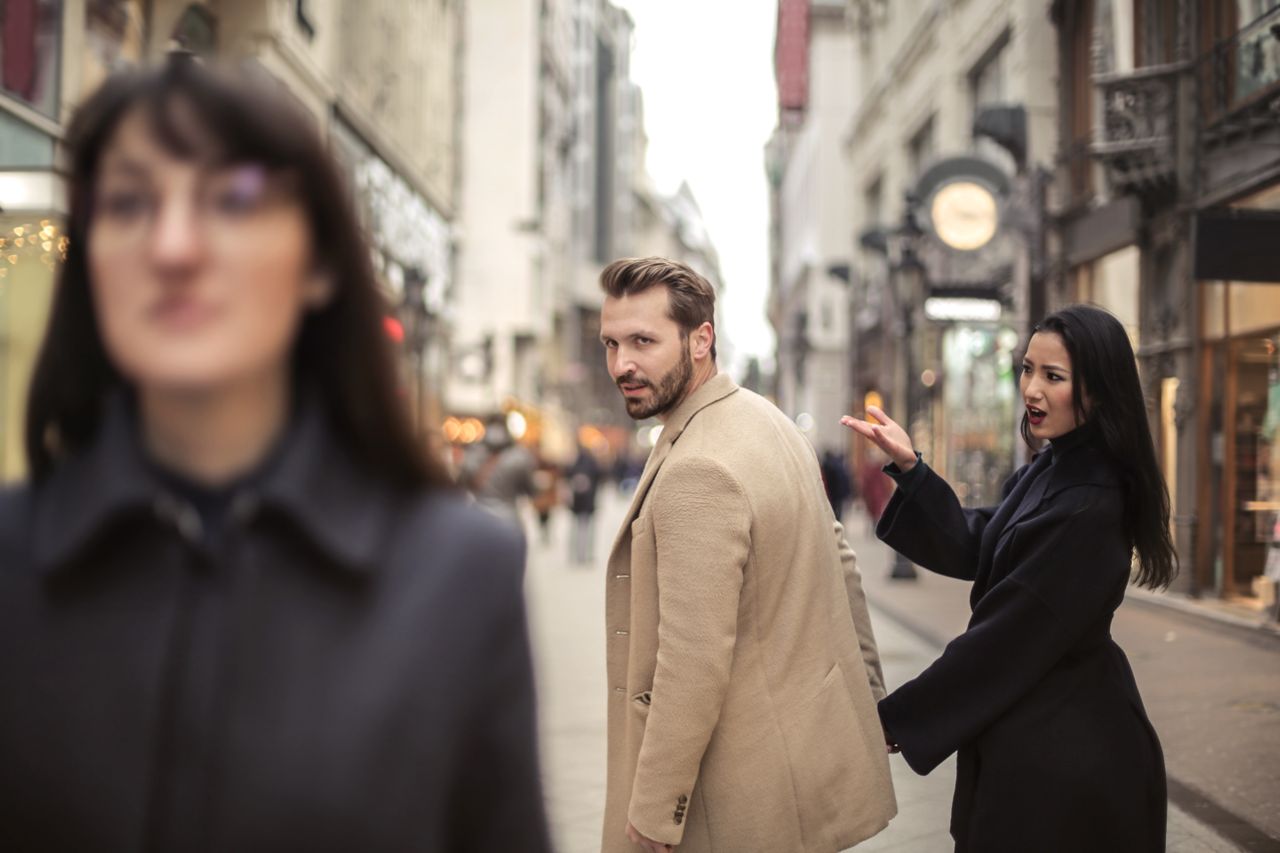
Image Credit: Andrea Piacquadio/Pexels
An Institute for Family Studies analysis of General Social Survey data found that 20% of men and 13% of women said they had sex with someone other than their spouse while married. Adults who did not grow up in intact families were also more likely to have strayed.
Numbers that large mean plenty of cheaters had faithful parents and plenty of faithful people had cheating ones. Family history can tilt the odds. It cannot hand anyone a script.
London twin data put the inherited share for women at 41%
In 2004, Lynn Cherkas and colleagues at St Thomas’ Hospital in London questioned 1,600 female twin pairs from the UK twin registry about infidelity, confidentially. Genes accounted for a moderate share: 41 percent for infidelity and 38% for lifetime number of sexual partners.
Attitudes toward cheating told a different story. Environment drove those, with no genetic contribution detected. Keep that split in mind, because it returns later.
A Finnish study pushed the male figure to about 62%, and nobody has matched it
Brendan Zietsch and colleagues compared identical twins, who share all their genes, with same-sex fraternal twins, who share half, across 7,378 Finnish twins and siblings. Genetic influence on extrapair mating over a one-year window landed near 40 percent for women and 62% for men.
A 2026 narrative review points out that the male estimate has not been reproduced in a comparable sample. It also stresses that heritability describes variance across a population. A 62 percent figure does not mean 62% of any single man’s choices were inherited.
The dopamine variant behind the reward-system claim came from 181 young adults
Her reward-system line traces to Justin Garcia and colleagues at Binghamton University. In 2010 they surveyed 181 young adults about their sexual history and collected a mouthwash sample to read a gene called DRD4.
Participants carrying at least one 7-repeat version reported more one-night stands and more than a 50 percent increase in instances of infidelity. Small sample, one university, self-reported behavior. It was a lead, never a verdict.
The lead researcher refused to let DNA become a cheater’s alibi
Garcia said plainly that the findings do not let transgressors off the hook. His team argued that the internal drive for a dopamine rush can operate independently of the drive for commitment. A person can want a lasting relationship and still feel the pull.
Urge and action are separate departments. Anyone waving a DNA alibi around is borrowing a conclusion the authors wrote against.
No single cheating gene has ever turned up
Even the loudest heritability number came with an awkward gap. A Psychology Today summary notes that Zietsch found no links to specific genes for men and only tenuous ones for women.
Garcia and Cherkas both warned against reading their work as proof of a cheating gene. Cherkas guessed instead that traits like risk-taking or sensation-seeking may sit underneath. Many small influences, no master switch.
Kids who believe a parent cheated report more cheating themselves
Researchers including Daniel Weigel ran a study of 1,254 participants across three parts, published in the journal Personal Relationships. Participants who thought a parent had been unfaithful were significantly more likely to have cheated in their own adult relationships.
The word to watch is thought. The design leans on what adult children believe about their parents and report about themselves, which cannot separate inherited wiring from a household where betrayal was visible.
Another survey found cheating parents doubled the odds, and its lead author called it no destiny
Dana Weiser’s survey of young adults found that people with a parent who cheated were twice as likely to have cheated as peers whose parents had not.
She told an interviewer the data does not mean a partner from that background will cheat. Relationship satisfaction, commitment, impulse control and personality all help explain who strays. Twice the odds still leaves most people on the faithful side of the line.
Permissive beliefs passed down through households offer a rival explanation
A Nevada, Reno dissertation advised by Weigel found that parental infidelity was linked to more permissive beliefs about cheating, which were in turn linked to more cheating. Similar patterns showed up for men and women.
Cherkas found attitudes were environmental, and the Nevada work shows attitudes carrying the effect forward. A child who spent years watching a parent lie convincingly may learn that betrayal is survivable. That version of the story needs no biology.
No twin study or dopamine paper can explain one podcaster’s choices
Klein publicly apologized to his estranged wife Hila Klein, their crew and his audience over an extramarital affair, TheWrap reported. The creator paired his story with a genetics theory. Nothing cited here studied him or his father.
What survives is her advice. If urge and action really are separate, as the researchers argued, the first step is still a choice.