A message meant for someone named Mark landed in the one inbox it should never have reached: the tenant it was about. Screenshots shared on social media, which could not be independently verified, show a landlord named David mapping out a rent hike for apartment 204, then following up with a short apology.
The proposed jump runs from $1,200 to $1,550. That is $350 a month, $4,200 over a year, and an increase of roughly 29%.
What the email actually says
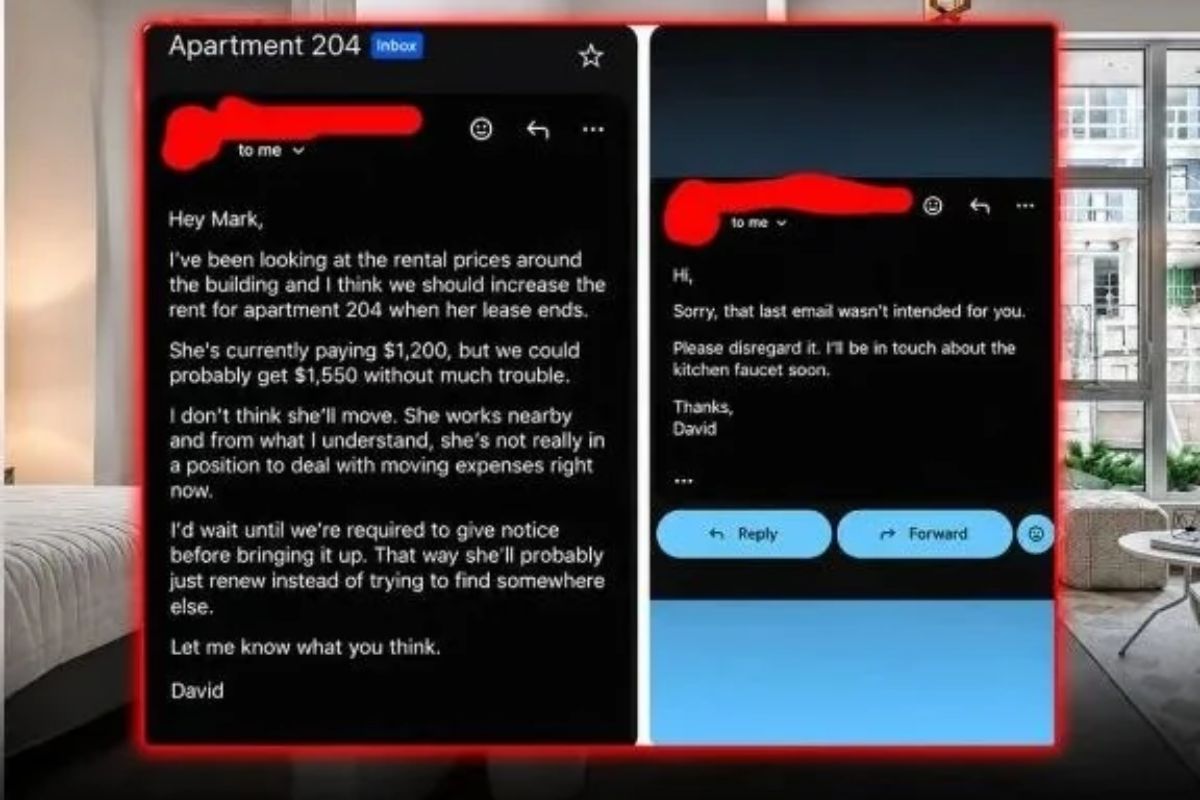
David opens by telling Mark he has been looking at rental prices around the building and thinks the rent on apartment 204 should rise when the lease ends. The tenant pays $1,200 now, he writes, but he could probably get $1,550 without much trouble.
The reasoning that follows has little to do with the unit itself. He doesn’t expect her to leave because she works nearby and, by his understanding, is “Not really in a position to deal with moving expenses right now.”
His plan is to wait until the lease rules require him to give notice before raising the subject. That way she will probably just renew instead of hunting for another place. He closes by asking Mark what he thinks.
The second message arrives stripped of all that context. David says the earlier email wasn’t meant for her, asks her to disregard it, and promises to be in touch about the kitchen faucet soon.
A price set by how little room she has to say no
Rent increases are routine, and nothing in the screenshots suggests this one is unusual in size for a landlord with a target number in mind. What stands out is the written logic. The only specific reasons David gives concern why the tenant will stay, not what the apartment is worth.
His comparison shopping appears once, in a single sentence, and none of it is shown. The commute and the moving costs get three.
Timing is the other half of the plan. Holding the news until notice is legally required means her first formal warning would arrive at the minimum the law allows.
The screenshots don’t say which state apartment 204 sits in, and that matters. California requires at least 30 days of written notice when an increase is 10% or less and 90 days above that, according to LA County consumer affairs. The same page adds that a tenant with a lease can’t be hit with an increase until the lease expires unless the lease allows it.
Maine uses a similar two-tier setup, with 45 days for increases under 10 percent and 75 days for 10 percent or more, as WGME in Maine reported. A 29 percent increase would land in the longer window in both places. Most states fall somewhere between 30 and 60 days, with a few reaching 90.
The stray email handed her a head start the law would not have guaranteed.
The $1,400 line
From 2014 to 2024, the count of U.S. rental units priced under $1,400 fell by 9.3 million, while units at $1,400 or more grew by 11.8 million, according to figures released with America’s Rental Housing 2026, the Harvard Joint Center for Housing Studies report published in March.
Apartment 204 currently sits below that line. At $1,550, it would sit above it.
The report’s managing director, Chris Herbert, cautioned that headline figures showing flat or falling rents can mislead lower- and moderate-income renters, for whom housing remains a heavy lift. A single apartment crossing the threshold is a tiny data point inside that shift, though a vivid one.
Soft national rents, a hard local ask
A competing reading deserves airtime here, because it cuts against the numbers above. National rent growth hovered near zero from mid-2023 into 2025, and by the final quarter of 2025, asking rents for professionally managed apartments had dropped 0.6% year over year, per Multifamily Executive’s coverage of the Harvard report.
Against that backdrop, a 29% ask looks aggressive. Local markets run on their own clocks, though, and David says he checked prices around his own building. His comparisons are the one claim no outside reader can test, since they never appear in the screenshots.
Cost burden is climbing the income ladder
The Harvard center counted 22.7 million cost-burdened renter households in 2024, or 49% of all renters, meaning they spent more than 30% of income on rent and utilities. Another 12.1 million, about 26%, spent more than half. Both figures are posted in the center’s own six takeaways from the report.
Whitney Airgood-Obrycki, a senior research associate at the center, has pointed out that strain is no longer confined to the lowest earners. Renters making between $45,000 and $74,999 were burdened at a rate just over 49%, up 24.3 percentage points since 2001.
Below $30,000, the squeeze is tighter still. The National Low Income Housing Coalition reported that renter households in that bracket had a record-low $210 left after paying housing costs, a drop of 60 percent from 2001.
The tenant’s income appears nowhere in the screenshots. Even so, David’s own assessment is that she lacks cushion for a move, and the national data shows how common that position has become.
A faucet, a rent hike and one inbox
The second email ends on a household errand. A kitchen faucet is evidently an open item between landlord and tenant, and David plans to raise it soon.
For a renter, the kitchen is where a lease gets lived in: coffee at dawn, dishes at midnight, a dinner for friends on a Saturday. Having a repair promise and a $350 price hike arrive in the same thread tells her what is on the landlord’s list. The faucet is on it, and so is her monthly payment.
What she knows that he didn’t plan for
The most valuable detail for her is the timeline. She now knows the target figure, the approximate moment he intends to bring it up, and the assumption driving it, which is that she will stay put.
Negotiating usually favors whoever has the clearest picture of the other side’s options. For one afternoon, the information ran in her direction.
Whether she renews at $1,550, pushes back, or starts looking is a decision the screenshots leave open. David’s apology asked her to disregard what she read, and that is the one request the email itself makes impossible to honor.